
What Do Haitians Need Most? To Get Away From Haiti

It will take much more than a global outpouring of grief to fix Haiti. But there is one concrete way rich countries could really help out – immigration. Twelve days after the Haitian earthquake, the choices for the poorest nation in the western hemisphere are stark. Haiti was already an impoverished and virtually ungoverned nation before January 12.
Haiti’s poverty has meant it lacks the basic things that make wealthy nations better able to cope with natural disasters – functioning emergency services, law and order, safe and stable buildings, and supplies that are cheap, abundant and accessible.
So with poverty and the failure of development being at the centre of the Haitian tragedy, it’s easy to be cynical when the usual crowd pipes up. Last week, UK Prime Minister Gordon Brown reportedly asked schlocky American Idol judge Simon Cowell to record a charity single to raise money for Haiti. George Clooney has hosted a fund-raising telethon, complete with “all of his famous pals”, as US Magazine succinctly described them. And Linkin Park, Alanis Morissette and Peter Gabriel are all donating “unreleased tracks” for a charity compilation. They’re no doubt trying to help in good faith.
Haiti has been a long-term recipient of foreign aid. Between 1990 and 2005, foreign aid to Haiti came to $US4 billion. Aid provides about 7 per cent of Haiti’s total gross domestic product. And for the past century, economic growth in Haiti has either been stagnant or declined. The reasons for this are many. Extraordinarily bad governments, which in the 20th century seesawed between repressive dictatorship and corrupt plutocracy, have undermined any legal framework for the protection of civil liberties, property rights, or for law and order.
It is for this reason that, when assessing the impact of its aid projects, the World Bank found “in project after project, the reason for delayed implementation or cancellation, is a coup [or] civil unrest”. This has been compounded by the bureaucratic complexity of many aid projects, administrative failures by Haitian governments, and confused priorities on the part of donors. Future assistance programs will have to directly tackle Haiti’s biggest problem – bad governance – if they are to succeed.
But if the developed world really wants to help Haiti, we could let as many Haitians as humanly possible work in the West. We could dramatically expand our guest worker and migration programs.
According to a 2008 study by the Centre for Global Development, Haitian immigrants in the US earn on average six times more than equally educated Haitians who stay home. It would be more effective and efficient to allow Haitians to move to other countries than wait for the international community or aid organisations or the Haitian Government to repair two centuries of institutional failure.
Immigration away from Haiti will actually help Haiti. Foreign aid to the country may be substantial, but it is overwhelmed by what expat Haitians send home. In 2008, foreign governments gave Haiti $US912 million. Haitian expats sent back at least $US1.3 billion, according to the most conservative estimates. Other estimates suggest unreported remittances to Haiti might account for up to a third of Haiti’s total GDP.
And while much foreign aid is delivered directly to the Haitian Government (which doesn’t have a wonderful track record in using it well), these remittances go straight to the Haitian people.
The Obama Administration’s recent announcement that Haitians already living in the US (illegally or not) will be granted temporary visas is an important step. But for domestic politicians in the developed world, increasing foreign aid is less politically complicated than dramatically expanding immigration intakes. And certainly less controversial.
Nevertheless, even a modest expansion of guest worker programs in the US and other developed nations will have a greater long-term effect than any amount of money Simon Cowell’s charity single can raise.
Lost Property: Home In Deed But Not In Fact

Debates over public policy rarely pivot on philosophical questions. But here’s one: what does it actually mean to “own” your property?
NSW farmer Peter Spencer is coming up to the 50th day of his hunger strike. Spencer is arguing that he should be adequately compensated for native vegetation regulations that prevent his chopping down trees on his land.
Fair enough. Compensation for loss of property rights is part of the Commonwealth constitution.
But native vegetation laws are state laws, and state constitutions don’t require state governments to pay just compensation for property they take. Spencer claims these laws were enacted at the behest of the Federal Government, allowing Canberra to meet its Kyoto greenhouse emissions targets without the hassle of paying those who own the native vegetation carbon sinks. (Constitutional limitations on government power must be pretty annoying.)
Certainly, the nuances of regulations governing the clearing of native vegetation sound dull, but they’re actually very important. A mountain of regulation imposed by all three levels of government is eroding one of our basic human rights – the right to own property.
This might seem a bit counter-intuitive. The Government hasn’t literally taken Spencer’s property away. He hasn’t been kicked off: he’s still allowed to wander his land at his leisure. He still holds the title. But his right to use the land has definitely been taken. Put it this way: what if the Government told you that you could keep your house, but couldn’t live in it? Sure, you’d technically still own it, but you bought that house because you thought it would be a nice place to sleep. You don’t really “own” it in any useful sense.
It’s the same with farmland. Spencer may not have been physically deprived of his land, but what’s the point if he’s not allowed to farm it? And if Spencer is not compensated for this regulatory taking, how is it much different from legalised theft? Spencer’s is not an isolated problem. In urban areas, planning regulations and heritage restrictions are increasingly onerous as state and local governments try to micro-manage the “character” of suburbs.
Karl Marx called the right to property “the right of selfishness”, and property rights are believed by many to be a synonym for individualistic greed. Sounds like greed, looks like greed, sure – but it’s not greed. More than anything else, property rights are essential for prosperity and growth. Nowhere is this clearer than in the developing world. Influential Peruvian economist Hernando de Soto has found that where property rights are not respected or recognised by governments and bureaucracies, countries are poor. After all, if you can’t demonstrate you have assets to your name, it’s very hard to get a loan to start a business.
Property rights are the foundation of social mobility. Indeed, property is pretty much just another word for accumulated savings. Savings help us up the economic ladder. By contrast, a society that regularly violates property rights is an unstable society, and one where the road to personal advancement is blocked.
The right to property is so important it has long been recognised as one of our basic human rights, like free speech or the right to a fair trial. The 17th century philosopher John Locke said we had three fundamental rights: life, liberty, and “estate” – property.
But in the late 20th century, the right to property became the mistreated stepchild of human rights law. Related, but unloved.
In 1948, property rights got their own article in the United Nations’ Universal Declaration of Human Rights (“No one shall be arbitrarily deprived of his property”). But when they finally got around to turning the declaration into a legally binding commitment in 1966, property was thought to be passe, like Dean Martin and the patriarchy: neither the International Covenant on Civil and Political Rights nor the International Covenant on Economic, Social and Cultural Rights mention property rights.
The European Convention of Human Rights says “no one shall be deprived of his possessions except in the public interest”. The phrase “public interest” is meaningless. What government has ever thought it wasn’t acting in the public interest? The 2006 Victorian Charter of Rights says no one’s property can be taken “except in accordance with law” – not much of a defence from eager legislators.
Peter Spencer’s hunger strike in defence of his human right to property is drastic and dangerous. We can only hope it won’t be tragic. But his desperation must make us rethink our attitude towards this essential, but increasingly neglected, human right.

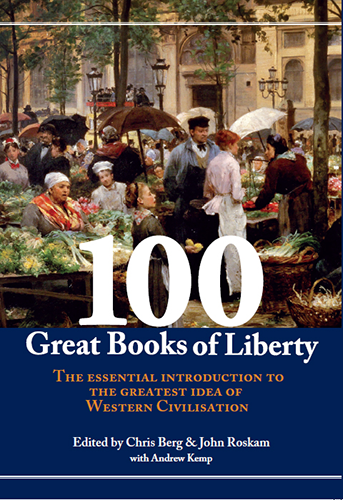
100 Great Books of Liberty: The Essential Guide to the Greatest Idea of Western Civilisation

Edited with John Roskam and Andrew Kemp, Connor Court Publishing, 2010

100 Great Books of Liberty is a comprehensive and accessible guide to the books which made liberty the most important idea of Western Civilisation. From Plato’s The Republic and The Wealth of Nations by Adam Smith, to Ayn Rand’s The Fountainhead and A Clockwork Orange by Anthony Burgess, these 100 books have laid the foundation for the modern world.

Covering history, biography, philosophy, politics, and fiction, 100 Great Books of Liberty is the indispensible guide to the foundations of Western Civilisation.

100 Great Books of Liberty is a joint project of the Institute of Public Affairs and Mannkal Economic Education Foundation.

100 Great Books of Liberty is the essential guide to: The Republic, Two Treatises on Government, The Wealth of Nations, The Western Canon Reflections on the Revolution in France, The Rights of Man, On Liberty, Leaves of Grass, Dialogues Concerning Natural Religion Democracy in America, The Federalist Papers, The Civilisation of the Renaissance in Italy, Animal Farm, Witness, Capitalism and Freedom, The Tyranny of Distance, The End of History, A History of the English-Speaking Peoples, Darkness at Noon, The Fountainhead … and eighty other great books of liberty.

Available at Amazon.com