Abstract: In the late 1980s and early 1990s the electronic markets hypothesis offered a prediction about effect of information technology on industrial organisation, and many business writers forecast significant changes to the shape and nature of the firm. However, these changes did not come to pass. This paper provides an economic analysis of why, using the transaction cost economic framework of Ronald Coase and Oliver Williamson. Non-hierarchical corporate organisation struggled against contracting problems in the presence of possible opportunistic behaviour. Technologies of trust offer an institutional mechanism that acts on the margin of trust, suppressing opportunism. The paper concludes that blockchain technology provides an economic infrastructure for the coordination of economic activity and the possible realisation of the electronic markets hypothesis.
Author(s): Chris Berg, Sinclair Davidson, Jason Potts
Attorney-General Christian Porter wants social media platforms like Twitter and Facebook to be legally liable for defamatory comments made by their users.
Right now, the common law can distinguish between the legal liability of active publishers of information (like newspapers and broadcasters) and the passive platform operators that allow users to publish information themselves. Courts decide where this distinction is drawn according the unique facts of each case.
But in a speech to the National Press Club on Wednesday, the Attorney-General declared he wants to eliminate the distinction altogether: “Online platforms should be held to essentially the same standards as other publishers.”
The Attorney-General’s proposal is fundamentally confused. Removing the distinction between digital platforms and newspapers would have a devastating effect on both those platforms and our ability to communicate with each other.
The proposal is bad on its merits. But even besides that, the conservative government needs to understand how destructive it would be to the conservative movement online.
Let’s start with the legal principles. It makes sense that newspapers and broadcasters are liable for what they publish. They actively commission and produce the content that appears on their services. They read it, edit it, arrange and curate it. They pay for it. Newspapers and broadcasters have not only an editorial voice, but complete editorial control. Indeed, it is this close supervision of what they publish that gives them strength in the marketplace of ideas.
Social media platforms do nothing of the sort. Not only do they not commission the content that appears on our newsfeeds (let alone read, factcheck, or edit that content), they don’t typically confirm that their users are even real people – not, say, bots or foreign impersonators. They merely provide a platform for us to communicate with each other. Social media has facilitated a massive, global conversation. But it has no editorial voice.
In the United States a parallel debate is going on among Republicans about whether Section 230 of the Communications Decency Act – which explicitly prevents courts from treating ‘interactive computer services’ as publishers or speakers for the purpose of legal liability – should be abolished.
Section 230 has variously been described by scholars and commentators as “the 26 words that created the internet” or the “the internet’s first amendment”. The internet law professor Jeff Kosseff writes that eliminating this provision would “turn the internet into a closed, one-way street”. Attorney-General Porter’s proposal would have the same effect.
If social media platforms have to bear legal responsibility for what their users say, they will assume editorial responsibility for it. That means editing, deleting, and blocking all content that could be even the least bit legally questionable.
Newspapers and broadcasters sometimes take calculated risks with what they print, if they believe that the information they reveal is in the public interest. But why would a technological company – a company that lacks an editorial voice or the journalistic vision – be anything but hypercautious? Why wouldn’t it delete anything and everything with even the slightest risk?
And here is where the practical politics comes in. Even if the Attorney-General’s proposal was a good idea in principle, this policy would be particularly devastating for the conservative movement that supports his government. Indeed, it is hard to imagine a legislative proposal that would more effectively, and immediately, cut down the Australian conservative movement online.
After all, what side of politics benefits most from the political diversity and openness of the modern internet? What side of politics has relied most on the internet’s ability to bypass traditional media gateways? It is difficult to imagine the conservative political surge in recent years without social media – without Facebook, Twitter, YouTube, and all those podcast platforms.
If conservatives are concerned about social media networks “censoring” conservative content on their services now, well, making them liable for everything conservatives say would supercharge that.
And why would this policy stop at defamation laws? Why wouldn’t it also apply to liabilities around, say, Section 18C of the Racial Discrimination Act? Or our sedition laws? We are looking at a future where technology companies in California (companies that many conservatives believe are stacked with culturally left employees) could be required to second-guess how the most left-wing judges in Australia might enforce this country’s draconian anti-speech restrictions.
The Coalition government should also reflect on how some of its most recent legislative programs have backfired on conservatives. The Foreign Influence Transparency Scheme, passed in 2018 in order to tackle Chinese interference in Australian politics, is now being used to target the organiser of the Australian Conservative Political Action Conference, Andrew Cooper, and even Tony Abbott.
The Attorney-General is right that defamation law needs reform. Australia’s defamation framework is heavy-handed and disproportionately favours private reputation over the public need to discuss significant issues. But removing the courts’ ability to determine liability for defamation – and instead deputising the world’s technology companies to enforce what they imagine it could be – would be a catastrophic mistake.
If we are going to realise the environmental vision of the circular economy, we need to first think of it as an entrepreneurial economy.
In PIG 05049 the artist Christien Meindertsma shows how the parts of a slaughtered pig get reused downstream. For instance, gelatine derived from the skin ends up in wine, acids from bone fat end up in paint, and pig hair ends up in fertiliser.
The farmer sells what they can to retailers and sells the rest to other businesses, who then process and resell the what they can’t use to other users and businesses, who then process and resell the other parts … anyway you get it the point.
In a world of perfect information and zero-transaction costs this use and reuse would be trivial. The near infinite uses of pig parts would be immediately apparent to everyone in the economy and every part of the pig would be reallocated efficiently.
But of course we don’t live in a world of perfect information. All these reallocations have to be discovered by entrepreneurs and innovators.
PIG 05049 is a story of how resources move through the economy in surprising ways, as entrepreneurs reduce waste in the pursuit of profit.
But a circular economy makes stronger demands on us. The circular economy aspires not simply to minimise waste, but for goods to be “reused, repaired and recycled” after their first users no longer need them.
The circular economy imagines a world in which material goods are recovered, endlessly, and thus the environmental impact of the materials that we rely on for our prosperity is radically reduced.
It’s a powerful vision. But it is a hard vision to realise because transaction costs are not zero. Obviously, as goods travel through their life cycle they deteriorate. Goods get worn out, they rust, they fall apart.
But just as critical is the fact that information about the goods deteriorates as well. Product manuals get lost. Producers go out of business. Critical parts get separated. What the goods are made from is forgotten.
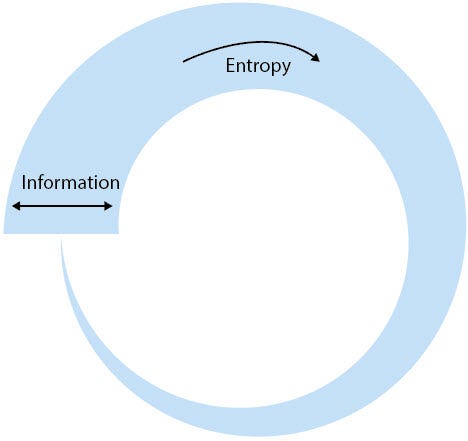
This information loss is a huge problem for the circular economy — it is very extremely expensive to reuse goods when we have lost information about what they are made of and how they work. This information entropy makes it hard for entrepreneurs and innovators to close the loop.
This is what that looks like
In some previous work we’ve described a hypothetical “perfect ledger” where information is infinitely accessible, immediately retrievable, completely immutable, perfectly correspondent to reality, and permanently available. The perfect ledger is a thought experiment. It’s a thought experiment like an economy with perfect information or zero transaction costs that allows us to see how our imperfect world differs from an imaginary ideal.
And in a world of perfect ledgers, the circular economy’s information loop is completely closed. There is no information entropy — we never forget, so we can always reuse.
Blockchain technology of course is not a perfect ledger. But on many of the relevant margins, it offers a drastically improved way of managing information about goods as they travel through their lifecycle.
Information can be stored on a distributed ledger in a way that is resistant not only to later amendment, but that persists when it a good is passed from hand to hand, or travels across a political border, or when it is discontinued and forgotten by its designer, or when its original manufacturer goes out of business.
The information about the goods we have sitting on our desk, scattered around our homes and workplaces, built into our buildings, and powering our vehicles is being unpredictably but relentlessly lost. This is the blockchain opportunity for the circular economy. Blockchains can secure more information, better, more permanently and more accessibly about goods, so that they can be more efficiently reused.
And in conjunction with similar technological developments that reduce search costs — that is, that allow innovators to identify underutilised goods in the economy that could be bought and repurposed — the owners of goods will have increased incentivises to store and protect their property, if only to maximise the sale price.
The circular economy is often thought as a problem for governments to bring about. But if the circular economy is to be realised, we need to rethink the problem of waste and reuse as an environmental problem caused by an information problem.
Technological advances in the way we store and trust information offer a vision of large-scale, yet still bottom-up environmental improvements, where market incentives, price signals and contracting work to close the industrial loop.