
Regretting Privatisation: Broadband and the 2007 election

Telstra was sold barely a year ago, but both major parties want to bring the government back into the telecommunications infrastructure game.

The Federal Government has responded to its own failure to reform the decade-old regulatory framework for telecommunications with an array of subsidies and initiatives to introduce high-speed broadband networks. In response, the Labor Party dangles in front of voters a $4.7 billion high speed fibre-optic network.

Both parties are trying to make political capital out of the regulatory quagmire which government action has created for the telecommunications industry. But their proposals offer far less than substantive regulatory change could, and they offer it at a much greater cost to taxpayers.

How broadband became an election issue

A decade is a long time in the communications industry.

In 1997, the ABS reported that barely 300,000 Australians subscribed to Internet connections. In 2007, that figure is now six-and-a-half million. (The number of actual users is far higher. With modern networking hardware not widely available a decade ago, many people share Internet access in the household or workplace.)

With the limited speeds offered by dialup technologies, accessing video and audio was then idle futurism. Today, some estimates place video and audio downloads at 90 per cent of traffic.

Nevertheless, the regulatory framework which was developed in 1997 to govern the industry remains the same regulatory framework governing the industry in 2007. While technology and consumption patterns are almost unrecognisable a decade later, the regulation hasn’t budged.

This regulatory framework was designed to encourage the competitive provision of telecommunications using the legacy infrastructure owned by Telstra. By purchasing capacity from the infrastructure owner, competitors could share the network, introducing competition where previously there was none, and without the need for competitors to build their own network from scratch. The approach favoured by regulators under such a framework is to encourage competitors first to resell Telstra’s products, and then progressively to install hardware into the network to compete with the dominant telco.

With carefully regulated access prices, this ‘ladder of investment’ is designed to encourage both competitors and incumbents to invest in infrastructure—the former in order to siphon off some of the market share of the incumbent; the latter to invest to stave off hungry competitors.

The high level of competition for basic internet and telephony service attests to the success — at least on one metric — of this regulatory model. Indeed, at one time, there were more than 600 internet service providers (ISPs) in Australia.

But a mere two dozen of those have had more than 10,000 customers, and competition is not merely a synonym for ‘lots of companies’. Most Australian ISPs are small shoestring operations — reliant on regulated access prices for reselling Telstra services, and highly prone to failure. This segment of the industry looks like a caricature of the economic models of ‘perfect competition’ — hundreds of companies, prices down to marginal cost, and homogenous products.

Nevertheless, the structure of the market is not the most significant flaw in the existing regulatory framework. Critically, the ‘ladder of investment’ theory is unable to deal with major shifts in technology. When it becomes time to move beyond the legacy copper-wire network — the need for a fibre-optic network in Australia is manifestly clear — access regulations are unable to encour-age the creatively destructive investments required.

After all, regulators have encouraged firms to invest further and further into the existing Telstra infrastructure. These firms rely on a specific regulatory framework to provide them with a business model. Furthermore, the prospect of entirely new networks threatens their existing hardware investments — a fibre-optic network may strand a firm’s assets, or at the very least provide unwelcome competitive pressures. Understandably, these firms resist any proposed change to the telecommunications access regime.

The ‘ladder of investment’ may encourage investment up the ladder, but it discourages investment in alternative ladders. There have been indications that this framework was distorting investment for some time. Optus had been migrating customers off its own cable network and on to the Telstra network when the regulated access price turned in its favour. Fearful of having its service declared by regulators as open access, Telstra is only turning on its recently upgraded high-speed ADSL2+ equipment in areas where there is investment from competitors — in Tasmania, for example, the telco has installed ADSL2+ in more than 100 telephone exchanges, but has switched it on in only three.

But the big evidence came in a flurry of controversy last year. The impasse between the Australian Competition and Consumer Commission (ACCC) and Telstra late last year over the access price for their proposed fibre-to-the-node network pivoted around the application of the regulatory framework to new infrastructure investments.

The fact that the two organisations could not come to an agreement (Telstra very publicly announced that it was scrapping its plans to build a new network) should have provided federal policymakers with a very clear indication that the decade-old regulations had finally collapsed.Unfortunately for taxpayers, this was not to be the case. Instead of reform, the political reaction to this regulatory failure has been to propose subsidies, grants, programmes, initiatives and plans. Worse — all of the proposals on the table would increase government involvement in communications investment, not decrease it.

With the ink barely dry on the full sale of Telstra, das broadband problem has politicians wanting to try their hand again at managing the telecommunications industry.

Picking winners, 2007 style

When Communications Minister Helen Coonan announced a one billion dollar award to an Optus–Elders consortium (dubbed ‘Opel’) to deploy a WiMAX wireless network for regional and rural broadband, she had to defend the technology against its legion of critics.

WiMAX is a successor technology to the WiFi standard that is common in home internet networks. In optimal conditions — that is, with access to the right licensed spectrum band, and in the best geographic and environmental circumstances—the technology can deliver broadband speeds at distances of up to ten or fifteen kilometres, wirelessly from the base station.

However, WiMAX’s reputation has suffered from over-hype. Early enthusiasts proclaimed a range of seventy kilometres, and when the technology failed to deliver even half of that, cynicism about its capabilities crept in.

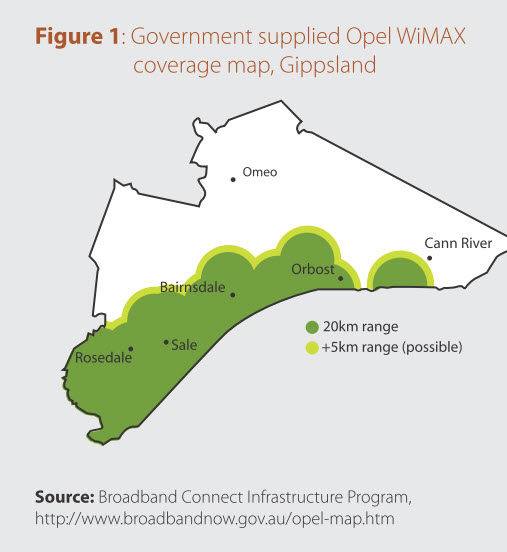
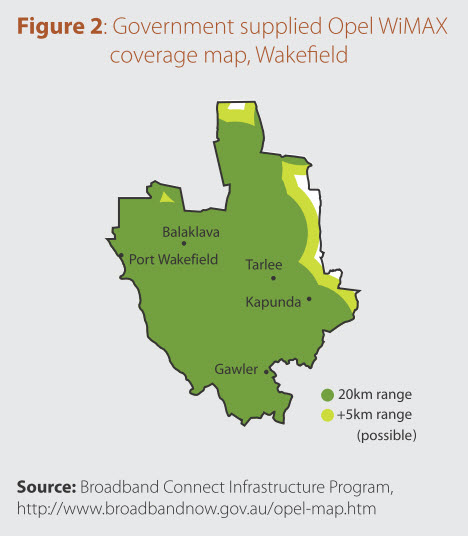
The Communications Minister has not avoided this trap. Releasing maps of the coverage of the Opel network, the Government has assumed a range of 20 kilometres, with a ‘possible’ further 5 kilometres, a much further distance than the broadband is likely to be available.

Two other factors work against the network’s favour. First, the Opel network will deploy a ‘fixed’ WiMAX network, which is being superseded by the superior ‘mobile’ WiMAX technology. Second, such range is only possible on licensed spectrum, to which the Opel network does not currently have access. WiMAX operating on unlicensed spectrum has to compete with a range of consumer technologies such as home wireless phones, private radio transmitters, garage door openers, and so on.

Given these problems, a more likely range for the WiMAX deployments would be in the region of five to ten kilometres. To be uncharitable, when considering environmental and topographical factors, a maximum range of as little as one or two kilometres is entirely possible.

When the maps of WiMAX coverage that were paraded around by the Communications Minister after the Opel announcement are redrawn with a more realistic range, the difference is stark.

Figures 1 to 4 illustrate this difference in two marginal electorates — Gippsland in rural Victoria, and Wakefield in northern Adelaide. (In an election year, electorates are always the most appropriate unit of measurement.) Figures 1 and 2 are the maps produced by the Department of Communications, which assume a twenty kilometre range with a possible added 5 kilometres for the WiMAX network. Figures 3 and 4 depict what the coverage would be like when we assume a more realistic, but still charitable, range of ten kilometres. In both cases, what appeared to be blanket coverage is now revealed as relatively spartan.
A range of ten kilometres may still be too optimistic. Many WiMAX experts predict even less—down to five, or even one or two kilometres. Experience with a similar technology used by the wireless ISP Unwired in Sydney gives little hope. That the likely range of a wireless network could be overestimated is certainly not unique. A firm competing in an open market that found its network was under performing would merely deploy more towers or upgrade to a better technology. But when the source of funding is public dollars, it should be of some concern.
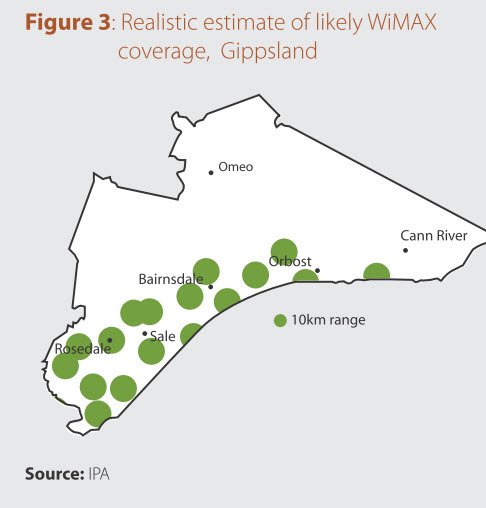
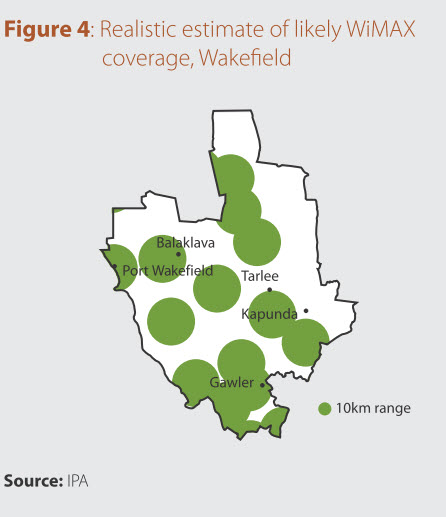
As these maps make clear, it is highly unlikely that the one billion dollar grant for rural broadband will produce the services advertised.

There is one further core problem with the Federal Government’s rural broadband proposal. While the choice of WiMAX has been the major public focus, the Opel plan also relies on widespread ADSL2+ installations. (For instance, Omeo in Gippsland will be serviced by ADSL2+, rather than WiMAX.) However, as we have seen above, Telstra has deployed ADSL2+ in hundreds of exchanges, but because of the risk of regulatory appropriation, has not switched it on until there has been competing investment.

It is yet another striking demon-stration of the perversity of the regulatory framework that governs the sector: once Opel has installed its equipment in exchanges around the country, and as a result Telstra feels free to switch its equipment on, taxpayers will have paid to build duplicated infrastructure.

Broadband to urban areas is to be dealt with separately, and a taskforce set up by the Government has released guidelines for firms applying to build a network. Applicants have until April to apply, and can specify any necessary regulatory changes required. The minister has gone so far as to suggest that one possible regulatory change would be to grant an infrastructure monopoly to the successful firm to protect it from competition, something which would resemble the legislative monopolies that have characterised Australia’s economic history for most of the twentieth century. Nevertheless, one of the core guidelines recommended by the taskforce is the maintenance of an ‘open access’ regime.

It is clear that few lessons have been drawn from the failures of access regulation in the telecommunications sector.

‘Well, we could just pay for the damn thing ourselves’

While the federal government has provided the most detailed plans, they were beaten to the punch by the ALP. In March, the Federal Labor Party announced its solution to the broadband problem — a $4.7 billion grant to build a national fibre-optic broadband network. Specifically, the ALP proposes a fibre-to-the-node network, which is the same sort of network that Telstra proposed and then abandoned six months earlier.

There is a degree of irony when con-sidering the source of the $4.7 billion. $2.7 billion will come out of existing communications funds—a legacy of the more than a dozen broadband infrastructure programmes of the Howard Government’s last five years. But the remaining two billion dollars will be drawn from the Future Fund, itself a result of the sale of Telstra. Telstra is, as the country’s biggest telecommunications infrastructure providers, likely to be a big contender for the grant. The ALP proposal may return to Telstra the proceeds of its own sale.

But less facetiously, it is hard to justify the use of taxpayer money to build a network that the private sector — in this case, Telstra — was desperate to build itself. And instead of regulatory reform, both the ALP proposal and the Federal Government’s proposal lock the telecommunications sector back into a cycle of government investment and regulated access.

To appropriate the graceless expression made famous by the Communications Minister, neither proposal adequately ‘future-proofs’ the communications sector. When the next inevitable infrastructure upgrade is faced — fibre-to-the-node is hardly the last communications network that will be built in Australia — the same regulatory challenges will arise, unless a more comprehensive and ‘future’ orientated reform is pursued.

As Alan Moran and Warren Pengilley have demonstrated in their recent Institute of Public Affairs monograph, Regulation of Infrastructure: Its Development and Consequences, telecommunications is hardly alone in suffering from inappropriate access regulation. Ports, gas, airports, electricity and railroads have all been negatively affected by infrastructure regulation which grants competitors access to their networks at a regulated price.

In telecommunications, a regulatory framework that includes a disincentive to invest is particularly damaging — technological change requires continuous investment. Broadband in Australia is less than it could be, not because the federal government has failed to assume responsibility for its infrastructure, but because it refuses to reform obsolete regulations that hold private investment back. Bringing the government back into the telecommunications market is no solution.

No Need For Local Films On Public Purse

Some phrases deserve scare quotes more than others. And it’s hard to find a better candidate for the sarcastic use of punctuation marks than the phrase “cultural imperialism”.

After all, the popularity of Hollywood films in Australia hardly resembles the violent military occupation of a foreign nation. If cultural imperialism wasn’t invoked so often, it would be self-evidently absurd.

Nevertheless, many people believe that, somehow, cultural products made by Australians are superior to those made by foreigners. Australians should be watching Australian films, listening to Australian music and reading Australian books.

Cultural nationalists — who come from both the left and right of politics — assume that only after burying ourselves in cultural products produced within our geopolitical borders will we be able to develop a genuine national identity.

This is silly on a number of levels. For instance, what about the poor old states — do we suffer from a lack of films set in Victoria and featuring Victorian voices? Similarly, suburbs could also be considered distinct cultural units. If so, we have an oversupply of television programs set in St Kilda and Brunswick, and an undersupply of those set in Frankston and Dandenong.

At the same time, cultural nationalists argue that if Australia’s culture is not protected by government through regulation, subsidies and broadcast quotas, then that culture is at risk. The market cannot provide what Australians need, and the government has to step in.

But the case for cultural protectionism is weak. Often calls for subsidy are just naked special pleading. These are easy to dismiss — probably the worst thing for both taxpayers and artists would be a special category of welfare for creative industries.

Decades of government subsidies have already fostered dependency in the cultural sector. And relying on government rather than consumers for finance provides little incentive for cultural producers to tailor their work to the demands of the public.

As a result, the steady stream of below-par and ideologically heavy-handed productions funded by the Government has given Australian films a poor reputation. Recent films Candy, Little Fish and 2:37 have depicted urban and middle-class life as awash with drug use, depression and death.

For audiences, the “made in Australia” brand now often has negative connotations. And when critics deliberately go easy on local films, they compound the problem.

Taxpayer support is seen as a right by artists who believe they are serving a higher purpose — rather than satisfying the demands of their audience.

But a culture dependent on government handouts is a weak culture. Throughout history, the most vibrant intellectual and artistic cultures have been those that were decentralised, entrepreneurial and commercial.

The market economy has been the driving force behind most of what we consider to be “great” art. Markets in which consumer choice dominates provide cultural producers with far greater freedom to supply niche products to consumers with diverse tastes. And markets discipline artists to produce accessible work.

French history provides an illustration of both the negative consequences of cultural subsidies and the virtues of marketplace-driven art.

French cinema dominated the first few decades of the 20th century. Indeed, it was so popular that American filmmakers argued that the US required protection.

But as the French government set up lavish film bureaucracies after World War II, its industry atrophied and its films grew less popular. US films now make up 60 per cent of the market in France — in the 1930s, that figure was just 15 per cent.

The reaction against cultural imperialism has the unintended consequence of making cultural industries uncompetitive.

Robert Manne hoped in the latest Monthly that if a Kevin Rudd government was elected that the gulf between the government and the nation’s creative artists would be bridged.

It is hard to imagine how turning more artists into tax-eaters would be good for Australian culture.

A Capital Idea: Move Them Out To Move Us On


Last week, when Canberra was named by the Institute of Public Affairs as one of Australia’s 13 biggest mistakes, the chief minister of the Australian Capital Territory complained that this was another predictable exercise in Canberra-bashing. Presumably, because we also listed the introduction of cane toads into this country as a mistake, we can expect letters from Friends of Cane Toads. But it is legitimate to examine the mistakes Australia has made in the past to avoid making similar ones in the future.

Australians are a remarkably creative, diverse and entrepreneurial people. Politics is slow, backwards-looking and uniform.

Inspired by misguided ideologies and without full understanding of the unintended consequences, it is very easy for governments to make mistakes. Unfortunately, since Federation, this has happened too often.

Australia entered the 20th century with the highest living standards in the world. By the 1970s, we couldn’t even crack the top dozen.

The media provide a good example of government failure. We now live in a world of iPods, YouTube and MySpace. Never has there been so much information and entertainment readily available. But if a service such as YouTube required government-managed airwaves to operate, rather than the free-for-all internet, there is no chance it would have been given a license in Australia.

Since taking over control of the radio-waves with the 1905 Wireless Telegraphy Act, successive Australian governments have needlessly held back the development of wireless telegraphy, AM radio, television, FM radio, subscription and now digital television. Most governments have been open about the reason – to protect the financial viability of existing media companies. Never mind the consumers.

Patrick White’s 1972 Nobel Prize for Literature could not be considered anything but a success, and the government’s response was to inaugurate the Australia Council. But when expatriates such as Germaine Greer criticise Australian culture from afar, they fail to recognise that this too may be a result of government action. How much different would Charles Dickens’ novels have been if he had been living off a government grant?

The US, which has a famously low level of state support for the arts, has a strong, vibrant culture. American artists are forced to respond to the demands of their audience. The result has been a century of innovation and experimentation.

But our large arts bureaucracy, funded by government and beholden to committees rather than consumers, could easily be the cause of our “cultural cringe”. If the government left our creative artists to their own devices, without offering them protection from their fickle audience, perhaps we could finally relax our cringe.

Similarly, when parents decry their children’s reluctance to move out of home, it would be worth considering that they can’t afford to. The imposition of regressive urban planning restrictions by governments has artificially inflated the prices of homes, beginning with the Western Australian Town Planning and Development Act in 1928. These laws have shifted the decision-making powers about how to use land from the land’s owners into the new urban planning establishment. By restricting the supply of housing, prices naturally go up.

Conceivably, fewer of these mistakes would have been made if our politicians, bureaucrats and regulators had been closer to the people they were governing, rather than sequestered away in Canberra. The decision in 1908 to shift the engines of government to a rural area isolated decision-makers from the consequences of their decisions.

If we had left the capital in one of our major cities, some of the folly of Australian history could perhaps have been avoided.

Thankfully, steady reform since the 1970s has partly reversed some of the worst mistakes. But if Australia is currently under the grip of some sort of “neo-liberal orthodoxy”, as is so commonly argued, then the question is not how have advocates of the free market and small government suddenly gained power, but where were they during the first 90 years of our federal system?

If we’d had a strong, liberal free-trade party in Australia that embraced individualism and economic and social freedom, perhaps this would have not been the case. Instead we were stuck with two protectionist conservative parties unwilling to challenge the prevailing dogma.

The bi-partisan reform movement to reverse some of the mistakes of past governments is giving back Australians some measure of control over their own lives. Australians can be justly proud of our successes. Most of our failures have been the fault of governments.

Australia’s 13 biggest mistakes
1. The end of the Reid government (1905)
2. The Harvester Judgement (1907)
3. Wireless Telegraphy Act (1905)
4. The Montreal Olympics (1976)
5. The Uniform Tax cases (1942 and 1957)
6. WA Town Planning and Development Act (1928)
7. Immigration Restriction Act (1901)
8. The Labor Party split (1955)
9. Publication of John Stuart Mill’s On Liberty (1859)
10. The release of cane toads (1935)
11. Federal money for science blocks at non-government schools (1963)
12. Patrick White wins the Nobel Prize (1972)
13. Invention of Canberra (1908)
Source: Institute of Public Affairs

The Slippery Slope Towards Internet Censorship Continues

The Australian Government continued down the slippery slope towards internet censorship yesterday by introducing a bill to give the Australian Federal Police the power to nominate terrorism or crime related websites for filtering.

In The Australian Greens Senator Kerry Nettle expressed concerns that the Police Commissioner might use these new powers to call for Greenpeace’s website to be filtered – which really should raise more questions about the activities of Greenpeace than the value of the legislation.

Nevertheless, there is slightly less to this bill than it seems at first glance. The internet industry code currently governing online content already provides for filtering of pornographic and offensive content. But this filtering is voluntary, not mandatory.

At the moment, internet service providers who want to be designated “family friendly” by the Internet Industry Association have to offer their customers one of a range of approved PC or server side commercial filters. And these filters are periodically updated according to an Australian Communications and Media Authority black list. Yesterday’s bill would merely allow the AFP to add terrorism or crime related sites to that black list. But why would aspiring terrorists and criminals willingly install a family friendly filter onto their PC?

A lot rides on how the Internet Industry Association rewrites its codes of practise in the light of the government’s NetAlert scheme. Under NetAlert, all internet service providers will be compelled to offer consumers the choice between an unfiltered internet connection or a server-side filtered one.

Again, terrorists are unlikely to choose a filtered internet connection. The government’s new legislation only really makes sense if the unfiltered product is not going to be truly ‘unfiltered’. That the internet content bill was introduced quietly yesterday morning does not inspire confidence that the government plans to leave our internet connections alone. And it’s worth remembering that the Labor Party has for a long time promised mandatory server side filters if they win government.

Quite aside from the internet censorship issue, this bill highlights a disturbing regulatory trend – governments delegating the policing of the internet to the communications industry. Many of the measures canvassed by the inquiry into social networking sites would do just that. Even outside the high-technology sector, counterterrorism and anti money laundering regulation in the financial sector compels firms to police their own customers.

Particularly in the communications sector, these sorts of regulatory burdens can only add to costs for consumers.

Better To Be Alert Than NetAlarmed

The internet will kill your children, or something.

At least, that is the message of the Federal Government ads plastered on the side of every second tram trundling down Swanston Street.

The Government’s approach to internet safety has all the hyperbole and sensationalism of tabloid current affairs programs. This is not surprising. Scare campaigns about the dangers of chatting or stumbling upon nudity usually have little to do with children, and all to do with raising fear in parents. Parents vote.

NetAlert, the initiative that provides those free internet filters that were broken within 30 minutes by a year 10 student, will do little to stop children finding pornography online if they want to. And the mandatory internet filtering that the Government has announced will be expensive and mostly unworkable.

In a further step, last Thursday the Government announced an investigation into sex offenders and pedophiles on social networking sites such as MySpace and Facebook. But the policy options raised by the Government — such as segregating adults and children online, mandatory age verification, or requiring parental approval before signing up to sites — will be as ineffective as NetAlert. Bureaucratic obstacles are no defence against individuals determined to cause harm.

It is hard to avoid the conclusion that the Government’s internet policies are not much more than cynical vote-gathering. In the absence of any other ideas for the upcoming election, the Federal Government is asking voters to think of the children.

But what do the children themselves think about internet safety? The Department of Communications kicked an own goal last week when it released a study of the attitudes of parents and kids. Parents were concerned that the internet exposed children to pornography and was full of strangers and chat rooms. Children were more worried about pop-up ads, viruses and substandard internet speeds. Not surprisingly, few were concerned about pornography. Some expressed concerns about interacting with dangerous strangers.

The study did not provide any support for one of the bulwarks of the Government’s policy — the mandatory internet filter. It revealed instead that internet literacy was a more effective protection against any potential danger online.

Regulating MySpace and filtering the internet provide no substitute for education. Governments can have a role to play in educating about online safety; they set the school curriculum and most children attend public schools. The second way governments can approach child safety is through police work. After all, parents should be outraged not that pedophiles could be on MySpace, but that there are pedophiles at large.

Like any matters to do with children, parents have to take the bulk of the responsibility. The most effective approach to internet safety and obscenity is monitoring online activity. The best protection for children is the setting of boundaries.

Too much of the Federal Government’s internet policy is a distraction from these far more effective approaches.

A few months ago, many commentators assumed that the Federal Government had a rabbit to pull out of the hat before this election. Free internet filters and giving Kieran Perkins the title of “Parent Ambassador” are unfortunately more likely to make the Government look like bunnies.

Dealing With That $30,000 Phone Bill… Without Regulation

There is a “mounting dossier” of complaints to communications regulators concerning unexpectedly high mobile phone bills, reports the Australian Financial Review today.

It’s hard to be too sympathetic with somebody who couldn’t figure out they had spent nearly $30,000 in a single month – they must now have an extraordinary library of downloaded ring tones.

But this surge in complaints is partly due to technological convergence. As mobile phones increasingly provide the same sort of internet connection that consumers are used to at home, those consumers expect it to be just as accessibly priced.

Unexpectedly high bills were the subject of a high-profile Australian Communications Authority investigation in 2004. The services the ACA fingered as culprits less than three years ago, MMS and subscription services, are strikingly different from those now. In 2007, it is mobile data and download services on 3G handsets that are at fault.

The industry ombudsman says that complaints over high bills have increased thirty percent over the last year.

Mobile providers need to develop processes to deal with the high account activity that leads to these extraordinarily high bills. Neither the consumer nor the firm is helped by the sudden appearance of a multi-thousand dollar debt.

Firms offering home broadband services have dealt with the unexpectedly high bill problem before. Early plans punished consumers with high ‘excess’ data prices, but now most firms have structured their prices to ‘shape’ data to a lower speed once consumers reach a certain limit.

This is a model that the mobile industry may be able to adopt. Indeed, some major mobile carriers apply hard caps to a range of premium services.

Furthermore, in the United States, the iPhone / AT&T deal offers unlimited data plans, which may indicate that the price of mobile data is trending towards zero. Certainly, in Australia mobile data is now much cheaper than it was when the only technology available was GPRS on a standard GSM phone. And some Blackberry plans offer unlimited email data already.

Horror stories like those in the AFR today tend to encourage regulatory responses. In this case, legislators should be wary of knee-jerk reactions – mandating specific pricing models for high data usage could raise prices for consumers across the board.

Instead, the phenomenon of unexpectedly high mobile bills simply illustrates how the communications industry needs to adjust their business models to changes in technology and consumer demand.

Society Rhetoric Just A Pulp Fiction

In politics, words are designed to obscure. For instance, Kevin Rudd has been telling business groups all week that it is Labor’s job to govern for “society”, not “vested interests”. John Howard, too, argues that his government represents Australian society, not the sectional interests of union thugs portrayed so stereotypically in anti-Labor ads.

Each party claims to represent society against overpaid and overdressed CEOs or overpaid and underdressed union apparatchiks. Whatever “society” is, it must be delighted — no matter who wins the election, it has a friend.

So it’s not surprising that Margaret Thatcher’s declaration in a 1987 interview with the British weekly Women’s Own that “there is no such thing as society” is considered the very epitome of ideological heartlessness.

Of course, her remark is more often than not taken out of context — the Iron Lady was targeting people who routinely place the blame for their misfortunes on others — but at the same time the statement can stand by itself.

Society is so large and so vague a concept that it is meaningless. There are individual men and women, Thatcher went on to argue, and there are families. She could have added friends, and she probably should have added communities — but Thatcher was essentially right. Society is a rhetorical fiction.

No political leader could ever hope to understand, let alone represent, the enormous range of wants and needs of everybody in a country of 21 million people. Individuals are just too diverse to be pressed into a great big lumpen ball of “society”. Furthermore, the boundaries of society are unclear. Does society stop at the water’s edge? Does society stop when we go to work? Is it society, or is it the government that compels us to pay tax? (It sure feels like government.)

The fiction of society also supports some remarkably poor public policy. For example, federal Immigration Minister Kevin Andrews has argued that the new citizenship test is designed to ensure Australia has a cohesive society by formally codifying some Australian values.

The word “value” is just as fraught as the word “society” — 100 philosophers locked in a room wouldn’t be able to decide what it means. Nevertheless, the Federal Government is convinced that as long as potential citizens can identify Sir Edmund Barton in a multiple choice list, Australia’s values will be maintained.

When we try to figure out what might be the shared values of our society, we usually end up repeating bad jokes from Crocodile Dundee. Instead, we should recognise that individuals can have values, and communities can have values, but insisting that everybody in the country recognises our Judaeo-Christian heritage won’t do much for anybody.

It would be better to drop the illusion of society and instead view Australia as a collection of varied and overlapping communities, which are voluntarily entered into and held together by genuinely common interests. These communities can pivot around schools, workplaces and football clubs, and economic, social or cultural interests.

And governments don’t have the burden of encouraging community. Indeed, a community imposed from the top down is not a community at all.

Governments do have a role in removing the impediments to community activity, but dressing up public policy with vacuous rhetoric does nothing more than obscure the importance of genuine community.

Cracking Coonan’s Filter And Other Tech Wrecks

For the second time in recent months, Communications Minister Helen Coonan has found herself in the awkward position of trying to defend the merits of specific technologies.

Coonan argued that the government had anticipated that the porn filter announced by the Prime Minister last week would be cracked, eventually but must have been shocked by how quickly it was. On Friday, a year ten student found a workaround in thirty minutes, and defeated the subsequent update in forty more. Nevertheless, the government stands by the software it chose.

Similarly, when the Minister announced that the Optus-Elders consortium had won nearly a billion dollars to provide regional broadband, she was forced to defend the WiMAX technology against a barrage of criticism.

WiMAX is a high-quality technology but its reputation has suffered from some outrageous claims by its proponents. Early WiMAX advocates breathlessly claimed ranges of up to 70 kilometres. The government claims a range of 25 kilometres – even this is hopelessly optimistic.

Real life experience suggests that the technology has a much more modest range of 5-10 kilometres, in good conditions. And only on spectrum that the Optus-Elders network doesn’t currently have access to.

This new role – the government as tech expert – is becoming more and more prominent. Consumers are now quick to learn whether specific technologies or services meet the government’s seal of approval.

For instance, Telstra’s Next G service is, apparently, not satisfactory – Helen Coonan has received “hundreds of complaints”.

The Minister has also determined that a recent Telstra upgrade of its Hybrid Fibre Coaxial cable network is better than fibre-to-the-node technology, which will be news for those in the industry who have spent the last two years debating the appropriate regulatory framework to encourage firms to invest in fiberoptic broadband network.

Sometimes these statements are mere rhetoric flourishes, indicative only of a government struggling to navigate the complex interactions between politics and high-technology. But many in the industry are frustrated with the Communications Minister’s self-appointed role as technology propagandist and critic.

The government, when pressed, insists that it remains strictly “technology neutral” when it writes public policy. Unfortunately, the reality is much different.

In the course of the long-running dispute with Telstra, the government has largely abandoned allowing the market to decide the most suitable technologies. Instead, it has readopted the characteristic winner picking strategies which have long discredited national industry policies.

Splitting Telstra Is Not The Right Move

Last week, the US Federal Communications Commission abandoned its decade-long experiment with forced access sharing. Under this process the four so-called “baby bell” phone companies were required to open their phone lines to competing broadband retailers, rather like Telstra’s ADSL must be opened to its rivals.

As the former chief executive of US West, the baby bell that served the US Midwest, Sol Trujillo is intimately aware of the harmful effects that forced access policies have on telecommunications services. In the name of competition, access requirements also disingenuously known as unbundling make an entire industry subservient to regulators, rather than the market and consumers.

Telstra’s last attempt to change prices for high-speed internet, involving the introduction of the entry level $30 per month price early last year, was subject to vigorous action by the Australian Competition and Consumer Commission and Telstra’s retail rivals seeking to have the price increased.

This was punishing the customer to preserve the competitors and was just as odious as the policies that US regulators have unanimously decided are harmful to true telecommunications competition.

Telstra’s decision last year to lower the cost of home broadband should have been welcomed around the country. Instead, a pricing arrangement which resulted in a massive surge in ADSL uptake was greeted with threats of a multimillion-dollar fine and a brutal series of condemnations in the press.

Telstra’s basic broadband pricing has not changed in 1 1/2 years, probably as the result of lessons learnt from last year’s ugly fight. Such stagnant pricing in such a dynamic sector is not the sign of healthy competition.

The most harmful effect of forced access regulation is on infrastructure. The telecommunications market does not have the same stability as electricity or water; the steady progression of new communication technologies requires significant infrastructure investments to meet consumer demands.

It is clear that allowing competitors to leech off Telstra’s copper wire network at a nominal rate that ensures their profitability, means that there are poor incentives to invest in newer, more advanced infrastructure.

To argue that the capital required to build such a network is so large that no company would possibly do so is fallacious. One need only look at the sudden explosion in aviation competition with the advent of Virgin Airlines to recognise this fact.

In telecommunications we can be confident that this will emerge in the US now that price shackling has been abandoned. Not only do the existing regulations dissuade young competitors from developing new services, but they give Telstra a significant disincentive to upgrade lines. This point was made clear in a Senate committee earlier this year in a discussion on comparable broadband speed.

Telstra’s reluctance to roll out fibre optic cable to the home a technology which will rocket broadband speeds to among the best in the world is based not upon a lack of desire to do so, but a fear that the ACCC will force the company to open its lines at a rate which could make the roll-out a poor investment.

This is the regulatory environment Trujillo faced in the US, and this is the one he faces in Australia right now. However the recent developments here have not followed the positive developments in the America.

While recent Australian debate has focused on the National’s rent-seeking demands for future-proofing, it is the operational separation of Telstra into a wholesale and retail division which threatens to be the legacy of the coalition’s compromise.

If it goes through as planned, separation will lock in the regressive forced access regulation. Telstra Wholesale will be no more than a province of the ACCC empire controlled not by consumer demand but by an ACCC managed cartel of parasitic competitors trying to suck concessions from the one provider of significant communications capital that the country has.

The timing of the US decision is fortuitous for the federal government and those who will draw up the new arrangements for the final sale of Telstra.

We can look to the US, and their momentous decision to end this regulatory arrangement, for ideas on how to progress.

Broadband Projects An Embarrassing, Expensive Failure

Perhaps John Howard is right – State Governments are stupid. When NSW Premier Morris Iemma announced its ambitious program to blanket Sydney with WiFi coverage, providing it for free to consumers, he explicitly referred to a San Franciscan project as one to emulate.

But it is becoming increasingly apparent that the Californian project is imploding. US internet provider EarthLink may pull out of San Francisco’s municipal WiFi project. Australian governments should take note – local politicians are not always the best investors in communications technology.

After the ACCC had torpedoed Telstra’s proposal to build a Fibre-to-the-node network late last year — but before the major federal parties had announced their intentions to simply pay for the high-speed networks themselves — State governments one by one proposed their own solutions to the broadband controversy.

Leading the charge, Peter Beattie proposed that a private firm finance, build and operate a fibre-to-the-home network in Brisbane, but this was little more than a wishful press release.

Other states drew on overseas broadband proposals. Western Australia’s $1 billion fibre proposal was modelled on Alberta’s SuperNet. By all accounts, the Canadian network has been a relative success, but both SuperNet and the WA plan focus on building network backbone to essential services rather than piping internet direct to consumers.

Certainly, there are a wide range of international comparisons to call upon. Particularly in the United States, local governments are taking it upon themselves to get into the broadband business, with or without private support. But the experience has been rocky.

Local WiFi projects are often underutilised, underperforming, and expensive. Local councils may assume that free broadband would be popular, but one citywide project in Orlando, Florida was shut down in 2005 when the city realised that only 27 people were using the service per day.

Uptake rates have been more positive in other cities, but are in the range of one to two percent of the population, comparing poorly with the forecasted demand of between 15 and 30 percent.

The most high-profile network – and one which Iemma praised when announcing the Sydney plan – has also been the biggest debacle. San Francisco’s joint venture with EarthLink and Google is no closer to deployment than when it was announced in 2005. Indeed, the project’s failure was abundantly clear at the time when the NSW government was examining it.

The Google-EarthLink plan has been derailed by political theatre and contractual disputes. And even if EarthLink doesn’t pull out, the network speeds offered will be a paltry 300kbps – a speed which has been widely derided in Australia as ‘fraudband’. Contrast this with the 60 mbps nationwide fibre-to-the-home network that Verizon is investing in at a cost of US$18 billion.

It is tempting for politicians to offer things to their constituents for free, especially something as popular as broadband. But local government broadband projects are proving to be an embarrassing, expensive failure.