
The Regulatory State’s democracy problem

Let’s briefly grant critics of ‘neo-liberalism’ their preferred terminology. Are Australia’s governments entranced by dreams of a neoliberal utopia?

‘Neo-liberalism’ has become commentariat dogma on both the left and the right. As any number of opinion pieces describe, Margaret Thatcher and Ronald Reagan engaged in privatisation and deregulation on a massive scale, fuelled by ideological zealotry. In Australia, Prime Ministers Hawke and Keating did the same, but in contrast to their Atlantic allies, they exhibited the measured and reasonable approach that could only be grounded in Treasury advice.

By the late 1990s, after a decade of continuous economic reform across the country, Australian governments had, sometimes reluctantly, handed their role in the provision of services to the private sector. Neo-liberalism, we read, rules the day.

But this reading of the form and function of Australia’s system of government is deeply incomplete. Instead, in 2007, the best characterisation of Australia’s political system is not a neo-liberal, ‘nightwatchman’ state, nor is it the social-democratic welfare state which dominated the twentieth century. Rather, it is a ‘Regulatory State’.

The Regulatory State shares elements of these traditional political models. Like the former, it has an economy relatively open to foreign capital and products. It has privatised most of its publicly-owned monopolies. And like the latter, Australia has a large welfare state, as well as extensive government provision of health and education services.

Australia is not, however, merely at a mid-point between liberalism and socialism. The phrase ‘Regulatory State’ indicates a separate alternative — the regulation of our economic and social life has come to be the primary activity of government, and the primary means by which government interacts with the economy and the individuals who comprise it.

In a Regulatory State, not only is regulating the first priority of the state, but regulation defines the state. It is a revealing way of analyzing Australian democracy.

Regulation governs our commercial interactions. It governs the work environment, the social environment — reflect for a moment on how many regulations there are by which you are suddenly administered the moment you walk into a bar — and the home environment.

From a historical perspective, regulation acts as a substitute for public ownership. The privatisations which critics of neoliberalism have fixed upon as indicative of a laissez-faire economy have been matched with a correspondingly dramatic increase in legislation and subordinate legislation to control these newly private entities. The Regulatory State has found that its social, environmental and economic purposes can still be achieved by the use of regulation, while avoiding the burden of actually owning, and being responsible for, the public utilities themselves.

The modern left’s primary criticism of privatisation is that private ownership will not deliver the social benefits that public ownership had (or could have). And yet no state business has been privatised without being saddled with an extensive regulatory programme aimed at trying to keep those benefits?

One exception to this is the padded workforces of the former state government trading entities. Privatisation — and its diluted form, corporatisation — has been fundamentally about forcing efficiencies by shedding labour. This willingness to jettison excessive, unionised jobs itself says much about the ideological progress of social-democratic parties. But job shedding in these former state entreprises has been accompanied by the creation of jobs in production management, as well as regulatory and governance jobs.

Almost all of the growth in regulation under the modern Regulatory State is social, rather than economic.

Environmental regulation has a long history, but its marked rise in the last quarter of a century was inaugurated by the 1972 Stockholm Conference on the Human Environment and the subsequent establishment in many nations, including Australia, of national environmental agencies. Consumer product safety, particularly in the transport sector, and Occupational Health and Safety regulations have also increased rapidly. Corporate and financial regulation has also displayed particular growth, often mandated by parallel international trends, but also propelled by what former British Prime Minister Tony Blair has described as an increasingly risk-averse population.

Charts 1 and 2 show just how dramatic this increase in regulatory and legislative activity has been. The impact of these regulations is cumulative — firms and individuals have to comply with the total body of law, not merely the law that has been passed in the most recent session of parliament. Certainly, much law is passed to override or amend existing legislation, but that in itself constitutes a further cost.
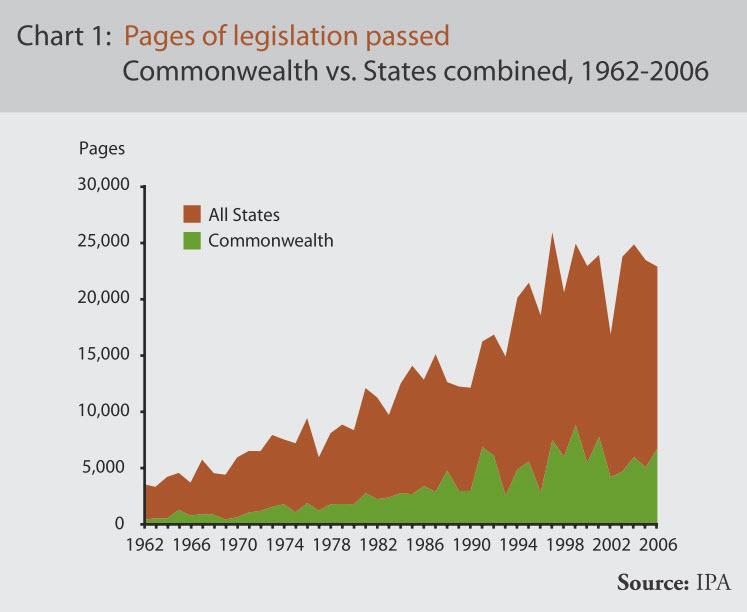
Furthermore, these charts do not include the web of quasi-regulations, codes of conduct, guidelines and other ‘voluntary’ self-regulations, which are often policed by regulators, or developed by the government, or instituted to ward off potential legislation. It would be a mistake to ignore these much-harder-to-quantify interventions when trying to ascertain just how significant regulation is in Australia.
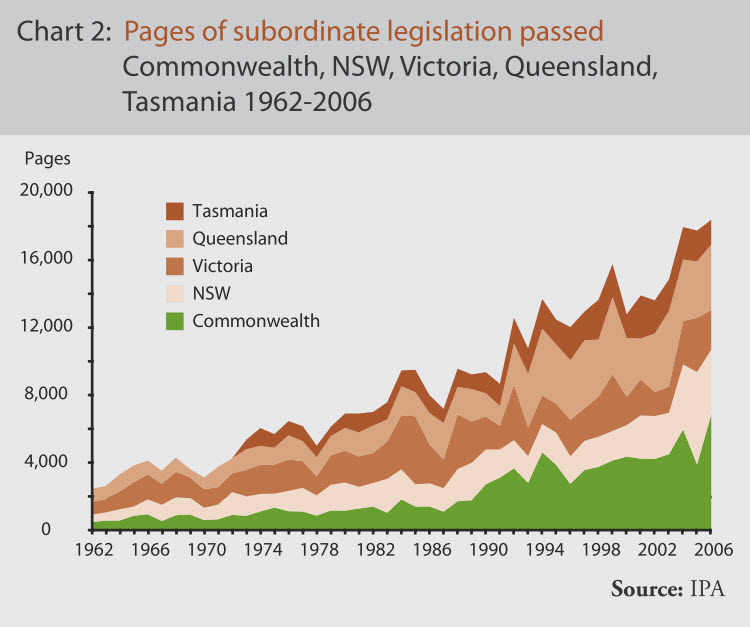
Using the direct tools of legislation, or the indirect tools of subordinate legislation and quasi-regulation, government intervention in the economy is expanding, rather than, as left-wing critics would describe it, receding. Furthermore, regulation has assumed a sort of entrepreneurial role for government intervention—a mechanism to search out new areas of the economy just begging to be regulated.

This casts Australian governments’ enthusiastic regulatory activity in a new light. The development of regulation is unambiguously a political activity whose direction is determined by political imperatives, and which has just as many political consequences as it has economic and social consequences.

Independent Regulatory Agencies

The direction of regulation may be determined by elected legislators, but its administration is delegated to the central institution of the Regulatory State — the independent regulatory agency.

These institutions are deemed ‘independent’ because they exist outside the normal bureaucratic chain of accountability — ministers and other elected representatives are not directly responsible for the agencies’ actions.

Independent regulators are accountable through such indirect means as procedural norms, requirements to be ‘transparent’, jurisdictional limitations and, as a last resort, the right of aggrieved firms and individuals to judicial review of the regulators’ decision-making processes. Nevertheless, within the confines of these mechanisms of accountability, regulators have significant discretionary power.

While the United Kingdom had inspectors policing factories for violations of the Factory Act from 1833, the independent regulatory agency is largely an American invention. The socialist fetish for public ownership never took strong hold in the United States, but, pioneering the now familiar pattern, regulation administered by independent regulatory agencies provided a substitute. In 1887, the Interstate Commerce Commission was formed, followed quickly by the Food and Drug Administration (1906) and the Fair Trade Commission (1913).

Then, as now, independence was intended to protect objectivity — the regulators would be friendly to business, but neutral in their application of the law.

But this balanced objectivity has also been under-mined historically by the bureaucratic impulses of the independent regulator to expand its jurisdiction, its powers and its discretionary budget. Regulators lobby governments for increased regulations, increased powers to administer them and, of course, increased budgets and staff. Regulators involve themselves more deeply in the activities of the firms they regulate, trying to discern the levels of compliance while, at the same time, trying to expand their jurisdiction into other industries and sectors.

For instance, having decided that the free-for-all internet is littered with bottlenecks to genuine competition, the ACCC is using the migration of media content online to explore new opportunities for regulation — a textbook example of regulatory creep.

In Australia, there are approximately 60 federal regulatory agencies, and 40 federal ministerial councils. We know that there are approximately 70 agencies in Victoria (the only state which publishes this data publicly), but extrapolating that figure, the Productivity Commission estimates that there are up to 600 regulators across the country.

Doing a similar extrapolation for the budgets of those agencies, and taking into account government departments with regulatory functions, inter-governmental bodies, and the range of quasi-official agencies and boards, it is easy to imagine that at least $10 billion is spent on regulating our activities.

Reigning over this web of institutions that is the Regulatory State are three ‘mega-regulators’ — the Australian Prudential Regulation Authority (APRA), the Australian Competition and Consumer Commission (ACCC) and the Australian Securities and Investment Commission (ASIC) — the results of a concerted effort over the last decade-and-a-half to consolidate federal and state regulatory agencies into single, one-stop-shop regulators.

Rather than having their jurisdictions delineated by the industries they regulate, instead they are delineated by the regulator’s ‘function’. ASIC is responsible for consumer and investment protection in cases of market manipulations such as insider trading. APRA is responsible for the regulation of information asymmetries in financial services, and the ACCC is responsible for anti-competitive conduct and consumer protection economy-wide. Old industry-based regulators, such as the Insurance and Superannuation Commission, had their functions divvyed up into the new functional bodies.

Just as the volume of regulation is growing, so are the three ‘mega-regulators’. We can see, since the turn of the twenty-first century, a significant increase in government spending and staff. We see increased media profiles and public relations activities. (The ACCC’s activism in the media was the subject of much criticism during the 2003 Dawson Inquiry into the Trade Practices Act — chastened, it decreased those activities immediately following the Dawson report, but has been steadily returning to its former levels.)

These agencies preside over the most intense period of regulatory and legislative activity in Australian history. This gives them enormous political power and influence — for which they are largely seperate from the traditional chains of democratic accountability.

Distracted by ‘red tape’

Regulation, admittedly, doesn’t get much good press. But the criticisms that regulations do receive are revealingly narrow.

Overbearing business regulation stifles incentives to take risks and to innovate’, wrote Labor’s Small Business spokesman Craig Emerson in The Australian earlier this year, ‘crucial to the efficient functioning of a market economy and productivity growth’. Undeniably true.

But the content of ALP policy focuses on reducing ‘red tape’ — only a small part of the total regulatory burden. Eliminating ‘duplication’ or regulatory confusion, which constitutes the bulk of ‘deregulatory’ proposals by both the ALP and the Coalition Government, does not address the real issue — regulations which discourage investment and entrepreneurial activity, and divert firms away from profit-making opportunities.

For example, Telstra estimates that it has to provide the government with 486 compliance reports annually — a significant red tape, or ‘paperburden’ cost. But the real cost of regulation of the telecommunications sector, however, is much higher, constituting the forsaken investment in infrastructure, the cost of universal service obligations, and the cost of delayed innovation across the economy. Similarly, the tomes of compliance reports required by ASIC dwarf the less tangible costs of diminished entrepreneurship and reduced corporate flexibility.

Focusing only on the paperburden cost of regulations is like focusing on the time spent filling out a tax return rather than the amount of tax paid.

In fact, the anti-red tape movement is reminiscent of regular movements throughout the twentieth century for more ‘efficient’ government. An efficient government is not a virtue if it is just as large as an inefficient one — indeed, efficiency can help it dominate the economy even more.

The bipartisan red tape proposals do nothing to reduce the size of government and its impact on the economy. Promises to reduce the red-tape burden offer little if they are not a constituent part of a promise to decrease the scope or extent of regulatory interventions.

A reduction in the volume of regu-lations and the extent of regulatory intervention in the economy will not only have economic benefits, it will have democratic benefits as well.

The dominance of the indepen-dent regulatory agencies in political and economic life is dependent upon this enormous pool of legislation and regulation — the problems of accountability and discretionary power will be resolved only when that pool is drained.

Regulation is the defining feature of the modern Australian state, and the regulatory problem requires a political solution.

Islam’s free market heritage

With Andrew Kemp

American strategy in the Islamic world has been aimed at the establishment of political democracy — a worthy goal, but a worryingly incomplete one. Social and political freedom cannot be fully established unless they are united with the other pillar of liberalism, economic freedom.

One of the late Milton Friedman’s great insights was the inherently peaceful nature of an open economy: the free market, he wrote ‘does not care what [the participants’] religion is; it only cares whether they can produce something you want to buy. It is the most effective system we have discovered to enable people who hate one another to deal with one another and help one another’.

This point also applies to states, as proved by the Economic Freedom of the World Index — reported in the December 2005 edition of the IPA Review. The higher a state’s measure of economic freedom, the less likely it is to wage war on other states. Economic freedom encourages valuable interdependencies between individuals which governments are reluctant to break.

While an Islamo-capitalism has yet to show its face in the most troubled parts of the Middle East, Muslim history and literature displays a sadly under-recognised liberal free market tradition. Islam is not inherently illiberal, as is sometimes portrayed, and there is a clear strand of Islamic tradition and thought that provides a stable base for a free society.

The Qur’an and the market

It is no coincidence that Makkah (modern Mecca), the site of Islam’s seventh-century theological birth, was also home to a thriving trading community. The early history of the Muslim world is a history of commerce—religious texts describing this period are replete with contextual references to commercial institutions, merchants and markets, commodities traded and commercial practices.

It would be hard to find a successful civilisation without a stable economic base at its origins, but it is worth emphasising the extent to which Islam, in particular, was conceived in a commercial environment. Makkah was a strategic trading hub, providing a gateway between East and West. Furthermore, its shrines to ancient gods attracted vast numbers of pilgrims, establishing the city as a form of sanctuary—an area recognised as free from interference by the internecine tribal rivalries of the time.

As a result, the Qur’an is infused with the smell of spices and the din of markets. Indeed, Muhammad himself, before arriving in history as a religious preacher, was a caravan trader and business manager. As the historian M.A. Shaban writes, ‘to attempt a study of Muhammad’s activities in Makkah and Arabia without taking trade into consideration is equivalent to studying contemporary Kuwait or Saudi Arabia without paying attention to oil’.

In a powerful article for the Islamic Free Market Institute Foundation, ‘Islam and the Free Market’, Peter J. Ferrara and Khaled Saffuri describe a Qur’an which strongly defends the market economy. The endorsement of voluntary trade is a keystone of the Qur’an’s attitude towards economic life, and is proclaimed in this early passage:

O ye who believe!
Eat not up your property
Amongst yourselves in vanities.
But let there be amongst you
Traffic and trade
By mutual consent (Qur’an, 4:29)

The Qur’an defends, amongst other things, private property, contract law, and profit through trade. It prohibits fraud. Muhammad himself prohibited price-fixing. The liberal scholar Dr Imad-ad-Dean Ahmad has argued that, even from a political perspective, the sacred text provides much guidance for believers in liberalism—advocating limited taxation, decentralisation, and strict restraints on the public sector.

Believers are to draw their income from the natural resources granted to them by God—it is not a legitimate role of the state to obstruct this process. The Qur’an is clear about Islamic priorities: pray, then profit.

And when the prayer is finished, then may you disperse through the land, and seek of the Bounty of Allah: and remember Allah frequently that you may prosper. (Qur’an 62:10)

The Qur’an is not a free market Bible. Islamic socialists have long pointed to an emphasis on the hero of ‘social justice’ within its pages, and many have drawn an inference in favour of state-granted minimum incomes, and even a large role for heavy public expenditures.

Others have cited Qur’anic prohibitions on usury (interest) as an indicator of anti-capitalist sentiment in Islam — even as an insurmountable problem for contemporary Islamic liberalism. (This objection will be dealt with below.)

But Muhammad, as the Marxist historian Maxime Rodinson wrote with perhaps a tinge of regret, simply ‘was not a socialist’.

As with many other religions, justice and fairness play a key role in Islamic theology, but it is disingenuous to ignore the emphasis on charity. Zakah refers to Muslims’ obligation to spend a fixed proportion of their income on the poor and needy—often supplemented by further charity (sadaqah). Just as voluntary charity is a vital part of a capitalist economy, zakah is the third of the Five Pillars of Islam.

Ibn Khaldun and The Wealth of Nations

These strong theological exhortations to prosper from God’s bounty have been reflected in early Islamic scholarship. Occupying a unique place in intellectual history, Ibn Khaldun was a medieval historian, historiographer, sociologist and economist who lived in Tunis, Granada, and Egypt in the fourteenth century. Largely written out of Western intellectual history — Joseph Schumpeter slandered Islamic scholarship by arguing that there existed a ‘great gap’ between the Greek scholars and the Christian scholastics — Ibn Khaldun deserves a central place in economic thought.

Indeed, Imad A. Ahmad argues forcefully that Adam Smith was ‘simply picking up where Ibn Khaldun left off’. Ibn Khaldun’s writings display a clear and unambiguous familiarity with many of the central tenets of what we know as classical economic thought — for instance, an appreciation of supply and demand, of causality, and an understanding of the difference between normative and positive analysis.

His support for the labour theory of value – the theory that the value of something is determined by the amount of labour that has gone into its production — is an open academic question. However, Ahmad convincingly argues that he had a strong appreciation of subjective value — a good’s value is solely determined by how much people are willing to pay for it — which would place him even higher on the intellectual hierarchy than many of the great nineteenth- and twentieth-century economists. While he wrote that labour was an important factor in production, elaborating on the work of Greek scholars, he nominated the utility of a good as a determining factor in its price.

Ibn Khaldun’s writings are rich with insights, and his clarity makes writing a review of his economic thought just that much easier. It is hard to avoid the temptation to quote him at length. For instance, he writes on the commercial ethic:

It should be known that commerce means the attempt to make a profit by increasing capital, through buying goods at a low price and selling them at a higher price, whether these goods consist of slaves, grain, animals, weapons, or clothing material. The accrued amount is called ‘profit’. The attempt to make such a profit may be undertaken by storing goods and holding them until the market has fluctuated from low prices to high prices. This will bring a large profit. Or the merchant may transport his goods to another country where they are more in demand than in his own, where he bought them. This will bring a large profit. Therefore, a veteran merchant said to a person who wanted to find out the truth about commerce: ‘I shall give it you in two words: Buy cheap and sell dear. That is commerce for you’.

He recognises the role of entrepreneurial risk and its relation to the supply of goods:

The transfer of goods from far away countries or through dangerous zones is of greater profit to traders and secures the fluctuations of the market in their favor, because the transferred good is rare and eagerly demanded, owing to its distant source or the risk incurred in its importation. It becomes thus rare, and much demanded and its price consequently rises … If, however, its exporting country was near and its communications secure, there would be many importers and it would be abundantly supplied and its price would tend to be low.

Ahmad’s characterisation of Ibn Khaldun as the Islamic Adam Smith is hard to dispute after reading his description of the advantages of a division of labour:

[T]he individual human being cannot by himself obtain all the necessities of life. All human beings must cooperate to that end in their civilization. But what is obtained through the cooperation of a group of human beings satisfies the need of a number many times greater (than themselves). For instance, no one by himself, can obtain the share of wheat he needs for food. But when six or ten persons, including a smith and a carpenter to make the tools, and others who are in charge of the oxen, the plowing of the soil, the harvesting of the ripe grain, and all other agricultural activities, undertake to obtain their food and work toward that purpose either separately or collectively and thus obtain through their labor a certain amount of food, (that amount) will be food for a number of people many times their own. The combined labor produces more than the needs and necessities of the workers.

Of course, no figure in intellectual thought can withstand all criticism, and Ibn Khaldun is no exception. For instance, he posited a beneficial role for public expenditure, writing, ‘if the state decreases its expenditures, the other markets follow its way and slacken much more’. But he quickly recognised the limits of this proto-Keynesianism, anticipating the Laffer Curve by about six centuries:

In the early stages of the state, taxes are light in their incidence, but fetch in a large revenue … As time passes and kings succeed each other, they lose their tribal habits in favor of more civilised ones. Their needs and exigencies grow … owing to the luxury in which they have been brought up. Hence they impose fresh taxes on their subjects … [and] sharply raise the rate of old taxes to increase their yield … But the effects on business of this rise in taxation make themselves felt. For business men are soon discouraged by the comparison of their profits with the burden of their taxes … Consequently production falls
off, and with it the yield of taxation.

Murray Rothbard’s two volume Austrian Perspective on the History of Economic Thought rightfully rehabilitates the Christian School of Salamanca in Spain as heretofore unacknowledged giants in economic history, pre-dating Adam Smith with many of the Scotsman’s
key insights, but unfortunately he too neglects Islamic scholars such as Ibn Khaldun.

But as Ahmad notes, the Salamanca School was born shortly after the reconquista of Spain from the Muslims in 1492. Given the intellectual cross-pollination of Medieval Europe, it is hard not to imagine that the leading scholars of the School of Salamanca did not have at least a passing familiarity with Ibn Khaldun’s work — he only died in 1406. Ibn Khaldun may have until recently been neglected by economic historians, but his work was not so neglected by his contemporaries.

It is hard not to be struck by Ibn Khaldun’s discussion of Islamic liberty:

Those who, of their own free will and without any compulsion, act according to the Qur’an and the Sunnah [the practice of the Prophet] wear the turban of freedom.

Ibn Khaldun may be a shining light in intellectual history, but he was by no means alone. For instance, one of his students, the Egyptian historian al-Makrizi applied his theory to the contemporary Arabic world, concluding that the causes of Egypt’s economic woes at the
time were government corruption, high taxes, and depreciated coins.

Earlier Islamic Economists

Preceding Ibn Khaldun, the eleventh-century scholar Abu Hamid al-Ghazali had an enormous influence on Islamic economic thought. Al-Ghazali investigated the relationship between the materialistic behaviour of the physical world on the one hand, and the moral foundations underpinned by religion on the other. Despite these conflicting elements, al-Ghazali clearly recognised individuals are motivated by self-interest. Observing traders, al-Ghazali wrote,

The motive behind all these activities is the accumulation of profits, undoubtedly. These traders exhaust themselves by travelling to satisfy others’ needs and to make profits, and then these profits too are eaten by others when they themselves obtain things from others.

Al-Ghazali was hardly an advocate of selfish behaviour, however. A conservative with many traditionalist underpinnings, al-Ghazali argued for moderation in the pursuit of profit, and was vehemently opposed to the excessive profitmaking of merchants.

A more accommodating view on the pursuit of profit and individual achievement was presented by the twelfth-century merchant Dimishqi, a Muslim writer from Damascus. Dimishqi wrote:

the wealthy individual is here considered a respected person who deserves people’s esteem because he is rich, not in need, and because he makes for good use of his fortune.

A similarly secular observation is seen by the Persian prince, Kay Kavus, who, in giving advice to his son, wrote:

Do not be indifferent to the acquisition of wealth, yet do not cast yourself into the danger for the sake of it. Assure yourself that everything you acquire shall be the best quality and is likely to give you pleasure.

Ibn Taimiya, whose life overlapped with Ibn Khaldun’s, showed an earlier, although less rich, appreciation of the role of supply and demand:

People’s desire is of different kinds and varies frequently. It varies according to the abundance or scarcity of the good demanded. A good is much more strongly desired when it is scarce than when it is available in abundance … It varies also depending on the number of demanders. If the number of persons demanding a commodity is large, its price goes up against when their number is small … It is also affected by the strength and weaknesses of the need for the good and by the extent of the need, how great or small the need is for it. If the need is great and strong, the price will increase to an extent greater than if the need is small and weak.

The Usury Problem

Depending on the interpretation, the Qur’an either forbids all interest, or merely usury, the charging of excessive interest on a loan. Known as riba — literally ‘in excess’ or ‘in addition’ — this practice is repeatedly denounced throughout:

Those who charge riba are in the same position as those controlled by the devil’s influence. This is because they claim that riba is the same as commerce. However, Allah permits commerce, and prohibits riba. Thus, whoever heeds this commandment from his Lord, and refrains from riba, he may keep his past earnings, and his judgment rests with Allah. As for
those who persist in riba, they incur Hell, wherein they abide forever (Qur’an, 2:275).

This seemingly unambiguous position has not been the restraint on economic activity that it is often assumed to be. As Maxime Rodinson noted in Islam and Capitalism, the practice of financial lending at interest was well entrenched within Meccan society before the birth of Islam, and remained a feature of Islamic commerce well after. Rather than grinding to a halt, with the assistance of Islamic scholars, Muslim money-lenders and merchants devised an array of legal devices (ruses, or hiyal) to avoid the prohibition on riba.

One technique, described supportively in a Shi’ite legal treatise, while in the same breath condemning riba, seems to indicate that this prohibition was not taken very seriously:

There is a way of avoiding riba. For example, Zeid sells Emru a bushel of wheat, in exchange for some other commodity, while Emru sells Zeid two bushels of wheat in exchange for something else. The goods handed over in exchange for the wheat being of little value, and being given in payment for the wheat, there is no riba here, since the things being exchanged are identical neither in kind or in weight.

A translator of this legal text notes that ‘no one could recommend more naively a legal way of breaking the law’. More sophisticated were the techniques detailed in the Book of Escapes and Ruses.

Regardless of the extent to which the prohibition on riba was enforced in Islamic commerce, or whether it refers to all interest or merely ‘excessive’ interest, the usury problem should not be overstated. Prohibitions against usury have been common in all cultures, including Judaism, Hinduism, Buddhism and Christianity. It is hard to beat the fifteenth-century Dominican prior Sant’Antonino’s condemnation of usury as ‘diabolic’, the great ‘harlot’ of the Apocalypse, and those who practise usury ‘worthy of death’. Despite Antonino’s passion, Christian banking has not suffered from his opposition.

Liberal Enclaves in Modern Islam

None of this discussion is to imply that the Islamic religion is consistently or inherently liberal, or necessarily free market. If nothing else, the process of discerning a liberal tradition in Islam illustrates the subjective nature of theology — individuals interpret sacred texts, rather than being controlled by them.

Further, authors should always be careful to interpret another culture’s religion. This article highlights a perspective of Islam not often examined in the west. Around the world, a small number of woefully under-funded free market think tanks are attempting to broadcast a liberal message to the Islamic world.

Organisations such as the Minaret of Freedom Institute and the Islamic Free Market Institute may be small but, with the fostering of Islamic liberalism constituting one of this century’s greatest challenges, their inheritance of the free market tradition has never been more important.

The other flurry of media mergers

With Hugh Tobin

The media is big business. Organisations such as Microsoft, Google, Apple and Yahoo! are rapidly manoeuvring themselves into competition with the traditional services. They exist in an unregulated online environment where innovation is rewarded and there is no limit to the acquisition power of companies.

In a short time, many Internet companies have grown to be even larger than the regulated traditional media players with which they compete. For instance, Fairfax’s market capitalisation of US$3.43 billion is dwarfed by Google’s US$139.1 billion. In the US market, Yahoo!’s market capitalisation is larger than CBS’s.

These companies are genuine competitors, and represent one of the greatest challenges to the incumbent leaders in the media industry since the introduction of broadcasting.

Like their traditional counterparts, the new media players have recently been undergoing dramatic structural and ownership changes. The big names — Google, Yahoo!, Microsoft — are buying up smaller entities which have developed recognisable and popular products, in order to integrate them into broad suites of products united under a single brand.

The quickest way to fortune in 2006 is to develop a Web product, build a strong and supportive user base, and sell out to Google.

The social networking video site YouTube, which gathered headlines around the world when it was acquired by Google for $2.2 billion in October 2006, is the most famous example, but it
is by no means alone.

A typical story in this era is Writely, a word-processor which runs within a browser, created by the Silicon Valley start-up Upstartle. At the time it was acquired by Google, in March 2006, it had only four employees. Google has since merged it with a spreadsheet program it developed independently, a product which most commentators believe signals a direct challenge to Microsoft’s dominating Office software suite.

Indeed, the often reported YouTube acquisition is just the tip of the iceberg. In the same month that Google acquired YouTube, it also acquired JotSpot, a collaborative document service, which will also integrate into its Office competitor.

In November, Yahoo acquired Bix, an advertising/contest service, MyBlogLog, a blogging aggregation tool, and KenetWorks, a service for mobile phones. Since 2002, Microsoft has bought 24 individual Web services, Yahoo! 25, including the bookmark-sharing Del.icio.us and the photo-sharing flickr, and Google has bought 27.

Online media is still in its early stages of development. But this ‘flurry’ of mergers and acquisitions seems to indicate that online media can now directly challenge incumbent broadcasters and traditional printers.

It was only in 1998 that NetFlix — a US subscription mail rental service which combined the two relatively new technologies of DVDs and the internet — was inaugurated. Bigpond Movies,
Telstra’s clone for the Australian market, is even younger.

But both of these services have already been made obsolete by offerings from Apple, Microsoft and Google — all released in 2006 — which provide films and television programmes for download or streaming at home. These services are an example of the competitive threats
that are now facing the traditional media.

But they also highlight the amazing benefits that increased competition brings for consumers.

Diversity — as far as it has any useful meaning — will survive any manner of media mergers or acquisitions, even in the unregulated online environment. It is now more useful to look at the media as an integrated market consisting of all the players mentioned above rather than the segregated silos of print, broadcasting and online which seems to dominate the analysis of the commentariat.

There is money to be made on the Internet, and there are serious businesses online. If only the traditional media were as dynamic.

How significant is online news?

The two opposing cases in the debate over ownership deregulation of the media can be quickly summed up. The first group argues that the case for deregulation is buttressed by the explosion of choice available on the Internet, and the second group counters that the influence of online media is exaggerated.

This second group commonly cites a series of polls indicating that the most commonly trafficked sites for domestic news are owned and operated by the proprietors of existing media businesses. Fairfax, News Limited, Channel 9 (in its ninemsn partnership with Microsoft) and the ABC top the list, with ‘new media’ sites such as crikey.com.au and Yahoo! News struggling to compete. Not only this, but fewer people than it is often assumed gather their news online—in one such survey, 75 per cent of people were either unable to name an online news source they visited, or did not do so.

The news revolution and the deregulation it inspires, is, argue the critics of reform, a myth. Of course, none of the data is surprising. In 2006, established media organisations can far easier produce news content, with their network of in-house journalists and associations with news services such as Reuters and Associated Press. Obviously not everybody is comfortable yet with browsing the Internet for their news; established patterns are hard to break.

But there are problems with these one-dimensional measurements of news site popularity. It is arguably more interesting that, in the 2005/2006 poll displayed on this page, in fifth and sixth position are Yahoo! and Crikey, archetypal Web start-ups. Bigpond comes in seventh—before the Internet, how many people could say they primarily sourced their news from Telstra?

Drawn from a series of interviews and extrapolated to the population at large, the polls also appear to underestimate the traffic at these sites. The 2005 poll reports 190,000 visitors to the Crikey Website per month. Crikey itself claims double that — 355,000 unique visitors to their Website, with 41,000 readers of the daily e-mail.

Internet statistics are an amazingly problematic enterprise. The differences between hits, page views, visits and unique visitors are arcane and technical, but can dramatically raise or lower sites in the rankings. Whether the user is on a home computer directly connected to the internet, or through a corporate network — which could mean that a couple of thousand employees only register as a single visitor—adds to the challenge. Whether you identify unique users by tracking their IP address, with a cookie, or by imposing a registration system on the site itself, further complicates the issue. Unfortunately, trying to ascertain traffic by interviewing consumers doesn’t really cut it.

The diffusion of knowledge about current affairs is not as linear as these surveys imply. As these metrics measure ‘news only’ sites, they ignore a large number of sources of news and opinion available both on and offline. Outlets which are not classified ‘news only’ are often rich with references to current events. Online services run by traditional proprietors are richer with content and opinion than their print or broadcast counterparts, and in many cases, by linking to other sources, encourage consumers to explore alternative outlets.

News consumption is shifting from a hit-driven culture to a niche culture, as consumers spread out across a suddenly massive array of media outlets available online.

By leaning on surveys such as these as a crutch, opponents of media deregulation miss the point. Media use has rapidly and irreversibly changed. Whether consumers visit Fairfax Digital or an obscure blog — or more likely, both — they have not just shifted format, but shifted their approach to news gathering.

The media is now more than ever intensely competitive — the ABC, ninemsn, News Limited and Fairfax aren’t resting, confident in their status as most popular news sites, but are instead being chased by hungry start-ups and competitors eating away at their bottom lines. Media regulation has to change to suit.

Software design by competition law

Europe is providing a steady stream of wrongheaded and counterproductive regulations — good for anecdotes, bad for Europeans.

When Windows Vista, the long-awaited successor to Microsoft’s operating system Windows XP, is released to the general public on January 30, some consumers around the world will have an additional product available. But, if the sales records of Windows XP ‘N’ are any indication, then Vista ‘N’ will be Microsoft’s most unpopular product in a long time.

The ‘N’ series is a special variety of Microsoft’s operating systems designed specifically to comply with antitrust rulings in the EU and in South Korea, which also has aggressive competition laws. In order to do so, XP ‘N’ shipped without Media Player, the free video and audio player which, for users outside these jurisdictions, is bundled with a standard XP installation. Both versions, ‘N’ and the bundled package, were available to European consumers at the same price.

Unsurprisingly, there have been no reported sales of XP ‘N’ to consumers since it was released in mid-2005. It would be hard for a market to reject a product any more entirely.

As has been argued, as long as competition is a download away, the law has done its job. But a steady stream of regulatory intervention and litigation in the computer industry over the last ten years disagrees.

Microsoft has been a staple target of antitrust authorities across the world. In 1998, the US Government sued the software manufacturer for tightly integrating its Internet browser with its operating system. The litigants alleged that their victory in the ‘browser wars’ — a period of vigorous competition between Microsoft’s Internet Explorer (IE) and Netscape Navigator — was due to IE being bundled with XP. Both products were free — but free and bundled can’t compete with free and downloadable, the critics alleged.

Experience suggest otherwise. Mozilla’s Firefox, the heir to Netscape Navigator, is rapidly gaining a share of the browser market. Firefox’s success has largely been due to a perceived lack of security and performance with Microsoft’s bundled product. Consumers are fickle enough to choose between competing products.

Indeed, there is good reason to suggest that the death of Netscape Navigator in the late 1990s was not due to predatory bundling by its powerful competitor, but to consumer disappointment with the software itself. Navigator had undergone a complete rewrite, and was buggy and bloated. When consumers were looking to upgrade their browser for the new features and web specifications becoming available, Internet Explorer was simply the better choice.

In the highly competitive computer industry, technological change makes pronouncements of such-and-such company as ‘anti-competitive’ laughable. IBM is no longer the terrifying anti-competitive monster that prosecutors described it as in the 1970s — in part because of Microsoft’s aggressive marketing of MS-DOS in the first years of the 1980s, and then the Windows 3.1x family of operating systems.

The 2004 competition actions in the European Union against Microsoft were encouraged by organisations such as Real Networks, which publishes a competing product to Windows Media Player. Again, Microsoft’s rivals allege that the competitiveness of their product is harmed by the product bundled with Windows. The EU regulators forced Microsoft to provide European consumers the option of buying XP ‘N’ — without the bundled Media Player. Microsoft wanted to call the package ‘Reduced Media Edition’ until the EU objected.

But again, reality intervenes. While Real Networks may have been disappointed with the popularity of their product, many of Microsoft’s rivals should not be. Apple’s iTunes, for instance, has ridden the popularity of its portable music player, the iPod.

In 2006, before it has been officially released, Windows Vista is under heavy fire from its competitors, and they’re going to the European Union for help. The new operating system includes an array of new features for which, presumably, Microsoft foresees a demand. Producers of anti-virus and security software object to the new low-level enhancements to security—a feature that consumers have desperately sought for a long time. Adobe, which invented the PDF document format, objects to the new document format XPS — a more dynamic format than the now standard PDF.

The EU fined Microsoft €497 million for bundling Media Player with XP, and it has been remarkably vague about Vista’s prospects when it comes before the European regulators. While Microsoft is already obligated to produce the Europe – only Vista ‘N’, the European regulator’s role, the EU argues, is not to give a ‘green light’ before Vista is available to consumers. If Adobe and others have their way, Microsoft could be lumped with another massive fine or have its product crippled for providing new features that consumers demand.

The nineteenth-century French liberal economist Fredric Bastiat divided human activity into two categories: ‘harmonious’ and entrepreneurial, or ‘antagonistic’ and rent-seeking. Unfortunately, as the vibrant, innovative technology industry becomes bogged down in competition litigation, too many are showing themselves to be the latter.

Containers and their enemies

A review of The Box: How the Shipping Container Made the World Smaller and the World Economy Bigger by Marc Levinson (Princeton University Press, 2006. 392 pages)

Strictly, the father of the modern international shipping container, Malcolm Mclean, didn’t invent his own invention. It wasn’t even new.

When the shipping container was first deployed on McLean’s converted World War II tanker Ideal X in 1956, experiments with its ancestors had been being conducted for nearly a century. British and French railway operators tried using custom-made wooden boxes for household furniture shipment in the second half of the nineteenth century. After the First World War, entrepreneurs experimented with interchangeable truck bodies and steel containers for railroads.

The problem was simple: none of these efforts ever demonstrated any cost savings to transport. Malcolm Mclean’s innovation was not the box itself, but the systematised, standardised, international network of shipping containers, freighting massive quantities of goods speedily and efficiently across the world.

Marc Levinson’s The Box: How the Shipping Container Made the World Smaller and the World Economy Bigger illustrates clearly how great risks are taken by entrepreneurs when entrenched interests and government regulators conspire against them. Even after these opponents are dispatched, technological and economic uncertainty plague the entrepreneur just as much as the vaunted ‘first-mover advantage’ blesses him, perhaps more.

The story of the shipping container is the story of the opponents of innovation.

Unions

Before the shipping container, the job of a longshoreman was brutally physical. Longshoreman could utilise winches to load and unload ships, but, as the unsorted cargo was dumped on the dock after its trip by railway or truck, and squeezed into every irregular space in the ship’s hold, human force was resorted to more often than not. Levinson quotes a former pier supervisor: ‘Because they had to bend over to do that, you’d see these fellows going home at the end of the day kind of like orangutans. I mean, they were just kind of all bent, and they’d eventually straighten up the next day’.

Not only this, but as pallets were packed and unpacked to squeeze into irregularly shaped cargo holds (the shipping fleet used after the war was mostly converted military surplus, not custom-made cargo vessels) damage — and ‘damage’ — were common. Longshoremen would pride themselves on such skills as the ability to tap whiskey form a sealed cask supposedly stored deep in the ship’s hold.

Automation, in its full-blooded shipping container form, came as a shock to the highly parochial and defensive maritime unions. Containerships could be loaded and unloaded in one-sixth of the time it took for traditional cargo ships. Sealed containers dramatically reduced theft. More disturbingly, containerisation required one-third of the labour. When the first shipping line asked to hire a smaller work gang in New York, the unions announced boycotts. The industry was to become bogged down in union disputes for ten years after the Ideal X first sailed.

Levinson details carefully the internecine rivalries of competing unions and the negotiations needed to relax the rigid contracts which had dominated maritime work. The radical changes that were re-negotiated slowly modernised the docks, but also spurred a massive boost in productivity for non-containerised cargo loading, as employers were suddenly given the capacity to change previously entrenched work practices on the docks. The casual conditions and practices were, in the ensuing decades, converted into highly paid, highly structured and highly secure jobs. But one unionist lamented: ‘the fun is gone’.

Regulators

Unions desperate to preserve existing work practices present a huge challenge for entrepreneurial innovation, but, as Mclean and other adopters of the shipping container discovered, the challenge posed by regulators can be even larger. By the mid-twentieth century, the United States’ Interstate Commerce Commission (ICC) had developed a firm regulatory structure which was being undermined not only by the nascent shipping container, but also by the increasing dominance of trucking.

The ICC, which regulated the rates and services of both trains and interstate trucks, struggled to adjust its regulations to the new dynamics of trucking and shipping. Rates were previously set depending on the commodity being carried, but in an era of homogenous containers distinguishable only by weight, this rate-setting principle began to make less and less sense.

But the ICC’s primary error was not practical but philosophical. The ICC’s brief, which was reiterated in the Transportation Act of 1958, was to block the chimeras of unfair or destructive competition. In the highly dynamic transport industry of the 1950s and 1960s, this instruction encouraged the ICC to protect existing operators from innovative practices such as the shipping container, and ‘piggy-backing’ — that is, placing a truck’s body on rail for the long legs of its journey.

A regulator briefed to defend an industry against ‘destructive’ competition — a phrase which is antithetical to an entrepreneurial economy — is not uncommon. It is just as antithetical to economic growth. Regulatory frameworks which are built around specific technologies or business models have no reason to promote innovation within that industry, and firms which benefit from the confines of those frameworks have every reason to prevent or resist change.

After a lengthy series of court decisions and regulatory pronouncements, the full influence of containerisation, which both ripped up the transport industry and pumped up the world economy, is obvious.

Levinson spends time trying to tease out the quantitative benefits of the box — as he notes, ‘a near impossible task’ — but he quotes Edward L. Gleaser and Janet E. Kohlhase who argue that, ‘it is better [now] to argue that moving goods is essentially costless than to assume that moving goods is an important component of the production process’.

Levinson convincingly credits McLean’s shipping container as a major, if not definitive, cause of the boom in world trade since the 1960s.

Ports

There was a boom for the international economy, but like so many economic revolutions, the benefits were diffuse. There were definite losers, particularly if you were a mayor in a town traditionally based around a port. The new breed of ship quickly outgrew the available space in ports designed before the container. Furthermore, older ports tended to have entrenched unions with just as entrenched antagonism towards change.

But some of the largest problems for older ports stemmed from the rapid change in business models caused by dramatically cheaper ocean transport. Immediately, the cost advantages of a factory location in New York, right next to the port, were eliminated. Between 1967 and 1976, New York lost a quarter of its factories and one-third of its manufacturing jobs.

In 2006, with ‘essentially costless’ transportation, it is possible to distribute the production of goods across the globe. The sudden rise of ports at Busan in Korea and La Havre in France and new ports at Felixstowe in England and Tanjung Pelepas in Malaysia, capable of processing super-sized container ships is just as much a factor in the deindustrialisation of the Western world as is industrial relations.

Once the impact of containerisation was clear, traditional port cities unleashed vast sums of money during the 1970s and 1980s to upgrade their infrastructure. In some cases they were successful. Seattle’s docks saw 10 per cent less cargo in 1960 than 1950, but had managed to resuscitate their traffic by the 1970s. Others, such as New York, tried and failed to do so.

But by the 1990s, not even the largesse of government was sufficient to make or break ports. Seven of the top 20 ports in 2003 had seen little or no traffic in 1990. Tanjung Pelepas, which now handles three and a half million 20-foot containers a year, did not exist in 1990. These new ports are mostly privately financed and managed — as Levinson describes them, ‘investments in globalisation’. As container ships inevitably grow, new ports will be built to service them.

In 2006, the revolution in international transport is obvious, but not complete. All innovation is incremental; steady computerisation and automation is cutting down the time spent at port and streamlining the processes. Reduced paper handling in Australian ports, and the reduction in manpower and human error it has brought, has already brought greater productivity for shipping lines. The upheaval brought about by containerisation has cleared many of the entrenched obstacles to change.

For the dock culture in the old, traditional, highly-unionised ports, the fun may be gone, but the benefits to all consumers brought about by costless shipping are clear.

In search of Smith’s legacy

Review of Adam Smith and the pursuit of perfect liberty, by James Buchan (Profile Books, 2006, 288 pages)

If an economic philosopher is to be judged by his sound bites, then Adam Smith’s best lines come not from his great masterpieces, but from a paper delivered in 1755, as reported by a friend:

Little else is requisite to carry a state to the highest degree of opulence from the lowest barbarism, but peace, easy taxes and a tolerable administration of justice.

All governments which thwart this natural course, which force things into another channel, or which endeavour to arrest the progress of society at a particular point, are unnatural, and to support themselves are obliged to be oppressive and tyrannical.

Twenty years later, his masterwork An Inquiry into the Nature and Causes of the Wealth of Nations would contain nothing so radical. James Buchan’s short intellectual biography of Adam Smith pivots around the publication of his Wealth of Nations and the earlier The Theory of Moral Sentiments. Spartanly but engagingly written, Buchan depicts an Adam Smith cursed by ill-health for his whole life. The racy novelist Marie-Jeanne Riccoboni, who befriended him while he stayed in France, described him as ‘ugly as a devil’ – she hated his voice and found him terribly absent-minded, but loved his sentimental philosophy.

Buchan describes in his introduction how both sides of politics have tried to claim themselves as the heirs of Adam Smith – long adored by the free-market right, reform-minded Social Democrats now try to co-opt his legacy. Buchan chastises both Alan Greenspan and Gordon Brown for inappropriately calling upon Smith’s ghost, but it would be interesting to see where the biographer ultimately stands on this.

Certainly Smith was not a dogmatic libertarian by modern standards. He saw a role for the State in education, if under a peculiar justification. The division of labour, he worried, would make the poor into specialised idiots, men who were ‘mutilated and deformed’. Public education would help alleviate their intellectual isolation, and lower the chances that their minds could be corrupted by the baser elements of political thought. He had a remarkably unenlightened view of women, but subsequent feminist authors made much of his theories by applying them more equitably.

Buchan rightly makes note of the misuse of what has wrongly become Smith’s signature term ‘the invisible hand’. Indeed, the ‘invisible hand’ was rarely used in Smith’s writings, only once in each of the Wealth of Nations and The Theory. An out-of-context quotation from the Wealth of Nations has imparted upon it the meaning it has for modern commentators: an economic actor is ‘led by an invisible hand to promote an end which was no part of his intention.’ Smith, in this case, is talking about merchants who choose to store their wealth at home rather than overseas for security purposes, and therefore raise the aggregate wealth of their home nation.

However misquoted or misunderstood, the ‘invisible hand’ has since become the universal metaphor for the workings of a free market. Buchan notes that while Adam Smith was not a particularly religious man, his metaphor helped illuminate his message to his students, most of whom were training for religious careers. The Theory is peppered with such references: Smith refers to the Great Superintendent, the Great Conductor, Benevolent Nature and the Superintendent of the Universe.

But, co-opted by economics teachers as a metaphor for Hayekian spontaneous order, its use just about gives the game away. If all that is required to shift resources efficiently throughout an economy is an omniscient designing mind, could not a sufficiently enlightened public servant, equipped with the best technology and intellectual expertise, do well enough to make it worth trying? But it is the process of voluntary exchange that creates the order of a market, and without perfect omniscience, no planner could replicate its results.

While the metaphor holds, it also leads to unfortunate hubris on the part of planners who presume to replicate the invisible hand with their visible fist.

A short postscript he wrote for his friend David Hume’s autobiography, who had attacked the religious sensitivities of establishment England at the time, caused Smith much greater problems than the Wealth of Nations, which had attacked the entire British commercial system. Buchan’s brief overview of Smith’s life gives us an engaging account of this man whose greatest work is now gathering the controversy it deserves.

Orwell’s Curse

A review of Privacy without Principle: The Use and Abuse of Privacy in Australian Law and Public Policy by Brett Mason (Australian Scholarly Publishing, 2006, 228 pages)

Privacy is a strange concept. Few debates over new technologies, changes in social structure or security measures are free from appeals to the right of citizens to conduct their affairs without surveillance, from either the corporate or the political sector.

As Brett Mason argues in Privacy without Principle: The Use and Abuse of Privacy in Australian Law and Public Policy, privacy has become a term of convenience for advocates of one or another political position.

The term itself has little conceptual core. Mason traces the variety of methods by which legislators, judiciaries and commentators have attempted to define the core of privacy — what is it that we are trying to protect? Privacy could be control of information regarding oneself, or deeply personal information that one may not wish to be made public. Privacy could be a manifestation of the autonomous individual, or could be the protection of intimacy.

In order to make consistent public policy decisions which respect the notion of privacy, legislators need an unambiguous and comprehensive definition. But none of the answers listed above, Mason argues, are conceptually clear, and provide little guidance for practical policy decisions. How, then, is the concept of privacy used in Australian politics? Mason singles out two debates within the last few decades — the 1994 Human Rights (Sexual Privacy) Act and the 1986 Australia Card Bill. Both of these debates exhibit the critical flaws in privacy discourse.

For example, why was privacy the vehicle upon which to legitimate homosexuality? While not always consistent with a liberal society, from a historical perspective, the state has always had an interest, or at least believed it had an interest, in the sexuality, sexual acts and reproductive habits of its citizens. The Human Rights (Sexual Privacy) Act sought to remove homosexuality from the interests of the state, but by hanging the act upon the concept of privacy, it did gay rights movement’s cause a great disservice.

The 1994 legislation posited that homosexuality was acceptable, as long as it was a private or intimate matter. If privacy is the foundation of the state’s interest in homosexuality, homosexual ‘legitimacy’ is premised on a staying in, rather than out, of the closet.

Mason also raises some other, challenging questions. For instance, if privacy determines the state’s interest in individual sexuality, does it follow that all (non-coercive) sexual acts are also legitimised? Such a formula would seem to legitimise acts which policy-makers may prefer not to condone, for instance, incest. It is unfortunate that the debate over the government’s interest in homosexuality in Australia led to a debate over what distinguishes homosexuality from incest. Advocates of gay rights are not well served by such appeals to privacy.

The Australia Card debate, and indeed, subsequent debates about national identification cards, have similarly used the concept of privacy loosely, often to their detriment. In this sense, George Orwell has done civilisation a great disservice. Both sides of politics ask a great deal of contemporary governments.

Government services need to be efficient. The terms of property have to be clearly defined. Laws need to be uniformly and rigorously enforced. Citizens need to be secure and, argue many from the progressive side of politics, they also need to be protected against their own choices.

Privacy is an inadequate focus of the debate over the relationship between the state and its citizens. That relationship, particularly in a time when social regulation and legislative paternalism are on the rise, needs to be closely examined.

But the doctrine of privacy against all else — undefined and unchallenged — does such a debate a great disservice.

Scandinavian Idol

Since William Lane’s disastrous attempt in the mid-1890s to create a socialist Australia in Paraguay, Australian social-democrats have looked offshore for their idols. This year marks the twentieth anniversary of the trade union mission to Scandinavian countries which culminated in the Australia Reconstructed report, a report which extolled Sweden above all others as a nation of unsurpassed social-democratic virtue. Since then, it has been used as an aside in numerous speeches, op-eds and policy papers – ‘If Sweden can do it, why can’t we?’

But does Sweden vindicate the Social-Democratic model? Sweden, and its Scandinavian neighbours, have long been touted as the archetypal well-functioning welfare states — stable, democratic, and, most indicatively, competitive. Ericsson and Ikea, models of successful globalising companies, originate in Sweden. Both symbolise innovation and international competitiveness, Eric-sson the high-tech mobile phone industry (joined by its regional competitor, (joined by its regional competitor, the Finish Nokia), and Ikea, the radical- and Ikea, the radically consumer-centric model of low-price, semi-disposable furniture.

But competitiveness in global markets is clearly not the major appeal of these Scandinavian countries to those who lean left around the world. Instead, it seems to hold the holy grail of social-democratic politics — record-high levels of social spending, a ‘consensus’ model of democratic governance, and internationally incomparable levels of trade union involvement in the political process.

It is no surprise that the Scandinavian model is much referenced as the ideal. Australia Reconstructed, presented a contrarian case to boost welfare and labour market restrictions at just the time Australia was moving away from that model. In May this year, RMIT academic Andrew Scott presented a paper to Melbourne University’s Contemporary European Research Centre arguing that the Scandinavian model described by Australia Reconstructed still had much to offer Australian policy-makers.

As the report is, in Scott’s words, ‘still the most comprehensive policy manifesto ever published by the Social-Democratic left in Australia’, its influence in the union movement and left-of-centre parties in Australia more generally is still significant. Scandinavian idolatry has lasted well into the twenty-first century. In the past six months, Stephen Smith has used Sweden as an example to attack recent workplace reforms. Wayne Swan has used it to condemn Australia’s R&D policy. In a speech in Melbourne to the Australian Institute of Company Directors late last year, Kim Beazley argued that social-democracy can still work, because Nokia and Ericsson produce high-quality phones. Praise for the Scandinavian model is a regular feature of Parliamentary and intellectual debate around the country.

But the tributes paid to the Scandinavian, particularly the Swedish, model by the ACTU researchers came at a peculiar moment in Swedish history. While not yet self-evident, it was clear that the Swedish model was in trouble. The Business Council of Australia, who replicated the ACTU’s Nordic retreat in October 1986, found that the Swedish economy was in dire trouble, having begun a slow but perceptible decline since the beginning of the 1970s and, even in the economic environment of the 1970s and 1980s, was more prone to stagflation than other comparable nations around the world. (A summary of the findings by the BCA, ‘Avoiding the ‘Swedish Disease’, by the head of the mission, Peter McLaughlin, appeared on these pages in April 1987.)

Less than five years after the debate over Australia Reconstructed, Sweden’s economy nearly collapsed. The economy went into deep recession, official unemployment figures skyrocketed, and the budget deficit rapidly increased. The economic crisis forced sharp cuts in welfare expenditure, and stopped to a halt the welfare expansion that had characterised the country over the previous few decades.

It is true that many other nations, Australia included, experienced economic crises at this time. But it is also the case that the source of these crises was more often than not the outdated social-democratic restrictions on the economy. The magnitude of the crisis in Sweden was therefore remarkable – the more inflexible you are, the less ready you are for the fall.

A brief history of the Swedish Model

Sweden is, surprisingly to outside observers, one of the great examples of liberal modernisation in the world.

Until relatively late by Western standards, the Swedish people were agrarian and dispersed. The aristocratic and political elite had little control over the economy. A series of land redistribution reforms in the late eighteenth and early nineteenth centuries broke up the feudal villages and set the stage for what became a modernisation with an unusually wide popular base. A massive liberalisation of economic barriers was instituted mid-century, beginning with the liberalisation of shipping and mining in the 1830s, until 1864, when the final barriers to trade and enterprise were eliminated.

Democratic reforms and the removal of aristocratic privileges followed from the 1860s onwards. Having shut down the old monopolies, strengthened rights to private property, and removed regulatory barriers and corporate subsidies, Sweden experienced one of the most rapid modernisations and industrialisations in the developed world.

With rapid growth, came calls for increased social regulations. In 1912, a universal workers protection law was passed, followed by a basic pension, universal accident insurance, new poor and unemployment relief system, and significant increases in health funding.

Out of this newly urbanised and industrialised state, was forged the famous Swedish ‘consensus’. Says Swedish Historian Emil Uddhammar:

public expansion during the 20th century (has) taken place without any consistent opposition, on grounds of principle, by any party … The expansion of public power has taken place without any significant controversies.

The consensus which grew out of the rapid growth of the late nineteenth century, it seems clear now, was fundamentally opposed to the reasons for that growth. Instead of embracing the liberal democratic model which had brought it such sudden wealth, it emphasised the role of the State in creating the preconditions for the best possible life, in organising the economy and society for common ends. This grandiose project was known by the motherly phrase folkhemmet, a combination of folk (people), and hem (home) — the all-embracing welfare state.

This consensus was only possible because the Social-Democrat Party, which held power in Sweden for most of the twentieth century, and whose vision of Sweden most informs the Swedish model, separated with its previous orthodox-Marxist ideals and co-operated with business, viewing its capacity for wealth-generation as the economic source by which it could construct folkhemmet. In co-operation with the strong trade union movements which guaranteed constant pay improvements, the Swedish consensus was born.

It was not until the Second World War, however, that the full force of folkhemmet could be mustered. Wrote Ernst Wigforss, the Finance Minister at the end of the war:

The important thing is that we felt our experiences during the war had given us new and decisive arguments for a bolder social policy being both economically feasible and politically justifiable … While realising that the difficulties were greater in peacetime, one could still unhesitatingly make reference to wartime experiences. Our resources were greater perhaps than most people had suspected. Would it not be possible, with a completely different strength from previously, to appeal to people’s feeling for the greatness of a common peaceful task of construction?

Having a fully functioning industrial base and a largely unharmed civilian population within reaching distance of the devastated continent turned out to be sufficient support to sustain record high levels of employment and steady, if not particularly impressive, growth.

As the consensus, and the faith in the Swedish model, grew, the level of social spending and state intervention matched it. The historian Arne Ruth writes:

The planning mentality was accepted on a scale, which even its keenest advocates in the thirties could hardly have imagined. The already dead-straight highway of Swedish industrialism was asphalted into the condition commonly known as the Swedish model. It was so outstandingly successful that virtually all criticism was silenced for decades. Through its very success it tended to exterminate all other options, all the objections great and small, which could have helped to correct its bearings in time. It killed history, not least. The planners extrapolated their graphs for decades ahead.

By the mid-1970s, as the 1987 BCA report indicated, it was possible to perceive deep flaws in the Swedish economy. Industrial employment had declined since the mid-1960s, and was similarly declining in importance to the economy. Absolute employment growth in the industrial sector culminated as early as 1965.

The core of the folkhemmet, lavish welfare entitlements, began to show its flaws during the 1960s and 1970s — so much so that Astrid Lindgren, the children’s author of, among other things, Pippi Longstocking, in 1976 wrote Pomperipossa in Monismanien, a fable about how the title character Pomperipossa lives out her life on welfare payments and never has to write another book.

As Mauricio Rojas, author of Sweden after the Swedish Model: From Tutorial State to Enabling State, writes, Sweden’s progressive taxation and welfare policies had changed Sweden’s ‘basic distributive principle from “equal pay for equal work” to “equal pay (or in-come) regardless of work”.’

What Australia can learn from Sweden

In the early 1990s, Sweden faced the fruits of four decades of social-democratic governance. Unemployment rocketed up from 2.1 per cent in 1990 to 12.5 per cent in 1993. The Swedish consensus, at least at this stage, was, however, largely intact — broadly supportive of an extensive, redistributive state.

This set of pressures — a devastating economic crisis, without a significantly reduced support for a large welfare system — inspired Swedish governments in that decade to institute a series of major innovative reforms to the government provision of social services.

In 1990, as part of a series of reforms to decentralise government services, the Swedish municipalities were given full financial control of the compulsory and the upper secondary schools. In 1992, this was followed by the introduction of what could roughly be described as a school voucher system, a major reform to the education system which has been advocated by liberal policy makers around the world for a long time. In Sweden, this consisted of an obligation on the municipalities to give independent schools 85 per cent of the cost of educating a child in the municipal schools, and giving parents the right to choose the right school for their children. Subject to maintaining certain educational standards, all independent schools are eligible for this funding.

For advocates of school choice in Australia, the empirical results from the adoption of such a system in Sweden have served as a vindication. A series of studies has found that competition between education providers has improved educational outcomes. As F. Mikael Sandström and Fredrik Bergström find in their paper ‘School Vouchers in Practise’:

Greater competition improves the standards of public schools. The wide scope of reform of the system for financing primary education makes the Swedish experience particularly interesting. Sweden has left a system with virtually no parental influence over school choice, and an almost complete dominance of public schools. A voucher system, where parents are allowed to choose any school approved by the National Agency for Education, has been put in its place. Independent schools receive funding on close to equal terms with public (municipal) schools. A widespread concern among opponents of school choice is that competition will hurt the public schools. The present study shows this fear to be without foundation.

For an Australian observer, it is interesting to learn that the school voucher system implemented in Sweden has been embraced by the teachers’ unions themselves. According to the head of the Swedish Teachers Union, Lärarförbundet, teachers were ‘a little suspicious at first’, but have come to embrace the new system — which not only gives parents choice of education institutions, but grants teachers greater choice of potential employers.

Nevertheless, their Australian counterparts continue to oppose them, arguing that such an innovative policy model is a mere ‘smokescreen to avoid tackling real equity issues in schools … the best way to improve schools is to improve public schools’.

Although not as advanced, Sweden has also made significant inroads into health care reform. The mid-1990s witnessed a series of slow but unmis-takable moves towards greater choice and competition in health care. By 2002, health authorities were utilising an extensive internal market, purchasing services from more than 2,000 medical providers in the Stockholm region alone. Most of these are medical practitioners.

Swedish health care analyst Johan Hjertqvist argues that given the unpromising state of international health care, these reforms ‘may represent the biggest privatisation of health care services production ever in the long history of socialised medicine’. Even emergency care is moving towards private ownership, as previously government-controlled emergency hospitals corporatise in preparation for their eventual privatisation.

Sweden has a pension scheme not dissimilar to Australia’s, where citizens are given ownership of part of the pension savings and the freedom to choose which funds to invest in.

It should be clear by this stage that the impression of Sweden as a social-democratic wonderland is incomplete at best. Like Australia, the nation is going through a long period of economic reform and rejuvenation. Privatisation has been a recurring theme. The postal monopoly was abolished in 1993, having been challenged in Stockholm by a private company, CityMail, which had been operating since 1991. Water services have been privatised throughout many municipalities since the mid-1990s.

In a setback in 2004, the national government banned the further privatisation of public hospitals. However, this year, the opposition conservative coalition has agreed to privatise a huge range of state-owned companies, indicating the continued appeal of liberal economic reform.

The harsh reality of the Swedish utopia

Many, but not all, of these reforms have been embraced by the Swedish public and have been integrated into the ‘consensus’. However, their history and the circumstances from which they were born make it clear that they were creations of necessity — possibly because of a public recognition of a crisis within the welfare state and the need for reform in services.

Despite these many changes, the welfare state remains largely intact, sustained by the largest tax burden in the OECD — 50.6 per cent of GDP, down from roughly 70 per cent in 1993. The consequences of such continuing massive government weight on the economy are entirely predictable and unsurprising — Swedish exceptionalism has not expelled economic man.

Although growth is high compared with the rest of Europe, since 1998 the economic recovery has, unfortunately, been only partial, and accompanied by a number of disturbing trends.

The crisis of the early 1990s threw a much larger segment of the population from 20 to 64 years of age on to some sort of aid or social security, from just over 700,000 in 1990 to nearly 1,200,000 in 1994. Since then, however, despite a significant economic recovery over the last ten years, this has only dropped moderately — in 2003, more than one million out of a total of 5.2 million within that age bracket of people were the recipients of wealth transfers.

Similarly, a significant growth in absenteeism due to illness has coincided with the reduction in unemployment levels. None of these trends will be un-familiar to those acquainted with general critiques of the welfare state, and despite the sentiments expressed by advocates of a similar model for Australia, are well in evidence in Sweden.

Mauricio Rojas states that:

A country like Sweden that provides broad and generous social benefits, necessarily assumes that, on the one hand, its citizens are willing to work and contribute a high percentage of their income to the State coffers and, on the other hand, will not misuse or take advantage of the subsidy systems. It is simply assumed that the people and State build this relationship on a strong foundation of decency and social solidarity. However, this moral foundation is showing visible and worrying cracks. Sweden in general and social democracy in particular are currently suffering what can be called a widespread moral crisis…

Sweden is similarly held back by a series of regulatory fashions whose time is certainly past. For instance, much Swedish housing is governed by a unique rent regulation system characterised by a collective bargaining system analogous to collective bargaining in labour markets. While the 1990s saw significant migration into metropolitan areas, the combination of restrictive planning laws and this collective bargaining system saw very little growth in housing construction, as well as the rise of a significant (although nearly impossible to measure) black market in rental contacts. Despite this, reform is opposed by the strong tenants union.

The effects of the still-strong Swedish model extend well past the predictable. The combination of the corporatist relationship between business and government and the expansive welfare state influences the structure of the nation’s industries, disincentivising certain industries over others.

For instance, by looking at job generation and the Swedish IT industry, the economist Dan Johansson has found that the nation’s large and centralised institutions systematically discriminate against innovative and small firms in favour of larger, older ones. Industrial subsidies and support have been confined to more traditional industries such as farming, construction and manufacturing; furthermore, even within these industries, the taxation system favours older, capital-intense firms with strong institutional links to the state.

Despite highly visible and publicised international successes such as Ericsson, and record high levels of public R&D spending, the Swedish economy is not the innovative one presented by supporters of Australia Reconstructed. Ericsson itself, along with Telia (Sweden’s largest telecommunications network operator), dominate the IT industry within the country at the expense of smaller, independent companies. Indeed, out of the 50 largest private firms, not one of them was established less than 35 years ago. Thirty-one were established before the First World War. The ownership of these firms has been concentrated in a small group of banks and families.

The well-established link between a strong welfare state and low levels of entrepreneurship is, despite the protestations of Kim Beazley, clearly in evidence in Sweden. As the Swedish economist Magnus Henrekson notes, ‘the entrepreneur is largely an alien in the Welfare State’.

The Scandinavian idol

Sweden is as good a test case for models of the political economy as policy makers are going to get. Until relatively recently it has been ethnically homogenous. Before the introduction of the welfare state it was small, yet highly industrialised and prosperous. It was not significantly affected by the wars which engulfed its European neighbours. It is untroubled by non-economic internal strife.

But despite all these advantages, the social-democratic model fares as well as theory predicts — unable to diminish the disincentives of universal welfare, unable, with a rigid and inflexible labour market and taxation system, to deindustrialise and reorientate the economy toward more entrepreneurial and technologically advanced sectors, and unable to increase productivity at the rate needed to maintain living standards in the long term.

Why is Swedish and Scandinavian idolatry so prevalent in Australian political debate? It is used by political ideologues as corroborative evidence that increases in state spending and welfare can work. Close examination, however, reveals it to be no exception to general political and economic principles.

It is also curious that its advocates neglect to mention its highly successful experiments in school choice and other market reforms.

But if social democracy doesn’t work in Sweden, few other nations present lynchpins on which to hang the dreams of social democrats in Australia — few, at least, with comparable social freedoms and democratic institutions, unlike the frustrating totalitarianism in Cuba. As the foregoing analysis has shown, Swedish idolatry is a chimera, little more than a rhetorical trick, and has little bearing on reality.

Media regulations need massive, radical reform, not minor tweaking

The latest proposals for media reform do nothing but reinforce the corporatist approach that the government has taken towards the industry. Designed to entrench incumbents and ‘future-proof’ them against competition, references to dramatic changes in media brought about by information technology are mere wrapping around minor regulatory tweaks. The discussion paper released in March, Meeting the Digital Challenge: Reforming Australia’s media in the digital age, has been greeted by much press and industry as a bold reform agenda for the sector, but the reality is that the government’s proposals do not even scratch the surface of the reforms which are desperately needed.

The Government’s reforms do no justice to the massive, sweeping changes faced by media in Australia and around the world.

In this field, few commentators, regulators and policy-makers shy away from the term ‘revolution’. If the word was not just as uniformly applicable to so many other industries whose business models are under siege from cheap, ubiquitous, and steadily more powerful computing and communications technologies, then it would no doubt be appropriate. Few, areas of economic activity — if any — are immune.

The histories of media content, delivery, and technology have been histories where radical change is the norm, not the exception. The twentieth century saw dramatic changes in the format, delivery and content of a huge range of media, from the amateur radio and recorded sound of its first decade to the MP3 of its last. Numerous technological innovations have altered the way we consume, produce and interact with media. The transition of magazine printing from the older rotary press to offset lithography in the 1960s and 1970s dramatically reduced the cost of printing, resulting in the proliferation of hundreds of specialty publications, in contrast with the previously rather limited selection. The history of popular music was shaped by a potent combination of the use of the FM band by independent broadcasters and the emerging competition from television in the 1950s. Vinyl recordings, tapes, CDs and MP3s — and the devices they are played on — have further altered our relationship with popular music, and the content of the music itself.

To a degree, the regulatory environment which has evolved has reflected the constantly mutating forms of its target. Ever since the ill-conceived ‘sealed set’ radio scheme — where, after a government-business conference in 1923, licensed stations would sell receivers locked so that they could only tune into the licensee’s station — there has been little attempt to allow the market to determine the topography of the Australian media terrain. Originating with a progressive-era pact between government and business for an orderly and restricted radio network, similar frameworks have been adapted for each new technology as it entered the market.

As the 2000 Productivity Commission report into broadcasting services aptly stated, the Australian media ‘reflects a history of political, technical, industrial, economic and social compromises. This legacy of quid pro quos has created a policy framework that is inward looking, anti-competitive and restrictive’.

In praise of stupidity

Traditional media are commonly viewed through the traditional vertical ‘silo’ model—separate, distinct networks which do not interact. Content delivered over radio is distinct from content delivered at the news-stand, and both are distinct from content delivered over television. And the networks themselves are designed to deliver and interpret the specific content they were designed for. Radio is unsuited to being delivered over the television network. The resolution of a basic television signal is ill-suited for delivering text in bulk.

Australian regulation is built around this silo model. For instance, content requirements and quotas are platform-specific. Anti-siphoning regulations use business models as their determinant. And, most obviously, cross-media laws specifically regulate different networks — artificially restricting ownership and, implicitly, content sharing — in local markets.

‘Convergence’, the process by which multiple products — for instance, video, person-to-person communication and broadcast audio — are delivered over a single network (the Internet) has made this regulatory approach increasingly unsuitable. Instead, the Internet is governed by an ideal termed ‘end to end’ (or e2e). Writes Lawrence Lessig:

e2e says to build the network so the intelligence rests in the ends, and the network itself remains simple. Simple networks, smart applications. The reason for this design was simple. With e2e, innovation on the Internet didn’t depend upon the network. New content or new applications could run regardless of whether the network knew about them. New content or new applications would run because the network simply took packets of data and moved them along. The fundamental feature of this network design was neutrality among packets. The network was simple, or ‘stupid’ … and the consequence of stupidity, at least among computers, is the inability to discriminate. Innovators thus knew that if their ideas were wanted, the network would run them.

The neutrality of the Internet Protocol (IP), essentially just an agreement on how computers communicate with each other, has encouraged innovators to develop countless programs unimagined by the Internet’s architects. The ‘dumb pipe’ of the Internet, unlike the highly regulated silos of traditional media, just doesn’t know how to distinguish between any of these.

As the content is divorced from the infrastructure that provides it, the Internet is infinitely expandable. There is no theoretical limit upon how many devices can connect to the Internet, subject to realizable minor adjustments such as IPv6 (Internet Protocol version 6.)

Stuck in the silos

But Meeting the Digital Challenge, despite its ambitious title, shuns any major realignment of media policy towards this new environment in favour of minor and insubstantial readjustments. Most clearly, the paper indicates a continual focus on what can only be described as a textbook example of government’s mis-regulating a new technology, digital television. Digital television is a perfect example of the poverty of the silo model of regulation, indeed, of regulation in the sector as a whole.

A new Digital Action Plan is intended to spur along take-up of digital television, and is likely to provide for a switchover period sometime between 2010–2012, having admitted that the previous deadline of 2008 was unrealistic.

Although the discussion paper is scornful of a ‘purely market based’ approach, it is the rejection of market processes that has left the transition bogged down in its technological quagmire. While ostensibly trying to encourage takeup of the new technology, content restrictions which force networks to simulcast the same content on both digital and analogue television remove the natural advantage that new forms of media have – the capacity to show something new. Instead, for most people, the investment in a set-top box or television capable of receiving the new signals will provide merely an increase in picture quality.

Digital television needs to add value for consumers, value above its ‘digital’ attribute — which is not inherently good in isolation. But instead of addressing this key issue, proposals for a Digital Action Plan focus on measures to stimulate take-up while most existing restrictions remain in place — including digital television awareness campaigns, compulsory labelling for analogue receivers, and financial assistance for those who cannot afford the new-fangled technology.

It is good that the ABC and SBS have been allowed to provide multi-channelling on their digital spectrum — why could not similar measures be taken for the far more popular commercial networks? It is unlikely that this relaxation will be sufficient to reverse the national apathy to a technology which the government bodies are so enthusiastic about.

The only reform is radical reform

But both government and regulators need to face the fact that, even if they get the switchover perfect from here on in, and the regulatory environment is at its theoretical most effective, digital television is unlikely ever to be the cornerstone of Australian media. That ship has long sailed.

It is not even appropriate to call media delivered over the Internet ‘next generation’ — new services such as Google Video and iTunes, delivering television and video content on demand for negligible cost, may be the thin end of the wedge, but they are fully functional and increasingly popular.

On the same day that Communications Minister Helen Coonan released the discussion paper, Apple’s iTunes — which had already sold 1 billion music files worldwide, and was offering television programmes such as Lost and Desperate Housewives — offered its first movie for purchase and download. The on-line retailing giant, Amazon, will soon offer movie downloads, and Google Video has been offering classic films since the start of the year. (And this is all before accounting for the massive, virtually unmeasurable peer-to-peer networks trading in current international television programmes and films.)

Unlike digital television, the advantages of these new services are clear – providing content free from quotas, timetables or geographic borders. Even in its infancy, the Internet commands significant ground in consumers’ entertainment choices. The low price of Internet usage obscures its significance as an entertainment competitor, but a recent National Bureau of Economic Research paper, ‘Valuing Consumer Products by the Time Spent Using Them: An Application to the Internet’, showed that, in the United States, around 10 per cent of all leisure time was spent on the Internet.

This is before on-demand television and film services have begun to take effect — most services have been launched in early 2006. Once it gains even the moderate popularity commanded by music downloading, and across a wider demographic, the real ‘digital challenge’ will become evident.

Therefore, whether the government recognizes it or not, the only regulatory framework that can fulfil the objectives of the Broadcasting Services Act — particularly, diversity of content and ownership, quality, competition and even development and reflection of Australian national character — is one that allows entrepreneurial investors to roll out high speed end-to-end networks free from government interference.

Rather than promoting services with dubious value, the government would do better to radically deregulate media industries to level the playing field across the sector — reducing distinctions between types of network, and recognizing that, regardless of whether the service traditionally delivers only sound, or only television, they now compete with a technology uniquely suited to delivering entertainment.

Any regulations which apply to one form of media should, by rights, apply to any other. Mismatched regulations artificially cripple legacy networks at the very moment that they need maximum flexibility to compete.

Regulations which restrict content need to be quickly reassessed. Australian and local content quotas, whatever their nationalistic intent, are meaningless on an end-to-end network — there is no way to measure 55 per cent of infinity, and even if there were, no mechanism by which Australian regulators could enforce it on a global entertainment service such as iTunes.

Anti-siphoning and anti-hoarding provisions have necessarily disadvantaged new media networks like pay television and digital television by providing incumbents with privileged access to ‘premium’ content. It is more worrying that, as the Chairman of the ACCC has intimated, premium content on so-called ‘third generation’ mobile networks and broadband services could be considered competition bottlenecks. Rather than further entrenching this regime by tweaking ‘loopholes’ as the discussion paper does, a forward-thinking media policy would look carefully at the rationale for anti-siphoning. Releasing popular content from restrictions such as these would encourage migration to new services far more than a top-down Digital Action Plan ever could.

Meeting the Digital Challenge allows for greater flexibility in foreign and cross-media ownership, but significant restrictions still remain. Even before the Internet became a significant challenge to the market share of traditional media, the regulated diversity of ownership is a strikingly indirect method of ensuring diversity of content — editorial or otherwise. As consumers migrate to an infinitely expandable network which allows for unlimited entrants in a global entertainment market, artificial restrictions on ownership in Australia make less sense. Media companies no longer face competition from a restricted set of similarly protected competitors, but from IT upstarts across the world. The sector, and consumers, could benefit from a radical liberalization of the market.

It is unfortunate that the Government has skipped the chance to push through radical reforms of the media sector, at a time when the need for such reform is evident. Forward-thinking deregulation is not a pipe-dream in this area—every newspaper across the country has emphasized the ‘revolutionary’ potential of the Internet—but what remains is for the Government to take the same leadership it has shown in other areas such as industrial relations, rather than to kowtow to the largely protectionist media industry.

Releasing popular content from restrictions would encourage migration to new services far more than a top-down Digital Action Plan ever could