Blockchain: An entangled political economy approach

Abstract: This paper incorporates blockchain activities into the broader remit of entangled political economy theory, emphasising economic and other social phenomena as the emergent by-product of human interactions. Blockchains are a digital technology combining peer-to-peer network computing and cryptography to create an immutable decentralised public ledger. The blockchain contrasts vintage ledger technologies, either paper-based or maintained by in-house databases, largely reliant upon hierarchical, third-party trust mechanisms for their maintenance and security. Recent contributions to the blockchain studies literature suggest that the blockchain itself poses as an institutional technology that could challenge existing forms of coordination and governance organised on the basis of vintage ledgers. This proposition has significant implications for the relevance of existing entangled relationships in the economic, social and political domains. Blockchain enables non-territorial “crypto-secession” not only reducing the costs associated with maintaining ledgers, but radically revising and deconcentrating data-conditioned networks to fundamentally challenge the economic positions of legacy firms and governments. These insights are further illuminated with reference to finance, property and identity cases. Entangled political economy provides a compelling lens through which we can discern the impact of blockchain technology on some of our most important relationships.

Author(s): Darcy W. E. Allen, Chris Berg, Mikayla Novak

Journal: Journal of Public Finance and Public Choice

Vol: 33 Issue: 2 Year: 2018 Pages: 105–125

DOI: 10.1332/251569118X15282111163993

Cite: Allen, Darcy W. E., Chris Berg, and Mikayla Novak. “Blockchain: An Entangled Political Economy Approach.” Journal of Public Finance and Public Choice, vol. 33, no. 2, 2018, pp. 105–125.

Continue reading “Blockchain: An entangled political economy approach”

Blockchains and constitutional catallaxy: an EOS case study

With Alastair Berg. Originally a Medium post.

The EOS mainnet launched earlier this year.

In EOS we are witnessing the emergence of what Ludwig von Mises and Friedrich Hayek would recognise as constitutional catallaxy — open source constitutional orders in which participants are continually developing the rules of the game even after the game has started.

EOS operates under a Delegated Proof of Stake (DPoS) consensus mechanism, with 21 Block Producers (BPs) overseeing the validation of transactions. As an open source constitutional order, the jurisdiction of these BPs has been guided by de jure constitutional arrangements. In the pre-launch phase of EOS, documentation was drafted and debated outlining an EOS Constitution, while users were to include a hash of that document in their transactions to acknowledge their understanding and acceptance of it.

However, open source constitutional orders like EOS also have stakeholders who may exercise de facto authority in the absence of formal procedural rules or technical constraints.

The launch of the EOS mainnet provides examples of how de jure and de facto constitutional arrangements can diverge. While no token holder vote has taken place on the EOS Constitution (via their proxies — BPs), de factosovereignty was quickly exercised through the banning of seven (and later many more) accounts following a conference call between BP representatives and a body known as the EOSIO Core Arbitration Forum (ECAF).

As a result of this call, BPs chose to exercise de facto sovereignty and freeze these accounts. Only retroactively did this dispute resolution body ECAF issue a statement which indicated their support of the actions of BPs.

Similarly, 6 weeks after launch, an announcement was made to fundamentally change the way in which economic value is distributed across the EOS protocol. On July 28 Brendan Blumer, CEO of block.one (the organisation which developed the EOS mainnet), announced changes in the way EOS inflation is to be allocated. This will see new EOS tokens being distributed to users who stake tokens and vote for BPs, in addition to the rewards BPs receive for overseeing the validation of transactions.

These actions have drawn support as well as opposition. Some have called it a successful demonstration of off-chain governance, while some see it as jurisdictional overreach by emergent institutions.

In previous articles, we have argued that blockchains are a lot like countries. These (usually) open source protocols are constitutional orders which define how individuals interact and transact — complete with their own currencies, property, laws, corporations and security systems.

Blockchains, along with nation states, attempt to coordinate action in a world of incomplete information and opportunism — while computer scientists and economists have different vocabularies, Byzantine fault tolerance and robust political economy are the same thing.

Systems of governance for blockchain protocols are not new — the genius of Satoshi Nakamoto was to allow the Bitcoin network to reach consensus when two equally valid blocks are presented by miners, in effect solving the double-spend problem.

Yet now we can observe the emergence of — and have debate over — other governance arrangements in blockchain protocols. (Who writes and has permission to change the law (code), who enforces the rules, the role and method of voting, the role of developers and token holders, on-chain and off-chain governance etc).

What’s interesting is that these are analogous to the debates that individuals had during the emergence of nations. Consider the United States. With little to guide them but the musings of philosophers and radical thinkers, individuals grappled with a myriad of competing principles and interests as they set the ground rules for how their new constitutional order was to be governed.

Previously, constitutional orders emerged from revolution, civil war, conquest and other usually violent means — much like the constitutional order that emerged in the 13 American colonies.

In the real world, the emergence of institutions — as well as the jurisdiction which they exercise power over — can take many years after their formal establishment. The Supreme Court of the Unites States has the now familiar power of judicial review, evaluating the constitutionality of legislation and executive action. However it was only 16 years after it was established that the Supreme Court granted itself the power to declare acts of Congress unconstitutional as a result of Marbury v. Madison. Similarly, the role of the President has significantly expanded over time, with the term the Imperial Presidencyaccounting for the increased powers gradually vested in the US executive since the administration of George Washington.

The US Constitution has similarly been amended, challenged and otherwise interpreted in a myriad of different ways over its lifetime, demonstrating a real-world divergence and interaction of de jure and de facto constitutional arrangements.

Constitutional catallaxy

Likewise, blockchains are constitutional orders governed by social norms as well as technical constraints. The de jure constitutional order which governs how BPs represent EOS token holders, and the ways in which disputes are resolved, are ultimately subject to the exercise of authority by those who have the means.

What we are seeing is a process of constitutional entrepreneurism — constitutional catallaxy — in the establishment of new economies. The institutions that coordinate activity in these economies change and adapt to both the technological limitations built into the protocols, as well as the mutual expectations and power of interacting stakeholders.

Crypto Public Choice

With Alastair Berg and Mikayla Novak

Abstract: This paper presents ‘crypto public choice’ which examines the economics of collective decision making in the functioning of blockchain protocols and among related communities of users. We introduce the blockchain community to public choice theory and show how it can be applied to the study of this technology. Public choice offers an extensive literature that can be applied to blockchain design, can interpret the actions of different types of blockchain users, and can explain governance problems and challenges in each of the blockchain protocols. Blockchains are institutional technologies which provide new ways in which to produce public goods including consensus over shared facts and the security of property rights. Collective decision making by users of blockchain protocols relates to consensus over the contents of a shared ledger, as well as the initial design and subsequent upgrading of these protocols.

Working paper available at SSRN

Imagining the Blockchain Economy

With Sinclair Davidson and Jason Potts. Meanjin, vol. 77, no. 2 (winter)

For the first few years after its invention, the laser was described as ‘a solution in search of a problem’. Now lasers are everywhere. They’re used to scan barcodes, remove tumours and analyse chemical compounds. But initially no-one was quite sure what to do with this new technology. We have the opposite problem today. We’re facing down a wall of radical inventions and innovations that we can easily imagine will transform our world.

Take autonomous cars—the most public and obvious change that is now just years, perhaps months away. Autonomous vehicles are already being used across our transport networks. Driverless trucks shift iron ore out of mines. Driverless trains move minerals across the Pilbara. Pilotless cargo ships send goods across the planet. Self-driving vehicles for consumers will change the way we commute, how we travel, how we relate to distance, sprawl and density.

Continue reading “Imagining the Blockchain Economy”

Institutional Discovery and Competition in the Evolution of Blockchain Technology

With Sinclair Davidson and Jason Potts

Abstract: Blockchains are an institutional technology for facilitating decentralised exchange. As open-source software, anybody can develop their own blockchain, ‘fork’ an existing blockchain, or stack a new blockchain on top of an existing one – creating a new environment for exchange with its own rules (institutions) and (crypto)currency. Since the creation of Bitcoin in 2008, blockchains have proliferated, each offering iterative institutional variation. Blockchains present a discrete space in which we can observe the process of institutional discovery through competition. This paper looks at the evolution of blockchains as a Hayekian discovery process. The public nature of blockchains – most blockchains offer public transaction – allows us to observe experimentation and competition at an institutional level with a precision previously unavailable compared to other instances of institutional competition.

Available at SSRN.

The rational crypto-expectations revolution

With Sinclair Davidson and Jason Potts. Originally a Medium post.

Will governments adopt their own cryptocurrencies? No.

Will cryptocurrencies affect government currencies? Yes.

In fact, cryptocurrencies will make fiat currency better for its users — for citizens, for businesses, for markets. Here’s why.

Why do we have fiat currency?

Governments provide fiat currencies to finance discretionary spending (through inflation), control the macroeconomy through monetary policy, and avoid the exchange rate risk they would have to bear if everybody paid taxes in different currencies.

As George Selgin, Larry White and others have shown, many historical societies had systems of private money — free banking — where the institution of money was provided by the market.

But for the most part, private monies have been displaced by fiat currencies, and live on as a historical curiosity.

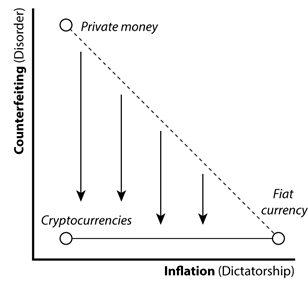
We can explain this with an ‘institutional possibility frontier’; a framework developed first by Harvard economist Andrei Shleifer and his various co-authors. Shleifer and colleagues array social institutions according to how they trade-off the risks of disorder (that is, private fraud and theft) against the risk of dictatorship (that is, government expropriation, oppression, etc.) along the frontier.

As the graph shows, for money these risks are counterfeiting (disorder) and unexpected inflation (dictatorship). The free banking era taught us that private currencies are vulnerable to counterfeiting, but due to competitive market pressure, minimise the risk of inflation.

By contrast, fiat currencies are less susceptible to counterfeiting. Governments are a trusted third party that aggressively prosecutes currency fraud. The tradeoff though is that governments get the power of inflating the currency.

The fact that fiat currencies seem to be widely preferred in the world isn’t only because of fiat currency laws. It’s that citizens seem to be relatively happy with this tradeoff. They would prefer to take the risk of inflation over the risk of counterfeiting.

One reason why this might be the case is because they can both diversify and hedge against the likelihood of inflation by holding assets such as gold, or foreign currency.

The dictatorship costs of fiat currency are apparently not as high as ‘hard money’ theorists imagine.

Introducing cryptocurrencies

Cryptocurrencies significantly change this dynamic.

Cryptocurrencies are a form of private money that substantially, if not entirely, eliminate the risk of counterfeiting. Blockchains underpin cryptocurrency tokens as a secure, decentralised digital asset.

They’re not just an asset to diversify away from inflationary fiat currency, or a hedge to protect against unwanted dictatorship. Cryptocurrencies are a (near — and increasing) substitute for fiat currency.

This means that the disorder costs of private money drop dramatically.

In fact, the counterfeiting risk for mature cryptocurrencies like Bitcoin is currently less than fiat currency. Fiat currency can still be counterfeited. A stable and secure blockchain eliminates the risk of counterfeiting entirely.

So why have fiat at all?

Here we see the rational crypto-expectations revolution. Our question is what does a monetary and payments system look like when we have cryptocurrencies competing against fiat currencies?

And our argument is that it fiat currencies will survive — even thrive! — but the threat of cryptocurrency adoption will make central bankers much, much more responsible and vigilant against inflation.

Recall that governments like fiat currency not only because of the power it gives them over the economy but because they prefer taxes to be remitted in a single denomination.

This is a transactions cost story of fiat currency — it makes interactions between citizens and the government easier if it is done with a trusted government money.

In the rational expectations model of economic behaviour, we map our expectations about the future state of the world from a rational assessment of past and current trends.

Cryptocurrencies will reduce government power over the economy through competitive pressure. To counter this, central bankers and politicians will rail against cryptocurrency. They will love the technology, but hate the cryptocurrency.

Those business models and practices that rely on modest inflation will find themselves struggling. The competitive threat that cryptocurrency imposes on government and rent-seekers will benefit everyone else.

It turns out that Bitcoin maximalists are wrong. Bitcoin won’t take over the world. But we need Bitcoin maximalists to keep on maximalising. The stability of the global macroeconomy may come to rely on the credible threat of a counterfeit-proof private money being rapidly and near-costlessly substituting for fiat money under conditions of high inflation.

A hardness tether

Most discussion about the role of cryptocurrency in the monetary ecology has focused on how cryptocurrencies will interact with fiat. The Holy Grail is to create a cryptocurrency that is pegged to fiat — a so-called stable-coin (such as Tether or MakerDAO).

But our argument is that the evolution of the global monetary system will actually run the other way: the existence of hard (near zero inflation, near zero counterfeit) cryptocurrency will tether any viable fiat currency to its hardness. No viable fiat currency will be able to depart from the cryptocurrency hardness tether without experiencing degradation.

This in effect tethers fiscal policy — and the ability of politicians to engage in deficit spending in the expectation of monetising that debt through an inflation tax — to the hardness of cryptocurrency.

The existence of a viable cryptocurrency exit tethers monetary and fiscal policy to its algorithmic discipline. This may be the most profound macroeconomic effect of cryptocurrency, and it will be almost entirely invisible.

Cryptocurrency is to discretionary public spending what tax havens are to national corporate tax rates.

Cryptodemocracy and its institutional possibilities

Abstract: Democracy is an economic problem of choice constrained by transaction costs and information costs. Society must choose between competing institutional frameworks for the conduct of voting and elections. These decisions over the structure of democracy are constrained by the technologies and institutions available. As a governance technology, blockchain reduces the costs of coordinating information and preferences between dispersed people. Blockchain could be applied to the voting and electoral process to form new institutional possibilities in a cryptodemocracy. This paper analyses the potential of a cryptodemocracy using institutional cryptoeconomics and the Institutional Possibility Frontier (IPF). The central claim is that blockchain lowers the social costs of disorder in the democratic process, mainly by incorporating information about preferences through new structures of democratic decision making. We examine one potential new form of democratic institution, quadratic voting, as an example of a new institutional possibility facilitated by blockchain technology.

Author(s): Darcy W. E. Allen, Chris Berg, Aaron M. Lane, Jason Potts

Journal: Review of Austrian Economics

Year: 2018

DOI: 10.1007/s11138-018-0423-6

Cite: Allen, Darcy W. E., Chris Berg, Aaron M. Lane, and Jason Potts. “Cryptodemocracy and its Institutional Possibilities.” Review of Austrian Economics, 2018.

Continue reading “Cryptodemocracy and its institutional possibilities”

Supply Chains on Blockchains

With Sinclair Davidson and Jason Potts

Blockchain technology is shaping up as one of the most disruptive new technologies of the 21st century, facilitating an entirely new decentralised architecture of economic organization. While still experimental, it is disrupting industry after industry, beginning with money, banking and payments, and now moving through finance, logistics, health, and across the digital economy. These waves of innovation are being driven by both new entrepreneurial startups as well as by industry dominant firms reimagining and rebuilding their business models and services to use blockchain technology. Trade platforms and supply chains are shaping up as the major use case for blockchain technology, and we explain here how this may lead to a second phase of globalisation.

Breakthroughs in the technology of trade can have far-reaching consequences. Sailing ships and steam ships, refrigeration and aircraft were all watersheds in the making of the modern world, but two technologies of trade delivered us the modern era of globalization: these are (1) the shipping container, and (2) the WTO (formerly known as the GATT).

The invention of the shipping container in 1956 led to a revolution in international trade, birthing a new phase of globalisation. Blockchains, invented in 2009, promise a similar revolution. Blockchains offer a fundamental architectural change in the way firms and governments manage international trade, with enormous efficiency and productivity gains.

But, just as the shipping container required significant investment to bear fruit—and came up against the interests of the unions, regulators and ports—blockchain-enabled trade will require substantial upfront investment in new systems and will inevitably challenge existing interests. In the 1950s the shipping container was the solution to the problem of the high expense in money, time, and security to load cargo in and out of ships. Handling costs were high, operations were slow, and theft was rife.

Today the constraints on trade consist of the ever-increasing complexity of the data, records, payments and regulatory permissions that accompany goods as they travel across the world. Every good moving along a supply chain is accompanied by a data trail, often still as paperwork, to track bills of lading, invoices of receipt and payment, origin, ownership and provenance, as well as compliance with vast schedules of trade prohibitions and environmental regulation, taxes and duties.

The shipping container is a physical coordination technology, while the WTO is an institutional coordination technology. At the Blockchain Innovation Hub we believe that blockchain technology – as tradetech – is shaping up as the third great technology of trade.

The Cost of Information and Trust

Blockchain technology can solve a major and growing problem with the global trading order – namely the problem of information. Every time a good or service moves, information moves with it. The quantity of information associated with each product continues to grow, and the costs of dealing with this information, from compliance, auditing, verification – trust, in a word – is becoming a greater and greater share of the costs of the global trading system.

This information includes provenance and inputs – the information on a label. It includes trade-finance, bills of lading, shipping and handling information, security clearance – the commercial and administrative information. It includes the documentation of where it’s been and where it’s going, and who has handled it and who hasn’t. And it includes all the information that each country requires in relation to customs and duties, biosecurity, labour and environmental regulations, compliance with various treaties – a vast rigmarole of auditing and compliance, each of which is necessary, desirable and costly. With each day, the information burden increases, not decreases.

As the information cost of trade increases, it is not simply enough to digitize everything, because the real problem is that we need to be able to trust the information that is there.

Tradetech

Globalisation 2.0 will be built on tradetech, and the crucial infrastructural component of tradetech is blockchain. Blockchain technology, which is a distributed, append-only, peer-to-peer, trustless secure ledger, is almost custom-made for trade-tech. It provides an infrastructural platform upon which to build a new information architecture for globally tradable goods – and to do so in a way that is fully digital, tamper-proof, low-cost, end-to-end secure, verifiable, transparent, scalable and computable. What cryptocurrencies did for money tradetech will do for globalization.

Tradetech will integrate the benefits of fintech into trade networks. Crypto-based models of payments, trade finance, insurance and other risk management tools will be automated. Tradetech will integrate the benefits of regtech into trade networks. Verification and compliance with local regulations will be automated. Tradetech will power-up logistics technologies with blockchain affordances such as smart contracts, decentralized autonomous organisations (DAOs), and the full technology stack that includes AI integration.

So we think of blockchain as a next-generation infrastructural technology for the global movement of goods and services. Service exports have the same constraints with respect to compliance with certification, credential verification, and quality standards assurance. These same problems apply generally to the movement of people too. We are still yet to weave together a seamless global system of identity documents, education and trade certification and permissions, and taxation and other public liabilities.

Example: Benefits for Australia

Tradetech facilitated supply chains could to bring significant advantages to Australia, and her trading partners. This is win-win because there are both consumers and producers on each side.

For Australian exporters, there are at least two obvious advances. Tradetech facilitated Australian Agriculture will significantly boost the quality of provenance claims as to origin and quality of product. When this transparent verifiable information passes at much lower cost to final consumers, more of that assurance value passes back to suppliers, boosting primary producer income.

We are starting to see this already with start-ups in the primary export industry, for instance with Beef-ledger, Agridigital and Grainchain. We will also likely see the benefits of similar assurance in advanced manufacturing, such as in aerospace, medical devices, pharma and other high value bespoke manufacturing where quality is paramount and certification is costly. Or in other areas that rely heavily on intellectual property, such as creative industries.

Blockchain based tradetech will benefit producers and consumers by lowering the cost of providing and processing high value information that rewards legitimate quality production and minimizes
rent-extraction along the way.

Crypto Free Trade Zones

Blockchain-based next-generation trade infrastructure opens the prospect of a next generation of crypto free trade zones. These may overlay existing trade zones – within bilateral or multi-lateral zones – with a standard protocol for information handling. This would lower the transactions costs of trade, which economic theory predicts would increase the quantity of trade, and therefore value creation.

But blockchain trade areas could also build on private supply chains and infrastructure, as with consortia such as the IBM-Maersk-Walmart alliance, or with the recently announced adoption by FedEx of blockchain technology. This is the difference between say email (an open standard) and Facebook (a proprietary model). The strength of the closed network model is that it incentivizes investment. But it creates power, and invariably requires regulation to constrain that power. And regulation in turn stifles innovation.

We need to start thinking about how we want free trade to evolve in the blockchain era. Global open standards should be our ambition, because this brings the maximum prospect for growth and innovation. But open standard protocols are challenging to get started, because it can stumble on a coordination problem at the outset. This is why in order to build the next generation of globalization on blockchain infrastructure we will need to solve the open standards coordination problem.

The Classical Liberal Case for Privacy in a World of Surveillance and Technological Change

Palgrave Macmillan, 2018

How should a free society protect privacy? Dramatic changes in national security law and surveillance, as well as technological changes from social media to smart cities mean that our ideas about privacy and its protection are being challenged like never before. In this interdisciplinary book, Chris Berg explores what classical liberal approaches to privacy can bring to current debates about surveillance, encryption and new financial technologies. Ultimately, he argues that the principles of classical liberalism – the rule of law, individual rights, property and entrepreneurial evolution – can help extend as well as critique contemporary philosophical theories of privacy.

Available from Palgrave Macmillan.

The ABC, ‘Independent’ to a Fault

With Sinclair Davidson

It is appalling that a sitting government should have to complain that the ABC is repeating Labor lies as facts. The ABC itself should be ashamed to have received such a complaint. Yet that is precisely why the Labor Party supported the establishment of the ABC – to provide a forum for pro-ALP news and opinion. This points to questioning the precise meaning of what is meant by the ABC being “independent”.

The Charter describes the ABC as an “independent national broadcasting service”, and it is that independence which forms many arguments in favour of public broadcasting. But this notion of independence needs deeper examination. The ABC is a state-owned broadcaster, which is dependent on triennial funding arrangements drawn from the Commonwealth budget, which is set by the political discretion of the government of the day.

ABC supporters refer to the ABC’s independence in two senses. First, it has editorial independence from the government, insofar as it is a statutory agency that is self-managing and separated from the normal chains of political accountability. Second, it is independent of the interests of advertisers and private sector media moguls, providing the “independent information” that the commercial media might not.

Public broadcasting has always been defined against the evils of private broadcasting, and the theme of an independent bulwark against the commercial media (the moguls and monopolists) has been integral right from the start. In the early years it was claimed that a purely private media market would be simultaneously disorderly and monopolistic. In the debate over the 1932 bill, the Labor member for Kalgoorlie, Albert Green, warned of the “chains of newspapers … obtaining such a stranglehold over the eastern part of the Victoria, and disseminating its propaganda through the stations that it controls”. The private monopolisation of radio – “one of the most revolutionary additions to the pool of human resources” – was constantly invoked by Labor members throughout the early debates. This concern, they felt, was more than just theoretical. The 1931 election loss showed, they felt, that the private media was systematically biased against the Labor Party, and a public broadcaster would be able to right that wrong.

Control of the wireless was the high ground of the political contest. In New South Wales a few years earlier the Lang government had sought to establish a state government radio that would resist what Labor saw as the Nationalist Party-dominated private media. As Albert Green, the most forthright of the Labor members on this point in the 1932 debate, put it:

Some B class stations are controlled by newspaper combines, which use them to broadcast only one political opinion. I had hoped that the air would be free to all, and that at election time every party would be given an opportunity to express its opinions over the air. Unfortunately that has not been our experience. Certain newspaper combines are endeavouring to obtain a monopoly of B class stations, and I sound the note of warning that sooner or later some government will have to tackle the very difficult, but necessary task of dealing with the problem of metropolitan B class stations. Nothing short of a complete national scheme will do.

In this sense, independence was understood by the Labor Party as being pro-Labor – or, at least, not anti-Labor. The 1942 inquiry into wireless reiterated this concern, arguing that public broadcasting was needed “to prevent the service from being used for improper purposes”.

Similar concerns drove the introduction of television. The overwrought claims about the social and psychological power of television only intensified the concerns about the new technology’s political importance. The public position of the Labor Party and the ACTU emphasised the cultural good that public broadcasting television could bring, rather than its role countering political bias. But there is no doubt that politics was front of mind when the labour movement considered the significance of television.

A public disagreement between Arthur Calwell and H.V. Evatt as to whether Labor would nationalise the commercial television stations if they were returned to government pivoted on their different impressions of how sympathetic the ABC was to the Labor Party. Calwell, who had been Minister for Information during the Second World War, had a hostile relationship to the commercial press. He believed that Keith Murdoch, who controlled the Melbourne Herald and several other papers across the country, was “a fifth columnist”, “megalomanic”, and his network of papers “a law unto itself” and “Public Enemy No. 1 of the liberties of the Australian people”. Murdoch’s pernicious influence could not be let onto television. Evatt felt that if the hybrid system was maintained, at least the Labor Party would be able to buy a commercial station to air its views. For its part, the conservative parties were just as aware of the political significance of television, arguing in response to the Chifley government’s proposal to establish a monopoly broadcaster that Labor was “merely another milestone on the socialised road to serfdom”.

The modern ABC’s independence is often declared but in practice is hard to pin down. Unlike the BBC, the ABC was not established under a royal charter, and the 1948 move away from licence fees to funding through budget appropriations brought it more into the political window.

Yet how independent could the ABC be? Compared to private and non-government organisations, the fortune of any state authority is going to be closely tied to the government of the day. Public broadcasters have their budgets set by the same governments which they purport to keep a check on. Commercial broadcasters might be dependent on the goodwill of advertisers, but the fact that there are many potential advertisers is a protection against excessive advertiser influence. A public broadcaster has only one funder, and it is a funder whose interests are driven by political rather than commercial incentives.

Nor are commercial broadcasters required to constantly justify their activities to professional politicians. Public broadcasters are regularly brought in front of parliamentary committees to answer for editorial decisions, from the trivial to the significant. The Senate estimates committee procedure requires statutory agencies to present themselves in front of a committee of Senators three times a year. At her first Senate estimates hearing in May 2016, Michelle Guthrie was interrogated about the cancellation of livestock market reports on ABC regional stations, the ABC Fact Check program, how unionised the ABC’s workforce was, whether the ABC was too Sydney-centric, how many people it sent to the Cannes film festival and how long they were out of the office, and how much the ABC spent on a custom typeface to use across its brands. This sort of scrutiny is, of course, entirely appropriate for a state instrumentality. But the notion that independence is the ABC’s unique value as a media outlet is difficult to sustain.

It is not obvious that independence from a democratically elected government is desirable. The ABC is a state-owned organisation, and like any state-owned organisation it derives its legitimacy from its relationship to the democratic expression of voter preferences. Public broadcasters join a large number of other regulatory and bureaucratic agencies that have been deliberately separated from the normal lines of democratic accountability: rather than being the “arm of the minister”, in the classical Westminster bureaucracy formulation, they are protected from political interference and given independence. In an open market, private media organisations are subordinate to consumers and advertisers. In government, politicians and bureaucracies are subordinate to voters. Independent statutory agencies are, by intention, subordinate to neither. Even at their most benign, they are highly susceptible to capture by their employees and management.

Indeed, staff capture has been a longstanding concern of critics of public broadcasters. As Michael Warby writes, “‘Independence’ from government interference … comes to mean effective independence from whatever tenuous public controls over the ABC exist in practice—it amounts to independence from the direct legal owner”. One of the consequences of staff capture, of course, is political bias. The historical context shows that this political slant is a deliberate feature of public broadcasting, not a bug.