
Unelected Officials Are Stifling Our Democratic Freedoms

Finally there’s a serious conversation happening about the Australian Parliament’s scorn for democratic accountability and the rule of law.

It was always going to be a bit controversial to propose absolute ministerial discretion to strip citizenship from dual nationals on the 800th anniversary of Magna Carta, that great symbol against arbitrary power.

But we’ve had a rule of law problem for a very long time in Australia. Long before the Islamic State. Long before al-Qaeda. And that problem has gone largely unnoticed – whether due to a lack of awareness or a lack of interest – by those groups now furious about the Abbott government’s national security policies.

Let’s start with the most basic rule of law principle: that we all deserve legal protections when accused of an offence, whether that offence is terrorism or traffic violation.

Last year the Institute of Public Affairs conducted an audit of all Commonwealth legislation and found 262 provisions of federal law that violated fundamental legal rights. These either removed the right to silence, removed the privilege against self-incrimination, reversed the burden of proof, or did away with “natural justice” – the suite of rights like the right to a trial, to appeal judgments or to know what we are charged with.

These violations aren’t just found in the sorts of laws that the human rights community was talking about this week – anti-terror and immigration laws. They’re found in economic laws like the Australian Competition and Consumer Act 2010 (that regulates mergers and consumer protection) or the Navigation Act 2012 (which regulates shipping) or the Broadcasting Services Act 1992 (which regulates broadcast media). The Fair Work Act violates all four legal rights.

In other words, they’re targeted at people in business, not just people in terrorist organisations. The Tax Administration Act has nearly as many violations of the right to natural justice as the Migration Act does.

Shortly after the 2013 election, the new attorney-general George Brandis directed the Australian Law Reform Commission to look at laws which limit traditional rights and liberties with a particular focus on workplace, commercial and environmental law.

You’d have thought such an investigation would have been well covered already by the Australian Human Rights Commission. But the commission, along with Australia’s human rights community more generally, have utterly neglected limits on personal freedom when they are bundled up with limits on our freedom to trade, truck and barter.

In a recent speech, the commission’s head Gillian Triggs pointed to all the post-September 11 laws which limit rights in the name of anti-terrorism. What about those which limit rights in the name of market failure?

It’s only economists and the occasional corporate lawyer that have been talking about, for instance, the draconian powers of the Australian Securities and Investments Commission.

Of course, rule of law is about more than personal legal protections. It describes the principle that administrative decisions should be made by elected officials and according to due process.

Parliament should write the laws and control the purse strings. Many of these principles can be traced back to Magna Carta. These principles have come under sustained assault in recent decades.

The prospect of ministerial discretion to strip citizenship without judicial review is just a tiny window into a much deeper problem.

For instance, Australian governments have vested more and more decision-making power outside Parliament and into “independent” bureaucratic agencies. These undemocratic, unelected officials have enough discretionary power to effectively make government policy.

Just last month the Tax Commissioner was granted the power to change tax law if he felt doing so would be in the interest of taxpayers. But it is Parliament’s job to make and amend the law of the land, not the bureaucracy’s. Other regulatory agencies have similar powers.

In many ways Australia is not a liberal democratic state, but a democratic-administrative state, where power is shared between elected representatives and a permanent network of independent bureaucracies who are only loosely answerable to Parliament, let alone voters. Some of the basic institutions of our government are undemocratic.

Gillian Triggs was right to say our democratic freedoms are under threat. Still, did she see any irony in the fact that the democratically elected Abbott government obviously wants to fire her but – since she commands an independent statutory agency – it cannot?

In 2012 Parliament passed a bill giving the government blanket authorisation to spend money on basically anything it wanted without having to ask Parliament’s permission first. The bill was rushed through with bipartisan support following the school chaplains case in the High Court. It was barely noticed by the press. Yet it was one of the most complete surrenders of parliamentary responsibility in the last half century.

There are serious problems with the Abbott government’s citizenship-stripping proposal. Coalition members might be happy with Peter Dutton holding such power. But all governments are temporary. Will they be just as happy when the next Labor immigration minister is able to wield the same powers?

This is the thing about the rule of law. Just as it protects good people and bad ones, it constrains good governments and bad governments alike. To abandon the rule of law is not just to abandon those protections, but to erode democracy itself.

The TPP Isn’t The Bogey-Treaty That We Think It Is

The debate about the Trans-Pacific Partnership (TPP) has gotten far, far ahead of itself.

On Friday morning, the US House of Representatives voted down the Trade Promotion Authority (TPA), a legislative agreement between Congress and the president that would effectively delegate trade negotiation authority to the latter.

The idea was to help “fast track” the TPP negotiation. The president’s authority could quickly be yanked back if Congress decided he was exceeding his mandate. Either way, the whole agreement or each individual parts would have to be voted on by Congress after the diplomacy was over.

In trade policy, acronyms build up very quickly. The TPA isn’t the TPP. But everyone knows without the TPA an American president is unlikely to get any final TPP through Congress. So it’s been used by American opponents as a proxy for the broader agreement.

The US union movement thinks “fast track trade deals” lead to “fewer jobs, lower wages, and declining middle class”. In Australia, GetUp! describes the TPP as “the dirtiest deal you’ve never heard of”.

This sort of hyperbole is likely to derail the TPP (if it hasn’t already been derailed by the US Congress) with very real and damaging consequences for the global economy and anti-poverty efforts in the developing world.

Because the potential benefits from a regional free trade deal are enormous. Analysis by the US-based Peterson Institute for International Economics finds that there are potential economic gains from the TPP in the order of US$1.9 trillion. A further analysis argues that by far the biggest winner out of the TPP would be Vietnam – that is, a poor, developing economy.

Now, there’s a standard caveat when we talk about bilateral or multilateral trade agreements. The benefits of free trade accrue to countries that liberalise their own trade barriers. This means unilateral liberalisation is best. But as I argued in The Drum last November, there are strong political reasons to welcome multi-country agreements, insofar as they create the political conditions often necessary for domestic reform.

There’s another caveat specific to the TPP. Right now, the TPP is highly secretive. A lot of the detail that we know about the TPP we know through WikiLeaks. Legislators who want to take a look at the negotiating text have to sign a rather absurd confidentiality agreement.

This secrecy is excessive and is damaging the free trade cause.

But trade negotiations are usually held privately between the upper levels of foreign governments. Diplomacy is about compromise, and the process of compromise is easier when kept off newspaper front pages.

The TPP negotiations are not much more secret than any other legislative agenda prepared by a bureaucratic department “secretly” before being introduced into the legislature.

The second stickler with the TPP is intellectual property. I find it hard to get agitated about what might possibly be in the final version of the TPP regarding intellectual property, given what the Australian Government is proposing to do in the copyright space right now.

With or without a TPP, advocates of increased patent terms or copyright penalties need to demonstrate these measures would inspire new innovations or creative works.

Still, it would be lot better – and the negotiation process a lot smoother – if intellectual property was not in the TPP. Copyright harmonisation is not going to boost economic growth. Copyright harmonisation is not going to do anything for poor people in Vietnam.

The devil of these multilateral trade agreements is that they rest on dozens of quid pro quos.

So the questions we may have to face if the TPP is finally concluded are not easy ones to answer. For instance, would we accept longer copyright terms in Australia if it meant other countries lower tariffs, which, in turn, would boost the incomes of poor Vietnamese clothing manufacturers? Maybe. Maybe not.

Figuring out whether the trade-offs in a huge deal like the TPP are worth it is only possible once the negotiations are finished and the document as a whole is up for public scrutiny.

If the US Congress has already killed the TPP by voting down the TPA, that chance may never come. The TPP will remain a secret bogey-treaty, on which special interests can project their deepest, wildest fears.

But if agreement can be found, there’s a lesson there too. The Australian public should not accept the argument made after the Australia-United States free trade agreement was signed a decade ago – that the enabling domestic legislation had to be passed because its terms had already been agreed to at the international level.

Because, ultimately, it is Parliament that decides what is in the best interest of the people of Australia, not our trade negotiators.

Magna Carta: Archaic Tax Document And Icon Of Liberty

The Magna Carta turns 800 years old next week.

The document has become an icon of liberty, variously credited with establishing everything from parliament to the rule of law. It is such a fixture of popular political thought that it is still rhetorically powerful eight centuries later. The Abbott Government’s proposed citizenship law changes have been widely condemned as a violation of its principles.

This is strange for something so archaic. The Magna Carta consists of about 3000 words of 13th century legalese about inheritance, feudal payments, land tenure and customary rights, in Latin, reflecting the economic and political concerns of a world distant from our own.

There’s one simple reason that the Magna Carta became the document of individual rights and a check against power that it is today.

If you want to understand the Magna Carta, you need to understand that it is about tax.

Most commentary on the document is written by lawyers looking for the origins of the English common law and rights like habeas corpus. This means delving through the complexities of medieval land law and legal systems.

Yet the vast majority of the provisions of the Magna Carta are specifically designed to limit how much tax the king can take from his subjects. As the historian David Carpenter writes, the document was “above all about money.”

If our liberties can be traced back to the Magna Carta, then it is in resistance to tax that they were forged.

By 1215, King John had spent 10 years soaking England for as much revenue as he could in order to reclaim his family’s European possessions.

John’s royal family had presided over an empire that stretched from Ireland to the French-Spanish border. But John had lost much of the continental empire shortly after taking the throne in 1199. John needed money to build an army to recapture his patrimony.

He levied feudal dues far beyond what Englanders were used to, ramped up customary legal charges, sold privileges and otherwise grabbed opportunistically at the wealth of the kingdom. Some historians have described John’s fiscal approach as “asset stripping” England.

John eventually invaded Europe in 1214. But he lost. This defeat sparked a civil war in England. The barons, a tiny, extremely rich sliver of the population, were sick of paying for John’s futile foreign adventurism.

The Magna Carta was supposed to be a peace treaty between the king and the barons. Hence, the shopping list of provisions that constrained the king’s revenue collection.

But it is one thing to write rules about what government may lawfully do; it is quite another to enforce them.

The Magna Carta did not invent parliament. Parliament-like bodies appeared in England several centuries earlier. But the Magna Carta gave parliament its purpose – and its leverage over the monarchy. One provision stated that feudal charges could only be imposed “except by the common counsel of our realm”. This rapidly became a political norm whereby the parliament had to approve any requests for new tax.

For centuries the English parliament used the threat – sometimes implicit, sometimes explicit – of withholding funds to carve out more power against the monarch.

Over time this evolved into a basic assertion of political equality. The cry of “no taxation without representation” was used by the American revolutionaries and the 20th century suffragettes alike.

Now, the tax revolt that led to the Magna Carta was a revolt of elites, not the general population. And in many ways what the barons won in 1215 enhanced their position in comparison to everybody else.

Obviously, the mere existence of parliament is no guarantee of liberty. A rebellion in 1381, the Peasant’s Revolt, was sparked by parliament’s predatory introduction of a poll tax. The elites that controlled parliament were happy to impose repressive taxes on those below them.

There was no Magna Carta after the Peasant’s Revolt. The rebels were massacred. Yet it wasn’t until 1989 that an English government attempted to introduce a poll tax again, and that time it led directly to Margaret Thatcher’s downfall.

There’s a tradition of history, derided as ‘Whig history’, in which the past is studied firmly with an eye on the present. In this tradition, the practice of history consists primarily of identifying the origins of contemporary practices and institutions, skipping over what makes the past alien and different – the historical dead ends and forgotten beliefs.

The Magna Carta holds a preeminent place in Whig histories as the source of English freedom. And not wrongly, either. Because those obscure Latin clauses became, in the hands of propagandists and revolutionaries decades and centuries after June 1215, a document symbolising general limits on royal power.

Anachronistic misunderstandings of the Magna Carta were themselves a force for liberal progress.

So to celebrate the Magna Carta is to celebrate 800 years of its history, not the specific rules it imposed about, for instance, the receipts of an estate’s earnings while it was held in wardship.

It is to celebrate how this strange, failed peace treaty established a permanent relationship between tax resistance and political freedom in the English-speaking world.

Things Get Messy When Popularity Trumps Policy

Hard to believe it, but the 2015 budget was delivered just three weeks ago.

Already the Abbott Government seems eager to move on.

Last week Tony Abbott announced the creation of a terror tsar, a new minister for counterterrorism, and a policy to strip Australian citizenship from dual nationals suspected of terrorist activities.

National security is important. And the Government has been telegraphing the citizenship changes for months. But the question is: why now? Why so soon?

The budget was delivered on Tuesday, May 12. National security week was launched on Monday, May 25. That’s 13 days. Really just 12, if you factor in the budget lockup and newspaper print deadlines.

This quick hop from economics to security is indicative of a broader problem with the Abbott Government’s populist push. It knows it doesn’t want to be unpopular. But it’s not sure what it wants to be popular about.

The 2015 budget is nothing like the political catastrophe that the 2014 budget was. If anything it has been well received. Everybody likes the accelerated depreciation changes for small business. The fiscal reckoning has been postponed, and nobody but sticklers, obsessives and economists could object to that.

So Labor has struggled to gain traction against the budget. That “fairness” thing, so potent last year, looks a bit sad when thrown at a budget specifically designed to avoid such attacks. It’s been widely observed that Abbott is doing better in part because Shorten looks played out.

National security week didn’t last long. The process was derailed by Joe Hockey’s Monday night Q&A blurt that he was open to exempting tampons from the GST, Bill Shorten’s announcement that he was going to introduce a gay marriage bill on Tuesday night, then the publication of incredibly detailed leaks out of cabinet about the citizenship stripping proposal.

Whatever momentum national security was to provide the Government was well and truly stalled by mid-week.

The Government has haplessly tried to put the gay marriage issue back in the box by saying that it is focused on getting the budget through Parliament. Marriage can wait. There are small business tax concessions to be passed. Yet this argument would be more convincing if the Government hadn’t already moved its attention from the budget to national security.

It’s very messy.

One of the conceits that the political class have is that they can host “public conversations” about the issues that matter to them; that the tone and topic of debate in the public sphere can be directed by the Prime Minister’s Office.

Sometimes this does work, admittedly. Hockey did manage to genuinely spark a discussion about tax earlier this year with the release of the tax discussion paper. The discussion took a turn the Government was not necessarily pleased about. Every special interest group used the space to air their proposals for new taxes. Still, at least everybody was on-topic. More often the public isn’t interested in talking about what PMO is.

Very quickly the national security issue became less about the threat of terror and more about divisions within cabinet and shadows of the leadership question. The imminent legalisation of gay marriage had more public “cut through” than the creation of a terror tsar. Perhaps even more than it would have, had the Government been less reluctant to talk about Shorten’s proposal. Nothing is more interesting than division in the ranks.

Now the Government wants to have a “national conversation” about the meaning of citizenship in an age of terror. This does not promise to be a particularly enlightening conversation. Nor a fruitful one, as it looks to simply expose the wavering support within the Government and its backbench for the rule of law.

Last week wasn’t just a case study in how policy debate can go off the rails, but a more significant indication of the long term importance of the 2015 budget.

Budgets usually loom large in the Australian political calendar, but the 2014 budget was a vortex sucking in everything around it. This year’s budget is a bit of a return to form. Parliament and the public are much calmer.

Yet a forgettable budget is hardly what the times demand.

The Australian Bureau of Statistics reported that capital investment in Australia fell in the March quarter by the largest amount since the Global Financial Crisis.

If this is a harbinger of things to come, Tony’s Tradies are going to need more than accelerated depreciation to ride out the storm.

Political historians will remember the 2014 budget for the heartache it gave the Government. But economic historians will remember this year’s budget for having reconciled the country to decades of debt and deficit.

Abbott’s eagerness to move on from economics to security is unfortunately more revealing about the future direction of this Government than anything his Treasurer released last month.

Magna Carta: The tax revolt that gave us liberty

With John Roskam, Institute of Public Affairs, 2015

‘Our liberty, democracy, and human rights are all in some way related to what was inscribed on parchment at Runnymede in June 1215’

The Magna Carta is a founding document of individual liberty, rule of law, and parliamentary democracy. In this accessible and engaging book, Chris Berg and John Roskam explain what the Magna Carta is, where it came from, and why it matters.

The barons demanded of King John nothing less than a wholesale revolution of government. The Magna Carta establish the fundamental link between tax and consent.

Eight centuries later, understanding how our liberties came from a revolt against oppressive taxation has never been more important.

Available from the Institute of Public Affairs and Amazon.com

Submission to Treasury consultation into exposure draft of Tax Laws Amendment (Tax Integrity Multinational Anti-avoidance Law) Bill 2015

With Sinclair Davidson

Introduction: The Tax Laws Amendment (Tax Integrity Multinational Anti-avoidance Law) Bill 2015 exposure draft represents an important and concerning watershed in the practice of Australian corporate tax governance.

The draft bill would base the assessment of Australian tax liabilities on an assessment of tax rules in other countries. It undermines global tax agreements to which Australia is a part that have developed to prevent double taxation, risking the phenomenon that those agreements were designed to avoid. It offers a disincentive for the world’s biggest firms from establishing operations in Australia. It mischaracterises readily understandable business decisions as tax avoidance and penalises firms for normal corporate structural practices.

The scope of this legislation amounts to a substantial, yet entirely unpredictable, increase in corporate tax, and an attendant increase in the regulatory burden faced by large firms operating in Australia. We dispute the claim that this is a “tax integrity” measure. It is very much a tax increase.

Available in PDF here.

A Welcome Mutiny Against Protectionism

It’s sometimes thought that the economic disputes that characterised the 1970s and ’80s are finished. The debate over protectionism, for instance, has been displaced by more modern debates over inequality and the environment.

Two issues raised by the Government in the last week show how untrue that is.

On Wednesday, Warren Truss outlined the Government’s plan to deregulate Australia’s coastal shipping industry, and yesterday the Australian Financial Review reported the Government was considering opening up domestic air routes in the north to foreign airlines.

I was critical of the Government last week for being reform-shy, but these proposals are very, very good.

Both coastal shipping and airlines are governed by cabotage rights – a peculiar 19th century term that refers to the right to transport passengers and goods between two points within a single country.

The issue here is whether foreign-registered or owned or crewed ships and planes have cabotage rights. For instance, can British Airways fly domestic routes in Australia? Under Australian law, only in emergencies. Are Chinese registered vessels allowed to ship goods between Brisbane and Sydney? Under highly regulated conditions designed to dissuade them from doing so.

Australia’s cabotage restrictions are protectionism by another name. They are restrictions on what economic activity foreign firms can conduct in Australia. And, as with any protectionist policy that limits competitive pressure, they raise costs to consumers and hinder economic growth.

Let’s start with coastal shipping.

Over the last few decades, the number of Australian registered ships used in coastal shipping has been in a dramatic decline. In 1996 there were 75 Australian registered ships in the coastal trade. Truss told a conference last week that number was now just 15. This is mostly due to the heavy burden of Australian industrial relations laws that apply to maritime workers on Australian vessels.

In 2008 a parliamentary committee declared the industry was in “crisis” and “many in the Australian maritime industry (believe) Australia would benefit from a revived and expanded coastal shipping sector”. One of those voices, of course, was the Maritime Union of Australia, whose members were losing out from the decline of Australian coastal ships.

So in 2012 the Gillard government passed a large package of reforms to the shipping industry that dramatically increased restrictions on what foreign vessels and foreign-crewed vessels could do in Australian waters.

Anthony Albanese, then infrastructure minister, made plain the protectionist purpose of the reforms: “Australian vessels paying Australian wages and providing jobs to Australians will be given preference to carry Australian goods on the Australian coast.”

As the former Productivity Commission head, Gary Banks, pointed out at the time, the government admitted these reforms were “strictly inconsistent” with the principles of competition policy that have driven economic liberalisation for the last few decades.

It’s worth recalling that those competition policies were originally established by Paul Keating’s Labor government. Labor now is, of course, opposed to any deregulation. For once that old commentary canard about the modern Labor Party having “betrayed the Hawke-Keating legacy” actually holds true.

Like shipping, aviation has avoided the comprehensive liberalisations of the last few decades. Not many travellers pause to question why domestic air consists almost entirely of Qantas and Virgin. Australia is a rich country. Surely some foreign airlines might want a piece of the busy Melbourne-Sydney corridor?

The Government’s proposal to allow foreign airlines to fly domestic routes is limited to northern Australia. It’s being sold as a “develop the north” strategy. But these sort of region-specific liberalisations are usually meant to be experimental tests for nation-wide reform. If airline deregulation works in the north – if it provides better, cheaper services – then there will be little reason not to roll it out across the country.

Liberalisation is always accompanied by the bleatings of those whose privileges are being taken away. “Qantas and Virgin are fighting a rearguard action behind the scenes” against the proposal, one report said yesterday. More publicly, Albanese complains deregulation would be “unilateral economic disarmament”.

It’s true that granting cabotage rights to foreign airlines is very rare around the world. But so what? Australia used to be a leader in market-oriented reform. A northern experiment would be good to prove these fears are nonsense.

In a sense these proposed Abbott Government reforms feel like the calm before the storm. This is cabotage liberalisation by choice before cabotage liberalisation becomes a necessity.

We are on the brink of an unpredictable yet certain revolutionary change in transport technology. Just as autonomous cars will challenge regulatory frameworks that assume every car has a driver, autonomous ships and autonomous planes will completely change the regulatory – and political – dynamic of these industries.

It sounds all a bit cringingly futurist but the pilotless ships are already seen by Australian unions as a threat to cabotage protectionism. No labour costs means pilotless ships can travel slower, thereby using less fuel. This is good for cheap shipping and the environment.

Likewise, when pilotless commercial aircraft become accepted, the old alliance between air services unions and airlines that underpins Labor’s opposition to deregulation is going to break down.

When this technological revolution occurs, limits on foreign firms operating in Australia are going to look like the 20th century anachronisms that they are.

An analogue budget meets the digital world

Budgets are a matter of light and shade. You have to get the balance right. And so having spent the weekend talking about its wonderful childcare plans, yesterday the Government paraded Treasurer Joe Hockey in front of cameras toformally announce some of the budget’s so-called “tax integrity measures”.

Yes, tax integrity measures. Treasury’s spinners would have worked hard on that little catchphrase. Funny how measures to strengthen the integrity of a tax system always seem to deliver more tax to the government.

First, the Government plans to adjust anti-avoidance laws to crack down on multinationals shifting their profits to lower taxing jurisdictions. Second, the Government is going to introduce a Netflix tax – that is, try to impose the GST on digital downloads like books, music, videos and so on.

These two are linked, and in an important way that perhaps even Hockey does not realise. Analogue tax system, meet digital world.

Let’s start with profit shifting. I’ve tackled the claims that multinationals are evading taxation by shifting their profits across borders on The Drum before. Long story short: it’s a beat up. But the Government wants a budget that sounds fair and nothing sounds fairer than beating up on big companies. The corporate tax is a diffuse and confusing tax. It’s designed that way.

We are told Australian Taxation Officers have been “embedded” in 30 different multinational companies. We’re not told which companies. And at the press conference yesterday the treasurer didn’t want to tell us how much revenue the new anti-avoidance measures might raise. “It’s billions of dollars, obviously.”

This should be a red flag. It’s true that Treasury doesn’t have a good track record for estimating how much money new taxes will raise – recall the embarrassingly low take from the mining tax. But this looks less like prudence and more like a lack of confidence. Running a media or political campaign against corporate tax avoidance is easy. Trying to reverse engineer the tax accounting of the world’s biggest firms is hard.

The Government’s crackdown has a certain Sisyphean quality. In a world where much value is tied up in intangible intellectual property, it is borderline nonsensical for politicians to command that economic activity occurs in this jurisdiction or that jurisdiction.

It used to be the case that big firms had capital assets you could see and touch. Factories, vehicles, equipment, land. What mattered to firms were things like location, infrastructure, access to markets, the price and skills of the labour force and so on. But now the assets of the biggest firms can be placed anywhere in the world instantaneously. So they tend to be clustered in low tax jurisdictions with established and reliable legal systems. Like Ireland and Singapore.

What isn’t obvious is why this is a bad thing. Yes, higher tax countries like Australia would prefer that firms book their intellectual property here so Treasury could skim some cash off the top. But treating big firms to a publicity focused “crackdown” only harms what we should be trying to improve: the Australian investment environment. Firms should want to put their assets here. Implicitly, the Government’s profit shifting claims suggest they do not.

There is almost exactly the same issue with the Netflix tax. Once again, the Government is trying to shoehorn a national tax better suited for an analogue era into the age of digital globalisation.

“It is plainly unfair that a supplier of digital products into Australia is not charging the GST whilst someone locally has to charge the GST,” Hockey said at the press conference on Monday.

But why? The GST is a tax that the Australian government has chosen to place on Australian businesses. If there is an unfairness here it is an unfairness imposed by the government when it chose to introduce the GST. It is not “unfair” that other countries do not charge the Australian GST.

When we import goods from other countries – real or intangible – they are priced free of the burden of the many taxes and regulatory costs imposed by the Australian government. This does not make international trade unfair. In fact, all those institutional, regulatory and geographic differences between different trading partners are why international trade is so beneficial.

And – as with the profit shifting debate – the Government’s rhetoric is running far ahead of its capabilities. It is absolute fantasy that Hockey and the Australian Treasury will be able to impose our taxes on international digital goods providers in any meaningful way.

Yes, they might be able to convince a few of the big firms to play ball. But many already are playing ball. Apple, for instance, already charges GST. Those online firms with no Australian base and few Australian interests are unlikely to sign up to this new impost. What’s the Government going to do? Censor them?

It was reported last week that the Abbott Government has scotched many of the tax increases on the table in order to free itself to attack Bill Shorten for wanting to increase tax. That’s good, as far as it goes.

But it would be better if they opposed tax increases because they find increasing tax inherently objectionable.

Ultimately, the tax “integrity measures” announced yesterday have to be seen in the context of a Government that thinks the only viable way back to surplus is more revenue.

Is The Looming Internet Filter Justified? Not Yet

Is intellectual property “property”? Kinda. Sorta. Not really.

That question might seem a bit abstract, on par with how-many-angels-can-fit-on-the-head-of-a-pin. But it matters. Because how Parliament sees the fundamental nature of one form of intellectual property – copyright – is almost certainly going to determine whether we are subjected to a new internet filter.

A bill now before Parliament, the Copyright Amendment (Online Infringement) Bill 2015, would give courts power to require internet providers block access to foreign websites whose dominant purpose is to facilitate copyright infringement.

In practice this means that Time Warner, which owns the copyright to Game of Thrones, could go to a judge and demand Telstra or iiNet block access to the Pirate Bay.

There are lots of problems with this bill. Its language is absurdly vague and broad. What counts as “facilitating” copyright infringement? Maybe it would block sites that offer virtual private networks, perhaps – those VPNs that Malcolm Turnbull has been encouraging us all to use.

But these are legislative technicalities. More importantly, blocking websites is censorship. The bill is an internet filter, no matter how stridently the Abbott Government rejects the comparison.

Supporters of the bill argue that technicalities and censorship aside, the real issue is that property is being stolen, and the Government – whose job it is to protect property – needs to act. After all, private property is a human right as much as free speech is. (Check out Article 17 of the Universal Declaration of Human Rights.)

It is true that intellectual property shares some of the characteristics of property. Like tangible property, intellectual property can be owned. It can be traded. So it’s property in those senses.

But, unlike tangible property, the use of intellectual property is not exclusive. When one person listens to a song or watches a movie they do not prevent others from doing so. It can’t be “stolen” in anything but a metaphorical sense.

This is why the law hasn’t treated intellectual property like real property. We don’t have a moral right to perpetual ownership and unimpeded exclusive control over the songs we write or movies we produce. For instance, copyright lasts 70 years after the death of the creator. Real property has no such time limits.

The scholar Tom W. Bell says that intellectual property would be better called intellectual privilege. This privilege is conferred for a specific purpose – to provide an incentive for the creation of new works. The theory is if we don’t confer that privilege people will supply less creative work than is socially desirable.

But that privilege has costs. For instance, copyright also stops us from using our other, real property as we see fit – we can’t use our computers, printing presses or internet connections as we would like. And we can’t build on the cultural capital created by others.

Thus the Howard government’s Ergas Report into Intellectual Property and Competition Policyargued that “over-compensating rights owners is as harmful, and perhaps even more harmful, than under-compensating them”.

So will the proposed Copyright Amendment (Online Infringement) Bill 2015 inspire the creation of new works? Even if placing a block on the Pirate Bay successfully stops internet piracy (please bear with me on this fantastic hypothetical) will artists go out and create more art as a result? And would enough new work be created to compensate for the restriction on free speech?

Many economists theorise about an “optimal” level of copyright protection – a sweet spot of enforcement and rules where the benefits of copyright are maximised and the costs are minimised.

Yet it is very hard to figure out where that sweet spot is. Even impossible. And the political system isn’t looking for the optimal policy – it’s looking for the most politically palatable policy, the one where the benefits are being maximised for politicians, not consumers.

In the United States, every time Mickey Mouse threatens to fall into the public domain the Walt Disney Company lobbies hard to extend copyright term limits. Nobody really thinks that maintaining Disney’s exclusive rights over Mickey for another decade or two will lead to more creative works being produced. But these are decisions made by politicians, not blackboard economists, so the extensions get granted.

The Australian Parliament has been considering copyright enforcement changes since last year. We’ve heard a lot of pontificating about “theft” and digital access and global release dates.

But the only policy question is whether website blocking would inspire the creation of enough new content to make up for the fact that the Government is censoring the internet.

And, so far, nobody has shown that would be the case.

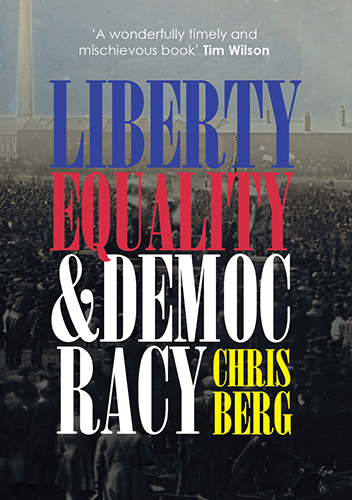
Liberty, Equality & Democracy

Connor Court Publishing, 2015

No one has the right to rule. If we don’t believe our fellow citizens are intellectually capable of deciding what and how much to eat, whether to drink, or how to arrange their financial affairs, then why do we think they are capable of voting?’

We live in a fundamentally undemocratic age. Governments treat their citizens as incapable of making decisions for themselves. Policy-making power has been taken out of the hands of elected politicians. Poll after poll shows the public are unhappy with democracy itself. In this wide-ranging book, Chris Berg makes the case for radical democratic equality, and a democracy order that truly respects the equality and rights of its citizens.

Available from Connor Court Publishing and Amazon.com