
Towards a Digital CBD

With Darcy Allen and Jason Potts

The COVID-19 pandemic is both a public health crisis, and a digital technology accelerant. Pre-pandemic, our economic and social activities were done predominantly in cities. We connected and we innovated in these centralised locations.

But then a global pandemic struck. We were forced to shop, study and socialise in a distributed way online. This shock had an immediate impact on our cities, with visceral images of closed businesses and silent streets.

Even after COVID-19 dissipates, the widespread digital adoption that the pandemic brought about means that we are not snapping back to pre-pandemic life.

The world we are entering is hybrid. It is both analogue and digital, existing in both regions and cities. Understanding the transition is critical because cities are one of our truly great inventions. They enable us to trade, to collaborate, and to innovate. In other words, cities aggregate economic activity.

The Digital CBD project is a large-scale research project that asks: what happens when that activity suddenly disaggregates? What happens to the city and its suburbs? What happens to the businesses that have clustered around the CBD? What infrastructure do we need for a hybrid digital city? What policy changes will be needed to enable firms and citizens to adapt?

Forced digital adoption

This global pandemic happened at a critical time. Many economies were already transitioning from an industrial to a digital economy. Communications technologies had touched almost every business. Digital platforms were commonly used to engage socially and commercially. But the use of these technologies was not yet at the core of our businesses, it sat on the sidelines. We were only on the cusp of a digital economy.

Then COVID-19 forced deep, coordinated, multi-sector and rapid adoption of digital technologies. The coordination failures and regulatory barriers that had previously held us back were wiped away. We swapped meeting rooms for conference calls, cash for credit cards, pens-and-paper for digital signatures. There had been a desire for these changes for a long time.

These changes make even more frontier technologies suddenly come into view. Blockchains, artificial intelligence, smart contracts, the internet of things and cybersecurity technologies are now more viable because of this base-level digital adoption.

Importantly, this suite of new technologies doesn’t just augment and improve the productivity of existing organisations, they make new organisational forms possible. It changes the structure of the economy itself.

Discovering our digital CBD

Post-pandemic, parts of our life and work will return to past practices. Some offices will reopen, requiring staff to return to rebuild morale and culture. And those people will also flood back into CBD shops, bars and restaurants. They will, as all flourishing cities encourage, meet and innovate.

But of course some businesses will relish their new-found productivity benefits – and some workers will guard the lifestyle benefits of working from home. Many firms will never fully reopen their offices and will brag about their remote-work dynamic culture.

The potential implications for cities, however, are more complex. Cities will fundamentally have different patterns of specialisation and trade than a pre-pandemic economy. Those new patterns are enabled by a suite of decentralised technologies, including blockchains and smart contracts, that were already disrupting how we organise our society.

We can now organise economic activity in new ways. CBDs have historically housed large, hierarchical industrial-era companies. As we have written elsewhere, decentralised infrastructure enables new types of organisational forms to emerge. Blockchains industrialise trust and shift economic activities towards decentralised networks.

How do these new types of industrial organisation change the way that we work, and the location of physical infrastructure? What are the policy changes necessary to enable these new organisations to flourish in particular jurisdictions?

Economies and cities are fundamentally networks of supply chains, and that infrastructure is turning digital too. The pandemic has accelerated the transition to digital trade infrastructure that provides more trusted and granulated information about goods as they move. How can we ensure that these digital supply chains are resilient to future shocks? What opportunity is there for regions to become a digital trade hub?

Another impact of digital technology is that labour markets just became more global. The acquisition of talented labour is no longer bounded by physical distance. Our collaborations are structured around timezones, rather than geography.

Labour market dynamism presents unique opportunities, but will also require secure infrastructure both to validate credentials and to facilitate ongoing productivity. How can Melbourne, a world-class cluster of universities, place itself for this new environment?

A research and a policy problem

Building a digital CBD is fundamentally an entrepreneurial problem—a problem of discovering what these new digital ways of coordinating and collaborating look like. Our Digital CBD research program contributes to this challenge with insights from economics, law, political science, finance, accounting and more. We aim to use this interdisciplinary research base to make policy recommendations that help our digital CBD to flourish.
Building a grammar of blockchain governance

With Darcy Allen, Sinclair Davidson, Trent MacDonald and Jason Potts. Originally a Medium post.

Blockchains are institutional technologies made of rules (e.g. consensus mechanisms, issuance schedules). Different rule combinations are entrepreneurially created to achieve some objectives (e.g. security, composability). But the design of blockchains, like all institutions, must occur under ongoing uncertainty. Perhaps a protocol bug is discovered, a dapp is hacked, treasury is stolen, or transaction volumes surge because of digital collectible cats. What then? Blockchain communities evolve and adapt. They must change their rules (e.g. protocol security upgrades, rolling back the chain) and make other collective decisions (e.g. changing parameters such as interest rates, voting for validators, or allocating treasury funds).

Blockchain governance mechanisms exist to aid decentralised evolution. Governance mechanisms include online forums, informal polls, formal improvement processes, and on-chain voting mechanisms. Each of these individual mechanisms — let alone their interactions — are poorly understood. They are often described through sometimes-useful but imperfect analogies to other institutional systems with deeper histories (e.g. representative democracy). This is not a robust way to design the decentralised digital economy. It is necessary to develop a shared language, and understanding, of blockchain governance. That is, a grammar of rules that can describe the entire possible scope of blockchain governance rules, and their relationships, in an analytically consistent way.

A starting point for the development of this shared language and understanding is a methodology and rule classification system developed by 2009 economics Nobel Laureate Elinor Ostrom to study other complex, nested institutional systems. We propose an empirical project that seeks conceptual clarity in blockchain governance rules and how they interact. We call this project Ostrom-Complete Governance.

The common approach to blockchain governance design has been highly experimental — relying very much on trial and error. This is a feature, not a bug. Blockchains are not only ecosystems that require governance, but the technology itself can open new ways to make group decisions. While being in need of governance, blockchain technology can also disrupt governance. Through lower costs of institutional entrepreneurship, blockchains enable rapid testing of new types of governance — such as quadratic voting, commitment voting and conviction voting — that were previously too costly to implement at scale. We aren’t just trying to govern fast-paced decentralised technology ecosystems, we are using that same technology for its own governance.

This experimental design challenge has been compounded by an ethos and commitment to decentralisation. That decentralisation suggests the need for a wide range of stakeholders with different decision rights and inputs into collective choices. The lifecycle of a blockchain exacerbates this problem: through bootstrapping a blockchain ecosystem can see a rapidly shifting stakeholder group with different incentives and desires. Different blockchain governance mechanisms are variously effective in different stages of blockchain development. Blockchains, and their governance, begin relatively centralised (with small teams of developers), but projects commonly attempt to credibly commit to rule changes towards a system of decentralised governance.

Many of these governance experiments and efforts have been developed through analogy or reference to existing organisational forms. We have sought to explain and design this curious new technology by looking at institutional forms we know well, such as representative democracy or corporate governance. Scholars have looked to existing familiar literature such as corporate governance, information technology governance, information governance, and of course political constitutional governance. But blockchains are not easily categorised as nation states, commons, clubs, or firms. They are a new institutional species that has features of each of these well-known institutional forms.

An analogising approach might be effective to design the very first experiments in blockchain governance. But as the industry matures, a new and more effective and robust approach is necessary. We now have vast empirical data of blockchain governance. We have hundreds, if not thousands, of blockchain governance mechanisms, and some evidence of their outcomes and effects. These are the empirical foundations for a deeper understanding of blockchain governance — one that embraces the institutional diversity of blockchain ecosystems, and dissects its parts using a rigorous and consistent methodology.

Embracing blockchain institutional diversity

Our understanding of blockchain governance should not flatten or obscure away from its complexity. Blockchains are polycentric systems, with many overlapping and nested centres of decision making. Even with equally-weighted one-token-one-vote blockchain systems, those systems are nested within other processes, such as a github proposal process and the subsequent execution of upgrades. It is a mistake to flatten these nested layers, or to assume some layers are static.

Economics Nobel LaureateElinorOstrom and her colleagues studied thousands of complex polycentric systems of community governance. Their focus was on understanding how groups come together to collectively manage shared resources (e.g. fisheries and irrigation systems) through systems of rules. This research program has since studied a wide range of commons including cultureknowledge and innovation. This research has been somewhat popular for blockchain entrepreneurs, in particular through using the succinct design principles (e.g. ‘clearly defined boundaries’ and ‘graduated sanctions’) of robust commons to inform blockchain design. Commons’ design principles can help us to analyse blockchain governance — including whether blockchains are “Ostrom-Compliant” or at least to find some points of reference to begin our search for better designs.

But beginning with the commons design principles has some limitations. It means we are once again beginning blockchain governance design by analogy (that blockchains are commons), rather than understanding blockchains as a novel institutional form. In some key respects blockchains resemble commons — perhaps we can understand, for instance, the security of the network as a common pool resource — but they also have features of states, firms, and clubs. We should therefore not expect that the design principles developed for common pool resources and common property regimes are directly transferable to blockchain governance.

Beginning with Ostrom’s design principles begins with the output of that research program, rather than applying the underlying methodology that led to that output. The principles were discovered as a meta-analysis of the study of thousands of different institutional rule systems. A deep blockchain-specific understanding must emerge from empirical analysis of existing systems.

We propose that while Ostrom’s design principles may not be applicable, a less-appreciated underlying methodology developed in her research is. In her empirical journey, Ostrom and colleagues at the Bloomington School developed a detailed methodological approach and rule classification system. While that system was developed to dissect the institutional complexity of the commons, it can also be used to study and achieve conceptual clarity in blockchain governance.

The Institutional Analysis and Development (IAD) framework and the corresponding rule classification system, is an effective method for deep observation and classification of blockchain governance. Utilising this approach we can understand blockchains as a series of different nested and related ‘action arenas’ (e.g. consensus process, a protocol upgrade, a DAO vote) where different actors engage, coordinate and compete under sets of rules. Each of these different action arenas have different participants (e.g. token holders), different positions (e.g. delegated node), and different incentives (e.g. to be slashed), which are constrained and enabled by rules.

Once we have identified the action arenas of a blockchain we can start to dissect the rules of that action arena. Ostrom’s 2005 book, Understanding Institutional Diversity, provides a detailed classification of rules classification that we can use for blockchain governance, including:

  • position rules on what different positions participants can hold in a given governance choice (e.g. governance token holder, core developer, founder, investor)
  • boundary rules on how participants can or cannot take part in governance (e.g. staked tokens required to vote, transaction fees, delegated rights)
  • choice rules on the different options available to different positions (e.g. proposing an upgrade, voting yes or no, delegating or selling votes)
  • aggregation rules on how inputs to governance are aggregated into a collective choice (e.g. one-token-one-vote, quadratic voting, weighting for different classes of nodes).

These rules matter because they change the way that participants interact (e.g. how or whether they vote) and therefore change the patterns that emerge from repeated governance processes (e.g. low voter turnout, voting deadlocks, wild token fluctuations). There have been somestudies that have utilised the broad IAD framework and commons research insights to blockchain governance, but there has been no deep empirical analysis of the rule systems of blockchains using the underlying classification system.

The opportunity

Today the key constraint in advancing blockchain governance is the lack of a standard language of rules with which to describe and map governance. Today in blockchain whitepapers these necessary rules are described in a vast array of different formats, with different underlying meanings. That hinders our capacity to compare and analyse blockchain governance systems, but can be remedied through applying and adopting the same foundational grammar. Developing a blockchain governance grammar is fundamentally an empirical exercise of observing and classifying blockchain ecosystems as they are, rather than imposing external design rules onto them. This approach doesn’t rely on analogy to other institutions, and is robust to new blockchain ecosystem-specific language and new experimental governance structures.

Rather than broadly describing classes of blockchain governance (e.g., proof-of-work versus proof-of-stake versus delegated-proof-of-stake) our approach begins with a common set of rules. All consensus processes have sets of boundary rules (who can propose a block? how is the block-proposer selected?), choice rules (what decisions do block-proposers make, such as the ordering of transactions?), incentives (what is the cost of proposing a bad block? what is the reward for proposing a block), and so on. For voting structures, we can also examine boundary rules (who can vote?), position rules (how can a voter get a governance token?) choice rules (can voters delegate? who can they delegate to?) and aggregation rules (are vote weights symmetrical? is there a quorum?).

We can begin to map and compare different blockchain governance systems utilising this common language. All blockchain governance has this underlying language, even if today that grammar isn’t explicitly discussed. The output of this exercise is not simply a series of detailed case studies of blockchain governance, it is detailed case studies in a consistent grammar. That grammar — an Ostrom-Complete Grammar — enables us to define and describe any possible blockchain governance structure. This can ultimately be leveraged to build new complete governance toolkits, as the basis for simulations, and to design and describe blockchain governance innovations.

An economic theory of blockchain foundations

With Jason Potts, Darcy WE Allen, Sinclair Davidson and Trent MacDonald

Abstract: Blockchain (or crypto) foundations are nonprofit organizations that supply public goods to a crypto-economy. The standard theory of crypto foundations is that they are like governments with respect to a national or regional economy, i.e. raising a public treasury and allocating resources to blockchain specific capital works, education, R&D, etc., to benefit the community and develop the ecosystem. We propose an alternative theory of what foundations do, namely that the treasury they manage is a moat to raise the cost of exit or forking because the benefit of the fund is only available to those who stay with the chain. Furthermore, building and maintaining a large treasury is a costly signal that only a high quality chain could afford to do (Spence 1973). We review these two models of the economic function of a blockchain foundation – (1) as a private government supplying local public goods, and (2) as a moat to raise the opportunity costs of exit. We outline the empirical predictions each theory makes, and examine the implications for optimal foundation design. We conclude that foundations should be funded by a pre-mine of tokens, and work best when large, visible, transparent, rigorously managed, and with a low burn rate.

Available at SSRN.

Response to Questions on Notice: Senate Select Committee on Financial Technology and Regulatory Technology

With Darcy W.E. Allen and Aaron M. Lane

Response to questions on notice at Senate Select Committee on Financial Technology and Regulatory Technology.

The capital gains taxation regime as it applies to cryptocurrency
is no longer appropriate

The Australian Taxation Office’s position that cryptocurrency is an asset for capital gains tax purposes and that every exchange between two cryptocurrency tokens should be treated as a “disposal” creates substantial regulatory compliance burdens on taxpayers, hinders fintech adoption, and achieves no policy objective.

This treatment of tokens poses unique challenges for cryptocurrency users. As each tokento-token exchange is treated by the ATO as a capital gains tax event, taxpayers are required to record gains or losses in the Australian dollars. However, token-to-token exchanges often occur at multiple times removed from Australian dollar-denominated markets. For many cryptocurrency tokens, liquid token-AUD exchange markets do not exist. In addition, the volume and complexity of some of these token exchanges make precise accounting of gains and losses on a per-transaction basis unrealistic, even for honest taxpayers seeking to fully ensure compliance.

Token-to-token exchanges of cryptocurrencies and other digital assets are foundational to the development of the digital economy, contributing to price and business model discovery. The current capital gains tax treatment to token-to-token exchanges imposes significant and unnecessary uncertainty and regulatory burden on cryptocurrency users, investors and the blockchain industry more generally.

The capital gains tax regime may have been appropriate five years ago when the cryptoeconomy was smaller, less complex and when there were relatively few places to make token-to-token exchanges. However, recent developments make the current policy regime inappropriately narrow and imposing. For example, the rise of decentralised finance (‘defi’) means that token-to-token exchanges are now commonly occurring through a vast ecosystem of decentralised protocols that operate at multiple levels removed from Australian dollar-denominated markets and provide no easy-to-use tools for the granular record keeping required by the ATO.

Additionally, the tokens that are being exchanged are also changing as the cryptoeconomy has developed. Defi activity can result in tokens being locked up in exchange for ‘governance’ tokens. Tokens that represent claims on other tokens through smart contracts – often necessary to acquire in order to participate in economic activity across multiple blockchains – can trade at a premium or discount. Treating these token-to-token swaps as capital gains events serves no policy purpose, and adds significant ambiguity and uncertainty to the Australian tax system.

The current regime also risks cryptocurrency users accumulating an Australian dollar-denominated tax liability that might be tied up in illiquid tokens.

The committee should understand that compliance with this regime in the Australian public is likely to be very low and the risk of taxpayers making errors in attempting to comply with the current legislation is very high.

Recommendation:

We recommend that CGT events be limited to exchanges where it is reasonable to comply with the capital gains tax regime. These would be when:

  • Cryptocurrency is exchanged with fiat currency (most commonly the Australian dollar),
  • Cryptocurrency is used in the acquisition or disposal of a tangible good or service, or a non-fungible token (such as a piece of digital art). Depending on the CGT classification of the respective token (for example a personal use asset or collectable), these transactions may yield the normal concessional treatments.

The burden of demonstrating compliance with these rules would remain with the taxpayer. This approach would significantly simplify the capital gains tax regime while reducing regulatory burdens, encourage innovation and the expansion of blockchain and cryptocurrency jobs in Australia, and be revenue neutral to the Commonwealth government.

The managed investment scheme regime doesn’t suit autonomous (algorithmic) financial products

A managed investment scheme (MIS) is an investment structure where a “responsible entity” manages investments for unit holders. In summary, the Corporations Act 2001 (Cth) provides that a MIS will exist where (i) members contribute money or money’s worth as consideration to acquire rights to benefits produced by the scheme; (ii) any of the contributions are to be pooled, or used in a common enterprise, to produce financial benefits, or benefits consisting of rights or interests in property, for the members; and (iii) the members do not have day-to-day control over the operation of the scheme. Generally, a MIS is required to be registered with ASIC if it has more than 20 members. A registered entity is required to be a public company and hold an Australian Financial Services License.

There is a significant risk facing blockchain companies in Australia that the MIS regime will be inappropriately applied, particularly as it pertains to decentralised finance (‘defi’) products. There is approximately US$41.5 billion worth of tokens in the defi ecosystem. Inappropriate and high cost regulation threatens the viability of the defi industry in Australia and will send entrepreneurs and job-makers overseas.

For example, popular defi applications include a class of automated market makers (AMMs) that allow users to make token-to-token exchanges outside ‘traditional’ centralised exchanges like Binance or Coinbase. Investors pool tokens in these automated exchanges, earning profit through fees. The pool automatically prices exchanges in a way that rebalances the pool, guaranteeingthat each asset is always available.

It is likely an AMM would be considered a MIS within the legal definition outlined above. However, there are several regulatory problems in applying the MIS regulatory framework to defi products like AMMs:

  • These schemes have no manager – that is, there is no responsible entity on whom the obligations of a financial services licence could be meaningfully imposed or exercised. The scheme – and thus the return on the investment – is determined entirely algorithmically.
  • Automated market makers like this have no responsible agent. Amendments to the protocol (for example, varying the fee for investors) are entirely controlled by the voting behavior of governance token holders (typically investors).

Applying the rules governing managed investment schemes to these autonomous and algorithmic financial products is a category error.

In any case, treating a defi product as an MIS would not achieve the government’s policy goals. Defi products are censorship resistant and fully digital. Australian investors are able to interact with defi products developed around the world at almost zero cost. Regulatory avoidance is trivially easy because these products can be freely “forked” (that is, their code copied, modified, and re-deployed permissionlessly). Applying the MIS framework to Australia-built defi products means that Australian companies are highly reluctant to innovate in this frontier fintech field.

The committee might consider amending the government’s enhanced fintech sandbox or develop a new blockchain technology specific sandbox to deal allow for defi products. However, we do not recommend this approach. One problem is that the current sandbox rules (such as limitations on the amount of money invested, or persons involved) would be inappropriate for defi because of the absence of centralised management, the ease of forking, and the quantum of funds. For example, automated exchanges have no mechanism to limit the size of the total pool (doing so would potentially reduce the stability of the pool) and even if limits were implemented they could be avoided through forking the pool and re-deploying it. Furthermore, if regulators were to determine that the defi product no longer compliant with the sandbox rules, given the uncensorable nature of blockchain, there would be no mechanism by which regulators could insist that the product could cease trading.

Recommendation:

We recommend that the Corporations Act be amended to exempt “autonomous financial products” from the existing definition of a MIS. To qualify as an autonomous financial product, the product needs to be:

  • Fully algorithmically deterministic (that is, all investment decisions are made by an algorithm rather than a responsible human entity);
  • Governance decisions are sufficiently decentralised and made solely by those who have invested; and
  • Fully open source, with its code published on a recognised platform (such as
    GitHub), allowing investors to scrutinise the code themselves.

This change would be straightforward and is consistent with the existing legislative approach of the Act. While legislative change is preferred to provide certainty, we note that this approach could also be achieved through regulation as section 9 of the Act provides a mechanism for the Regulations to declare that a scheme is not a MIS.

PDF version with references and footnotes available in here.

Submission to Select Committee on Financial Technology and Regulatory Technology (Response to Interim Report and Second Issues Paper)

With Darcy W. E. Allen and Aaron M. Lane

A submission to the Senate Select Committee on Financial Technology and Regulatory Technology (‘Committee’) following the tabling of the Committee’s Interim Report and the publication of the Second Issues Paper, focusing on the regulatory implications of blockchain technology.

Available in PDF here.

The Political Economy of Australian Regulatory Reform

Abstract: The problem of regulatory accumulation has increasingly been recognised as a policy problem in its own right. Governments have then devised and implemented regulatory reform policies that directly seek to ameliorate the burdens of regulatory accumulation (e.g. red tape reduction targets). In this paper we examine regulatory reform approaches in Australia through the lens of policy innovation. Our contributions are twofold. We first examine the evolutionary discovery process of regulatory reform policies in Australia (at the federal, intergovernmental and state levels). This demonstrates a process of policy innovation in regulatory mechanisms and measurements. We then analyse a new measurement of regulatory burden based on text analytics, RegData: Australia . RegData: Australia uses textual analysis to count “restrictiveness clauses” in regulation—such as “must”, “cannot” and “shall”—thereby developing a new database. We place this “restrictiveness clauses” measurement within the context of regulatory policy innovation, and examine the potential for further innovation in regulatory reform mechanisms.

Author(s): Darcy W. E. Allen, Chris Berg, Aaron M. Lane, Patrick A. McLaughlin

Journal: Australian Journal of Public Administration

Year: 2020 Pages: 1–24

DOI: 10.1111/1467-8500.12447

Cite: Allen, Darcy W. E., Chris Berg, Aaron M. Lane, and Patrick A. McLaughlin. “The Political Economy of Australian Regulatory Reform.” Australian Journal of Public Administration, 2020, pp. 1–24.

Continue reading “The Political Economy of Australian Regulatory Reform”

The Cryptoeconomics of Cities, Data and Space

Abstract: We explore the connection between new decentralised data infrastructure and the spatial organisation of cities. Recent advances in digital technologies for data generation, storage and coordination (e.g. blockchain-based supply chains and proof-of-location services) enables more granulated, decentralised and tradeable data about city life. We propose that this new digital infrastructure for information in cities shifts the organisation and planning of city life downwards and opens new opportunities for entrepreneurial discovery. Compared to centralised governance of smart cities, crypto-cities are more emergent orderings. This paper introduces this research agenda on the boundaries of spatial economics, the economics of cities, information economics, institutional economics and technological change.

Author(s): Darcy W. E. Allen, Chris Berg, Kiersten Jowett, Mikayla Novak, Jason Potts

Journal: Cosmos + Taxis

Vol: 8 Issue: 8–9 Year: 2020 Pages: 117–129

Available at: Cosmos + Taxis and in PDF here. Preprint available at SSRN. (Previously titled ‘Spatial Institutional Cryptoeconomics’)

Cite: Allen, Darcy W. E., Chris Berg, Kiersten Jowett, Mikayla Novak, and Jason Potts. “The Cryptoeconomics of Cities, Data and Space.” Cosmos + Taxis, vol. 8, no. 8–9, 2020, pp. 117–129.

Continue reading “The Cryptoeconomics of Cities, Data and Space”

What we think we know about defi

This essay follows an RMIT Blockchain Innovation Hub workshop on defi. Contributions by Darcy WE Allen, Chris Berg, Sinclair Davidson, Oleksii Konashevych, Aaron M Lane, Vijay Mohan, Elizabeth Morton, Kelsie Nabben, Marta Poblet, Jason Potts, and Ellie Rennie. Originally a Medium post.

The financial sector exists solely to smooth economic activity and trade. It is the network of organisations, markets, rules, and services that move capital around the global economy so it can be deployed to the most profitable use.

It has evolved as modern capitalism has evolved, spreading with the development of property rights and open markets. It has grown as firms and trade networks became globalised, and supercharged as the global economy became digitised.

Decentralised finance (defi) is trying to do all that. But just since 2019, and entirely on the internet.

Any business faces the question of “how do I get customers to pay for my product?” Similarly consumers ask the question, “Where and how can I pay for the goods and services I want to buy?” For the decentralised digital economy, defi answers this question. Defi provides the “inside” money necessary to facilitate transactions.

But what in traditional, centralised finance looks like banks, stock exchanges, insurance companies, regulations, payments systems, money printers, identity services, contracts, compliance, and dispute resolution systems — in defi it’s all compressed into code.

From a business perspective trade needs to occur in a trusted and safe environment. For the decentralised digital economy, that environment is blockchains and the dapps built on top.

And as we can see, defi doesn’t just finance individual trades or firms — it finances the trading environment, in the same way that taxes finance regulators and inflation finances central banks. If blockchain is economic infrastructure, defi is the funding system that develops, maintains and secures it.

These are heavy, important words for something that looks like a game. The cryptocurrency and blockchain space has always looked a little game-y, not least with its memes and “in-jokes”. The rise of defi has also had its own cartoonified vibe and it has been somewhat surreal to see millions of dollars of value pass through tokens called ‘YAMs’ and ‘SUSHI’.

Games are serious things though. A culture of gaming provides a point around which all participants can coordinate activity and experimentation — what we’re seeing in defi is the creation of a massive multiplayer online innovation system. The “rules” of this game are minimal, there are no umpires, and very little recourse, where the goal is the creation and maintenance of decentralised financial products, and willing players can choose (if and) to what extent they participate.

Because there is real value at stake, the cost of a loss is high. Much defi is tested in production and the losses from scams, unethical behaviour, or poor and inadequately audited coding are frequent.

On the other side, participation in the game of defi is remarkably open. There are few barriers to entry except a small amount of capital that players are willing to place at risk. Once fiat has been converted into cryptocurrency, the limit on participation in decentralised finance isn’t regulatory or institutional — it is around knowledge. (Knowledge is a non-trivial barrier, excluding people who could be described as naive investors. This is important for regulatory purposes.)

This is starkly different from the centralised financial system, where non-professional participants have to typically go through layers of gatekeepers to experiment with financial products.

The basic economics of defi

The purpose of defi is to ensure the supply of an ‘inside money’ — that is, stablecoins — within decentralised digital platforms and to provide tools to manage finance risks.

In the first instance defi is about consumer finance. It answers basic usability questions in the blockchain space: How do users of the platform pay native fees? Which digital money is deployed as a medium of exchange or unit of account on the platform?

In the second instance defi concerns itself with the operation of consensus mechanisms — particularly proof of stake mechanisms and their variants. The problem here is how to capture financial trust in a staking coin and then how to use that trust to generate “trust” on a blockchain. Blockchains need mechanisms to value and reward these tokens. Given the (potential) volatile nature of these tokens, risk management instruments must exist in order to efficiently allocate the underlying risk of the trading platform.

As we see it, the million yam question is whether the use of these risk management tools undermine trust in the platform itself. It is here that governance is important.

Which governance functions should attach to staking tokens and when should those functions be deployed? Should they be automated or should voting mechanisms be used? If so, which voting mechanisms and what level of consensus is appropriate for decision making.

Finally defi addresses the existence of stablecoin and staking tokens from an investor perspective. Again there are some significant questions here that the defi space has barely touched. How do these instruments and assets fit into existing investment strategies? How will the tax function respond? How much of existing portfolio theory and asset pricing applies to these instruments and assets?

Of course, we already have a complex and highly evolved centralised financial system that can provide much of the services that are being built from the ground up in defi. So why bother with defi?

The most obvious reason is that the blockchain space has a philosophical interest in decentralisation as a value in and of itself. But decentralisation addresses real world problems.

First, centralised systems can have human-centric cybersecurity vulnerabilities. The Canadian exchange QuadrigaCX lost everything when the only person with access to the cryptographic keys to the exchange died (lawyers representing account holders have requested that the body be exhumed to prove his death). Decentralised algorithmic systems have their own vulnerabilities (need we mention yams again?) but they are of a different character and unlike human nature they can be improved.

Second, centralised systems are exposed to regulation — for better or worse. For example, one of the arguments for UniSwap is that it is more decentralised than EtherDelta. EtherDelta was vulnerable to both hackers (its order book website was hacked) and regulators (its designer was sued by SEC).

Third, digital business models need digital instruments that can both complement and substitute for existing products. Chain validation instruments and the associated risk management tools presently do NOT have real world equivalent products.

Fourth and finally, the ability to digitise, fractionalise, and monetise currently illiquid real-world assets will require a suite of instruments and digital institutions. Defi is the beginning of that process.

In this sense, the defi movement is building a set of financial products and services that look superficially familiar to the traditional financial system using a vastly different institutional framework — that is, with decentralisation as a priority and without the layers of regulation and legislation that shape centralised traditional finance.

Imagine trying to replicate the functional lifeforms of a carbon-based biochemical system in a silicon based biochemical system. No matter how hard you tried — they’d look very different.

Defi has to build in some institutions that mimic or replicate the economic function provided by central banks, government-provided identity tech, and contract enforcement through police, lawyers and judges. It is the financial sector + the institutions that the traditional finance sector relies on. So, initially, it’s going to look more expensive, relative to “finance”. But the social cost of the traditional finance sector is much larger — a full institutional accounting for finance would have to include those courts and regulations and policymakers and central banks that it relies on.

Thus defi and centralised finance look very different in practice. Consider exchanges. Traditional financial markets can either operate as organised exchanges (such as the New York Stock Exchange) or as over-the-counter (OTC peer-to-peer) markets. The characteristics of those types of market are set out below.

Image for post

Defi exchanges represent an attempt to combine the characteristics of both organised exchanges and over-the-counter markets. In the very instance, of course, they are decentralised markets governed by private rules and not (necessarily) public regulation. They aim to be peer-to-peer markets (including peer-to-algorithm markets in the case of AMM).

But at the same time they aim to be anonymous (in this context meaning that privacy is maintained), transparent, highly liquid, and with less counterparty risk than a traditional OTC market.

Where is defi going?

Traditional finance has been developing for thousands of years. Along with secure private property rights and the rule of law, it is one of the basic technologies of capitalism. But of those three, traditional finance has the worst reputation. It has come to be associated with city bros and the “Wolf of Wall Street”, and the Global Financial Crisis. Luigi Zingales has influentially argued that the traditional finance system has outgrown the value it adds to society, in part because of the opportunities of political rent seeking.

This makes defi particularly interesting.  Defi is for machines. Not people. It represents the automation of financial services.

A century ago agriculture dominated the labour force. The heavy labour needs of farming are one of the reasons we were poor back then. As we added machines to agriculture — as we let machines do the farming — we reduced the need to use valuable human resources. Defi offers the same thing for finance. Automation reduces labour inputs.

Automation of course has been increasingly common in financial systems since at least the 1990s. But it could only go so far. A lot of the reason that finance (and many sectors, including government and management) resisted technological change and capital investment, was at the bottom, there had to be a human layer of trust. Now that we can automate trust through blockchains, we can move automation more deeply into the financial system.

Of course, this is in the future. Right now defi is building airplanes in 1902 and tractors in 1920. They’re hilariously bad and horses are still better. But that’s how innovation works. We’re observing the creation of the base tools for entrepreneurs to create value. Value-adding automated financial products and services comes next.

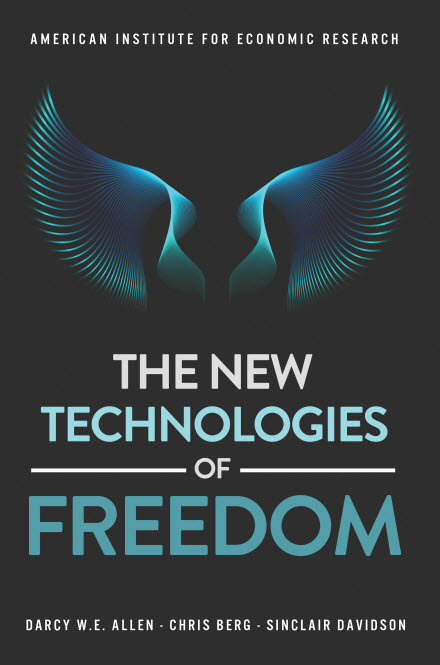
The New Technologies of Freedom

With Darcy WE Allen and Sinclair Davidson. American Institute for Economic Research, 2020

We are on the cusp of a dramatic wave of technological change – from blockchain to automated smart contracts, artificial intelligence and machine learning to advances in cryptography and digitisation, from Internet of Things to advanced communications technologies.

These are the new technologies of freedom. These tools present a historical unprecedented opportunity to recapture individual freedoms in the digital age – to expand individual rights, to protect property, to defend our privacy and personal data, to exercise our freedom of speech, and to develop new voluntary communities.

This book presents a call to arms. The liberty movement has spent too much time begging the state for its liberties back. We can now use new technologies to build the free institutions that are needed for human flourishing without state permission.

Available at Amazon.com

Deregtech: using technology to deregulate the economy

With Darcy WE Allen and Aaron M Lane. Originally a Medium post.

The Australian Prime Minister Scott Morrison wants to make deregulation and cutting red tape the centrepiece of the COVID-19 economic recovery.

This focus is not just welcome, but essential. Entrepreneurs need room to experiment with new business models without being held back by unnecessary rules — as we argue in our recent book Unfreeze: How to Create a High Growth Economy After the Pandemic.

But at the same time, developed world governments have spent at least three decades trying to cut burdensome red tape — with little obvious to show for it. The regulatory state just keeps expanding.

Existing regulatory policies such as sunset clauses have not worked to stem the steady growth in regulation and regulatory complexity. We need a new deregulation strategy.

The term ‘regtech’ describes how technologies such as blockchain, artificial intelligence and the internet of things can assist with regulatory compliance.

Now is the time for deregtech: using frontier technologies to identify, coordinate and incentivise deregulation.

Deregtech leverages technology not for compliance, but for policy reform.

Adopting the principles of permissionless innovationinstitutional diversity, and private governance will be vital if we are to get a rapid recovery from the COVID-19 crisis. Deregtech is about designing specific mechanisms that governments can deploy to identify and encourage that deregulation.

At least in Australia, every government on both sides of politics has promised some form of deregulation as part of their election agenda.

It turns out that deregulation is hard. It’s hard for two reasons:

  • First: it is hard to identify regulatory reductions that are strongly beneficial but at the same time politically easy. Few regulations do not have a passionate constituency behind them. Few regulations are completely pointless. But in aggregate, regulation adds to a significant economic burden.
  • Second: policymakers might talk a good game about deregulation, but have little incentive to deregulate. All the incentives go in the other direction — towards more rules, more regulatory interventions.

To solve the identification and incentive problems of reform, governments have increasingly implemented ‘regulatory policies’. That is, policies and mechanisms directed at the regulatory process itself.

For example, sunset clauses and regulatory impact statements force legislators to more closely assess or revisit the burden of a given regulation. But these don’t propel forward deregulation. Other approaches try to use the flow of new regulation to reduce the stock of existing regulation. New regulations can be made subject to ‘regulatory budgets’ or ‘1-in, n-out’ policies. But these are highly sensitive to how we measure regulations and their burdens.

The economy is a dynamic complex adaptive system, and as it evolves so too must the regulatory state. In the wake of the pandemic, which has accelerated many economic and technological trends, this has never been more necessary.

Deregtech can be directed at regulatory analyticsto better measure and grasp the extent of the regulatory state. The RegData project, for instance, counts the number of ‘restrictive clauses’ in regulations. New measurements encourage innovation in regulatory policies and make new mechanisms possible. RegData’s associated QuantGov initiative provides the tools for open-source policy analysis, rather than this being done within government departments.

With strong regulatory analytics — analytics that can be verified by observers from outside the government — tighter controls over a regulatory budget can be introduced, and affected industries can have a better understanding of the state of regulation.

These systems are not just a way to monitor regulation — they are an infrastructure on which deregulatory efforts can be built.

For instance, can we apply machine learning to identify regulatory changes that are unobservable to humans? Can technologies be leveraged to create new measurements to analyse regulatory overlap?

At the same time deregtech can encourage regulatory experimentation to reveal the costs and benefits of rules in practice. New technologies can act as the foundation for regulatory experimentation, encouraging competition between jurisdictions.

Inserting greater competition into governance, such as in special economic zones and charter cities, encourages discovery. On a more granular level, regulatory sandboxes attempt to reveal local knowledge about where regulatory burdens fall and what they are inhibiting.

Deregtech also encompasses more extensive regulatory automation, driving the enforcement and governance of regulations into private platforms. Blockchain platforms, for instance, enable complete enforceability of particular trading rules by incorporating them into the platform.

Deregtech will reduce the regulatory barriers that hamper our transition to a decentralised, automated and digital post-pandemic economy. The technological inputs of deregtech are here with us today. Now we just need to build them.