The digital consequences of the pandemic

With Darcy WE Allen, Sinclair Davidson, Aaron M Lane, and Jason Potts. Originally a Medium post.

The global policy response to the COVID-19 pandemic has been extraordinary. We’ve seen a massive increase in government spending and social welfare programs, heavy handed policing, and some less remarked on crisis deregulation.

But the long run effect of the pandemic will be even more substantial. COVID-19 is driving far deeper, and profound, changes in the economy.

Some of these changes we can start to see already, but their full implications are still murky and distant. Nonetheless, as we argue in our book Unfreeze: How to Create a High Growth Economy After the Pandemic, the economy will not simply snap back into place. The post-COVID-19 economy will not look like the pre-COVID-19 economy.

Here we offer seven changes that have big consequences for policymakers, entrepreneurs, and employees.

1 — Digital acceleration

COVID-19 has massively accelerated the adoption of digital technology to facilitate work from home. But also shop from home, school from home, telehealth, and so on.

This digital shift is often remarked on but not well understood. Technology adoption normally follows a particular diffusion trajectory. Digital technologies that have significant scale effects must overcome behavioural and institutional resistance, and they can get stuck at take-off. This means that the productivity benefits from widespread technology adoption, especially infrastructural and production technology, can be very slow to realise.

COVID-19 arrived at a critical time in the history of technology — when a supercluster of digital technologies were forming, poised to disrupt the underlying infrastructure of the economy. This suite of digital platforms and technologies had been developing for the past several decades. But they had run into innovation constraints caused by coordination adoption problems and regulatory barriers.

In March 2020, many of these constraints suddenly vanished. The spread of online education and telemedicine, which had been until then a multi-decade process, occurred in a matter of weeks.

This was a massive, global, multisector, virtually-instantaneous coordinated adoption of digital technology. That’s utterly incredible — and perhaps unique in the history of technology adoption.

A major problem with platform technologies is to drive coordinated adoption. The pandemic did in a few weeks what decades of government effort had failed to do. Long-run that is very good. But short-run it is highly disruptive.

2 — A need for massive entrepreneurial adjustment

In Unfreeze we argue that there is an urgent need for entrepreneurs to adapt to the post-COVID-19 world. Economies are made of connections, information, contracts, webs of value, relationships. When we try to restart the economy, much of this connective tissue will be gone.

The rapid technological acceleration driven by the crisis creates its own unique needs for adaptation. We’re already seeing the formation of new consumer preferences, new types of jobs, new types of business models with new cost and demand structures, new patterns of supply, and new regulatory and legal uncertainties.

But this implies that a significant amount of human capital and physical capital (built for industrial era technologies and business models) has rapidly devalued.

The first priority for entrepreneurs in the post-COVID-19 economy will be understanding how particular markets and jobs and administrative functions have changed. For example, many restaurants have moved to take-away only. Will consumers expect those new services to continue? Much of the white-collar economy has moved to work from home. Will employees demand that continues?

Entrepreneurial skills are essential during periods of rapid change. Entrepreneurship is not something that can be supplied by governments. But it can be inhibited. Policymakers have to make sure they are facilitating — not impeding — entrepreneurial adaptation to the accelerated digital adoption triggered by COVID-19.

3 — Decentralised production and innovation

One consequence of this sudden digital uptake is increased decentralisation. With the rapid adoption of work from home — not just the technologies but the social practices — we’ve seen a shift in the locus of much economic activity from offices into homes.

This shift has several implications. One, it facilitates greater co-production of value. More household resources, including especially local information, are being mixed into production.

Two, this also shifts the sites of innovation, facilitating greater household innovation and user innovation. More innovation occurs in the commons rather than in markets and organisations. This in turn increases the need for trusted decentralised networks and, in turn, increases the demand for and use of distributed innovation technology and institutions.

Three, distributed production will require more distributed dispute resolution mechanisms. Traditional courts have been slow to adapt to the digital environment and parties will be looking to more agile forms of alternative dispute resolution.

Four, because more production and innovation is occurring in households and in the commons, this means that it is harder to measure value creation and improvements in these non-market contexts. The non-market part of the economy will increase in apparent scale. So our industrial era measurements of economic activity (like GDP) will need to catch up with these new digital era realities of value creation.

This new institutional economic order will require a new economics to make sense of these new patterns of consumption and production, and new digital forms of capital and value creation.

4 — Powered-up economic evolution

The pandemic is a selection filter. As the precursor and mechanism of many of these changes, the economic consequence of the economic policy response to the viral pandemic is a powerful evolutionary selection mechanism passing over the global economy and through each sector.

This brutal selection mechanism is causing job losses, contract terminations or renegotiations, demand reductions, business closures and bankruptcy, fire sales, credit shrinkage, asset repricing, factor substitution, and other distinct forms of economic destruction that will play out over the coming months and years.

This hard evolutionary selection mechanism is also a filter. It will kill off some things disproportionately and let other things pass through. Most obviously, digitally enabled businesses and sectors will do better, because they are more well-adapted to the new environment. Bigger firms with better capitalisation (or better political connections) will do better, and smaller firms will be selected against.

In labour markets some positions are more vulnerable than others, particularly part-time workers or contractors. While many workers and firms are on temporary support through public sector subsidy of wages or quasi-partial nationalisations, a proportion of those positions or organisations being kept alive will die as soon as support is removed. There are many zombies already.

Similarly, there will be a lot of bad debt on company books (and thereby in banks) that will be realised in market revaluations over coming periods. These collapses will release resources for subsequent entrepreneurial reconstitution and reinvention.

But we should also expect consolidation of existing markets and resources among surviving players. This may actually result in higher growth and profits among large adaptive companies — particularly technology driven companies. So a period of global economic destruction is not inconsistent with a booming share market.

5 — The twilight of conventional macroeconomic policy

At the same time, COVID-19 looks to fundamentally break the standard monetary and fiscal policy levers that have been used to manage business cycles over the twentieth century.

From a public finance perspective, the magnitude of the committed policy actions is already unprecedented. The levels of public debt that are planned in order to deal with this crisis — the policies to subsidise wages, provide rent and income relief, bail out companies, etc in order to avoid market catastrophe — are the largest that has ever been experienced. Moreover, these actions are being taken during a massive collapse in tax receipts. The implications for public finance are catastrophic, with a huge increase in public debt, a vastly worse central bank balance sheet, and looming inflation.

The result is a policy challenge that far exceeds capabilities of traditional monetary and fiscal levers. We will require institutional policy reforms to deal with the crisis. But institutional policy designed to free-up the supply side of the economy, to lower the costs and constraints on businesses, is politically much harder to achieve.

Indeed, the limits of these policy levers reveals the extent to which government administration (e.g. of money, of asset and property registries, of identity, of regulation and governance) is still the foundation of a modern economy. The pandemic has brought into sharp relief the limits and constraints of this centralised public infrastructure and the technocratic foundations of the macroeconomic policy mechanisms built upon them.

The real alternative to conventional policy levers isn’t different policies (like quantitative easing, negative interest rates, or universal basic income) but better institutional technologies. We’ve been looking in the past few years at distributed digital technology (that is, blockchain) that offers a new administrative and governance base layer of the economy (see herehereherehere and here to start).

A digital infrastructure base layer of industry utilities and digital platforms would provide a far more agile foundation for targeted economic policy and entrepreneurial adaptation.

6 — A new global trading order

One of the most powerful institutional forces over the past several centuries, and which has underpinned global economic prosperity in the industrial era, was the development of global trading infrastructure for commodities and capital. It was built around the Westphalian system of nation-state record-keeping and intra-nation state treaty-based institutional governance (i.e. trade zones). But it has come to a virtual halt in the crisis.

In the short and medium term the global trading order will rebuild around a different order, namely provable health identity and data to facilitate the safe movement and interaction of people. Where that can safely happen, so can economic activity. Health zones can become the basis for trade zones. Australia and New Zealand are already talking about a “health bubble”. It would be easy to include other highly successful health economies — Taiwan, Japan, Germany, potentially Hong Kong and Singapore, some Pacific Island nations.

Green zones (or cordon sanitaire) have long been used in pandemics and have once again been proposed as a way to exit lockdown. As the health zone grows, so can the trade zone. Economic zones can then free ride on the decentralised identity and data infrastructure created to build a health zone. The result will be the redrawing of physical and network boundaries, even eliminating artificial economic borders, to create integrated trade zones.

7 — A new political order

The costs of COVID-19 do not fall evenly across the population. The health risks fall heavily on some groups (the elderly and those with co-morbidities), and the costs of economic lockdown fall on different groups and will be felt differently. The differential impact by sector, jobs, education, human capital investments or physical or financial capital write-downs shape how the costs are distributed across society.

The virus imposes huge private costs that will be in part socialised through political bargaining. The outcome of these politically mediated bargains and transfers that will shape politics for years to come.

But the pandemic also shifts some of the anchor points of political economy. The sudden growth of the welfare state, of unemployment insurance and wage-support, of healthcare provision and childcare, even of social housing are unlikely to be easily rolled back. So there will be a higher demand for social welfare safety nets.

But to pay for this, along with the urgent need to address the huge deterioration of public balance sheets, economic policy will need an aggressive pro-market agenda to unleash economic growth. Politically, this is a pivot to the centre with very ‘dry’ economic policy and ‘wet’ social policy — what was called ‘third way’ in the 1990s.

The counterpoint to that centre-pivot is that many of the high-cost political projects of both the right and the left will be abandoned. Reduced economic growth means we can afford fewer of the luxuries of advanced capitalism.

This is a vision of a new kind of social-digital capitalism to be built after the reset — from the government-led physical infrastructure of the industrial era, to a digital era built on private, open and communally developed technology platforms.

Finally

The economic consequences of the COVID-19 pandemic are mostly currently being discussed as a macro policy response to dealing with the economic destruction that the public health strategy necessitates. This is talk of the V-shaped, U-shaped, L-shaped or W-shaped recoveries. In Unfreeze we wrote of the need for a square root shaped recovery — after the reopening, we’ll need a long period of high economic growth to return to the prosperity of 2019.

But here we’ve gone further. COVID-19 is driving structural evolutionary change in the economy. The accelerated adoption of digital economic infrastructure during the crisis will leave a lasting mark on the political and economic system of the future.
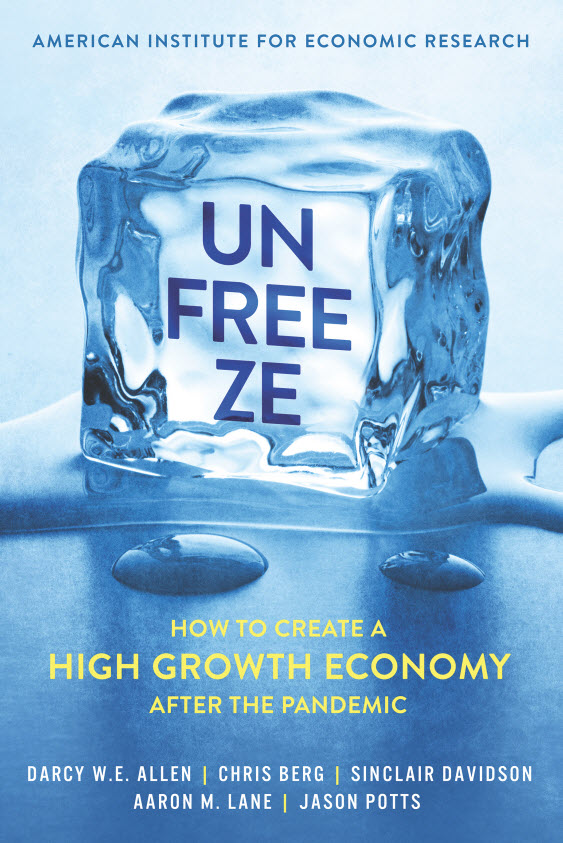
Unfreeze: How to create a high growth economy after the pandemic

With Darcy WE Allen, Sinclair Davidson, Aaron M Lane and Jason Potts. American Institute for Economic Research, 2020

During March and early April 2020, much of the world economy was deliberately shut-down and frozen to combat the COVID-19 pandemic. Modern economies are complex systems that are not easily frozen and unfrozen. Governments now face the challenge of unfreezing their economies. The social and economic cost of the pandemic will be enormous and long-lasting. This book develops an analytic and policy framework—cryoeconomics—for understanding what needs to happen next and how to restore our standard of living. We spell out the policy settings necessary for the rapid adaptation and market re-coordination that is required to resuscitate the economy. We explain why a return to business as usual is simply not enough to get everyone working again. A period of high growth prosperity will be imperative to deal with the costs of the freeze. This book tackles the tough questions and fills some of the current void of ideas and thinking about economic recovery. We develop a framework and principles for an institutional re-build, presenting a path to recovery based on the ideas of private governance, permissionless innovation, and entrepreneurial dynamism.

Available at Amazon in print and Kindle and Amazon Australia in Kindle edition.

Cryoeconomics: how to unfreeze the economy

With Darcy Allen, Sinclair Davidson, Aaron Lane and Jason Potts. Originally a Medium post.

The Australian government, like many governments around the world, wants to freeze the economy while it tackles the coronavirus pandemic. This is what the Commonwealth’s JobKeeper payments and bailout packages are supposed to do: hold workers in place and keep employment relationships together until mandatory social distancing ends.

Easier said than done. We are in completely uncharted territory. We’ve never tried to freeze an economy before, let alone tried to thaw it out a few weeks or months later. That’s why our new project, cryoeconomics, looks at the economics of unfreezing an economy.

To understand why this will be so hard, think of an economy as a remarkably complex pattern of relationships. Those relationships are not only between employees and employers, but also between borrowers and lenders, between shareholders and companies, between landlords and tenants, between producers tied together on supply chains, and between brands and tastemakers and their fans.

The patterns that make up our economy weren’t designed from above. They evolved from the distributed decisions of consumers and producers, and are shaped by the complex interaction between the supply of goods and services and their demand.

The problem is that the patterns the government plans to freeze are not the patterns we will need when they finally let us thaw.

When the government decides to pull the economy out of hibernation, the world will look very different. As a simple example, it’s quite possible that many Australians, forced to stay home rather than eat out, discover they love to cook. This will influence the demand for restaurants at the end of the crisis. On the other hand, our pent-up desire for active social lives might get us out into the hospitality sector with some enthusiasm. There will be drastic changes because of global supply chain disruptions and government policies. These changes will be exacerbated by the fact that not all countries will be unfrozen at the same time.

The upshot is that the economy which the government is trying to hibernate is an economy designed for the needs and preferences of a society that has not suffered through a destructive pandemic.

Unfreezing the economy is going to be extremely disruptive. New patterns will have to be discovered. As soon as the JobKeeper payments end, many of the jobs that they have frozen in place will disappear. And despite the government’s efforts, many economic relationships will have been destroyed.

Yet there will also be new economic opportunities — new demands from consumers, and new expectations. Digital services and home delivery will no doubt be more popular than they were before.

These disruptions will be unpredictable — particularly if, as we expect, the return to work is gradual and staggered (perhaps according to health and age considerations or access to testing).

As we unfreeze, the problem facing the economy won’t primarily be how to stimulate an amorphous ‘demand’ (as many economists argue government should respond to a normal economic recession) but how to rapidly discover new economic patterns.

It is here that over-regulation is a major problem. So much of the laws and regulations imposed by the government assume the existence of particular economic patterns — particular ways of doing things. Those regulations can inhibit our ability to adjust to new circumstances.

In the global response to the crisis there has already been a lot of covert deregulations. The most obvious are around medical devices and testing. A number of regulatory agencies have stood down some rules temporarily to allow companies to respond to the crisis more flexibly. The Australian Prudential Regulatory Authority is now willing to let banks hold less capital. The Australian Securities and Investment Commission has dropped some of its most intrusive corporate surveillance programs.

The deregulatory responses we’ve seen so far relate to how we can freeze the economy. A flexible regulatory environment is even more critical as we unfreeze. Anything that prevents businesses from adapting and rehiring staff according to the needs of the new economic pattern will keep us poorer, longer.

Today the government is focused on fighting the public health crisis. But having now turned a health crisis into an economic crisis, it must quickly put in place an adaptive regulatory environment to enable people and businesses to discover what a post-freeze economy looks like.

Blockchain Governance: What we can Learn from the Economics of Corporate Governance

Abstract: Understanding the complexities of blockchain governance is urgent. The aim of this paper is to draw on other theories of governance to provide insight into the design of blockchain governance mechanisms. We define blockchain governance as the process by which stakeholders (those who are affected by and can affect the network) exercise bargaining powers over the network. Major considerations include the definition of stakeholders, how the consensus mechanism distributes endogenous bargaining power between those stakeholders, the interaction of exogenous governance mechanisms and institutional frameworks, and the needs for bootstrapping networks. We propose that on-chain governance models can only be partially utilised because of the existence of implicit contracts that embed expectations of return among diverse stakeholders.

Author(s): Darcy W. E. Allen, Chris Berg

Journal: The Journal of the British Blockchain Association

Vol: 3 Issue: 1 Year: 2020

DOI: 10.31585/jbba-3-1-(8)2020

Cite: Allen, Darcy W. E., and Chris Berg. “Blockchain Governance: What We Can Learn from the Economics of Corporate Governance.” The Journal of the British Blockchain Association, vol. 3, no. 1, 2020.

Continue reading “Blockchain Governance: What we can Learn from the Economics of Corporate Governance”

Blockchain and Investment: An Austrian Approach

Abstract: Investment is a function of expected profit, which involves calculation of the cost of trust. Blockchain technology is a new institutional technology (Davidson et al 2018) that industrialises trust (Berg et al 2018). We therefore expect that the adoption of blockchain technology into the economy will affect investment and capital structure. Using a broad Austrian economic approach, we examine how blockchain technology will affect the cost of trust, patterns of investment, and economic institutions.

Working paper available at SSRN.

Author(s): Darcy W. E. Allen, Chris Berg, Sinclair Davidson, Jason Potts

Journal: The Review of Austrian Economics

Vol: 34 Year: 2021 Pages: 149–162

DOI: 10.1007/s11138-020-00504-x

Cite: Allen, Darcy W. E., Chris Berg, Sinclair Davidson, and Jason Potts. “Blockchain and Investment: An Austrian Approach.” The Review of Austrian Economics, vol. 34, 2021, pp. 149–162.

Continue reading “Blockchain and Investment: An Austrian Approach”

The Crypto-Circular Economy

With Darcy WE Allen and Jason Potts. Originally a Medium post

If we are going to realise the environmental vision of the circular economy, we need to first think of it as an entrepreneurial economy.

In PIG 05049 the artist Christien Meindertsma shows how the parts of a slaughtered pig get reused downstream. For instance, gelatine derived from the skin ends up in wine, acids from bone fat end up in paint, and pig hair ends up in fertiliser.

The farmer sells what they can to retailers and sells the rest to other businesses, who then process and resell the what they can’t use to other users and businesses, who then process and resell the other parts … anyway you get it the point.

In a world of perfect information and zero-transaction costs this use and reuse would be trivial. The near infinite uses of pig parts would be immediately apparent to everyone in the economy and every part of the pig would be reallocated efficiently.

But of course we don’t live in a world of perfect information. All these reallocations have to be discovered by entrepreneurs and innovators.

PIG 05049 is a story of how resources move through the economy in surprising ways, as entrepreneurs reduce waste in the pursuit of profit.

But a circular economy makes stronger demands on us. The circular economy aspires not simply to minimise waste, but for goods to be “reused, repaired and recycled” after their first users no longer need them.

The circular economy imagines a world in which material goods are recovered, endlessly, and thus the environmental impact of the materials that we rely on for our prosperity is radically reduced.

It’s a powerful vision. But it is a hard vision to realise because transaction costs are not zero. Obviously, as goods travel through their life cycle they deteriorate. Goods get worn out, they rust, they fall apart.

But just as critical is the fact that information about the goods deteriorates as well. Product manuals get lost. Producers go out of business. Critical parts get separated. What the goods are made from is forgotten.

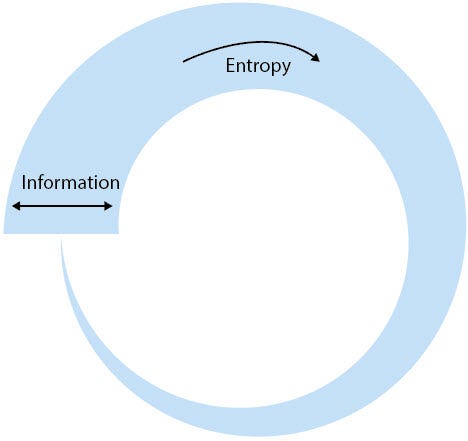
This information loss is a huge problem for the circular economy — it is very extremely expensive to reuse goods when we have lost information about what they are made of and how they work. This information entropy makes it hard for entrepreneurs and innovators to close the loop.

A circular economy with information entropy
This is what that looks like

In some previous work we’ve described a hypothetical “perfect ledger” where information is infinitely accessible, immediately retrievable, completely immutable, perfectly correspondent to reality, and permanently available. The perfect ledger is a thought experiment. It’s a thought experiment like an economy with perfect information or zero transaction costs that allows us to see how our imperfect world differs from an imaginary ideal.

And in a world of perfect ledgers, the circular economy’s information loop is completely closed. There is no information entropy — we never forget, so we can always reuse.

Blockchain technology of course is not a perfect ledger. But on many of the relevant margins, it offers a drastically improved way of managing information about goods as they travel through their lifecycle.

Information can be stored on a distributed ledger in a way that is resistant not only to later amendment, but that persists when it a good is passed from hand to hand, or travels across a political border, or when it is discontinued and forgotten by its designer, or when its original manufacturer goes out of business.

The information about the goods we have sitting on our desk, scattered around our homes and workplaces, built into our buildings, and powering our vehicles is being unpredictably but relentlessly lost. This is the blockchain opportunity for the circular economy. Blockchains can secure more information, better, more permanently and more accessibly about goods, so that they can be more efficiently reused.

And in conjunction with similar technological developments that reduce search costs — that is, that allow innovators to identify underutilised goods in the economy that could be bought and repurposed — the owners of goods will have increased incentivises to store and protect their property, if only to maximise the sale price.

The circular economy is often thought as a problem for governments to bring about. But if the circular economy is to be realised, we need to rethink the problem of waste and reuse as an environmental problem caused by an information problem.

Technological advances in the way we store and trust information offer a vision of large-scale, yet still bottom-up environmental improvements, where market incentives, price signals and contracting work to close the industrial loop.

Blockchain and the Evolution of Institutional Technologies: Implications for Innovation Policy

Abstract: For the past century economists have proposed a suite of theories relating to industrial dynamics, technological change and innovation. There has been an implication in these models that the institutional environment is stable. However, a new class of institutional technologies — most notably blockchain technology — lower the cost of institutional entrepreneurship along these margins, propelling a process of institutional evolution. This presents a new type of innovation process, applicable to the formation and development of institutions for economic governance and coordination. This paper develops a replicator dynamic model of institutional innovation and proposes some implications of this innovation for innovation policy. Given the influence of public policies on transaction costs and associated institutional choices, it is indicated that policy settings conductive to the adoption and use of blockchain technology would elicit entrepreneurial experiments in institutional forms harnessing new coordinative possibilities in economic exchange. Conceptualisation of blockchain-related public policy an innovation policy in its own right has significant implications for the operation and understanding of open innovation systems in a globalised context.

Author(s): Darcy W. E. Allen, Chris Berg, Brendan Markey-Towler, Mikayla Novak, Jason Potts

Journal: Research Policy

Vol: 49 Year: 2020 Article: 103865

DOI: 10.1016/j.respol.2019.103865

Cite: Allen, Darcy W. E., Chris Berg, Brendan Markey-Towler, Mikayla Novak, and Jason Potts. “Blockchain and the Evolution of Institutional Technologies: Implications for Innovation Policy.” Research Policy, vol. 49, 2020, article 103865.

Continue reading “Blockchain and the Evolution of Institutional Technologies: Implications for Innovation Policy”

Submission on the final report of the Australian Competition and Consumer Commission’s Digital Platforms Inquiry

With Darcy Allen, Dirk Auer, Justin (Gus) Hurwitz, Aaron Lane, Geoffrey A. Manne, Julian Morris and Jason Potts

The emergence of “Big Tech” has caused some observers to claim that the world is entering a new gilded age. In the realm of competition policy, these fears have led to a flurry of reports in which it is asserted that the underenforcement of competition laws has enabled Big Tech firms to crush their rivals and cement their dominance of online markets. They then go on to call for the creation of novel presumptions that would move enforcement of competition policy further away from the effects-based analysis that has largely defined it since the mid-1970s.

Australia has been at the forefront of this competition policy rethink. In July of 2019, the Australian Competition and Consumer Commission (ACCC) concluded an almost two-year-long investigation into the effect of digital platforms on competition in media and advertising markets.

The ACCC Digital Platforms Inquiry Final Report spans a wide range of issues, from competition between platforms to their effect on traditional news outlets and consumers’ privacy. It ultimately puts forward a series of recommendations that would tilt the scale of enforcement in favor of the whims of regulators without regard to the adverse effects of such regulatory action, which may be worse than the diseases they are intended to cure.

Available in PDF here.

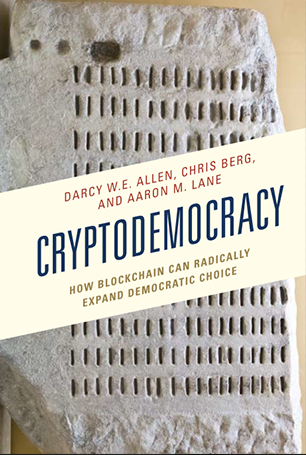
Cryptodemocracy: How Blockchain Can Radically Expand Democratic Choice

With Darcy WE Allen and Aaron M Lane. Lexington Books, 2019

This book investigates the theoretical and practical implications of blockchain and other distributed ledger technologies for democratic decision making. What new structures of democracy does blockchain technology enable? A cryptodemocracy is cryptographically-secured collective choice infrastructure on which individuals coordinate their voting property rights. Drawing on economic and political theory, a cryptodemocracy is a more fluid and emergent form of collective choice. This book examines these theoretical characteristics before exploring specific applications of a cryptodemocracy in labor bargaining and corporate governance. The analysis of the characteristics of a more emergent and contractual democratic process has implications for a wide range of collective choice.

Coming soon from Lexington Books

Blockchain and the manufacturing industry

With Darcy Allen and Jason Potts

Bitcoin was invented in 2008 by Satoshi Nakamoto as a censorship-resistant cryptocurrency built for the internet. With regular fiat money centralised bodies such as banks and governments control the records of who owns what. For bitcoin those records are held in a decentralised blockchain. Blockchains are updated and maintained by a decentralised network. To ensure the transactions and records are correct, economic incentives to continually drive the blockchain network towards consensus.

Applications of blockchain extends beyond records of money. We rely on trusted third parties to maintain our registries, enforce our contracts, and maintain our records. Entrepreneurs are now discovering which roles carried out by third parties such as governments and firms will be shifted towards blockchain-based decentralised networks.

Blockchain is now being applied to trace goods along supply chains, to give control of medical records to patients, and to create decentralized identities that help people move across borders.

What does blockchain mean for Australia’s manufacturing industry?

At first glance manufacturers produce physical products and then transport those goods to consumers. More deeply, the manufacturing process is heavily reliant on databases of information in multiple directions along their supply chains. This is especially true for advanced manufacturing. When goods and inputs move, information about them must move too. This includes information about the provenance of sub-components and intermediate parts, information about the integrity of rare products prone to counterfeit, and information about ethical standards in production.

It’s harder to produce this supply chain information than you think. The information must be coordinated between hundreds of parties in the supply chain. Most of those parties don’t know or trust each other. And this information is still often paper-based or siloed within organisational hierarchies. The result is a trail of information about manufactured goods that is prone to error, fraud and loss. And these problems only get worse as supply chains get longer in a globalised world, and manufactured goods become more complex.

Blockchain technology presents a different way to govern supply chain data that centres on the movement of the good itself. Rather than passing pieces of paper between supply chain participants to track goods, information can be recorded in a decentralised blockchain. In practice goods are given a digital representation. Then as the goods move, information about them is timestamped in an immutable blockchain. Importantly this information is stored outside of organisational boundaries, making blockchain an alternative mechanism to solving the age-old problems of provenance and quality. What information is stored in a blockchain could be the historical location of a good, who produced it, how it has been stored, and who has finance on the goods.

Supply chain information extends beyond a single supply chain. To produce a complex product involves first mining raw materials, transforming those into intermediate parts, before manufacturing of the final good. Blockchains are critical here because they can track goods and components across multiple supply chains, giving more visibility and traceability deeper into complex manufactured goods.

Blockchain supply chains will leverage other frontier technologies such as the Internet of Things (IoT). Containers and products will contain sensors to record information such as GPS location and temperature. This information won’t be sent to a centralised party, but recorded cryptographically into a blockchain. This information can help consumers in verifying genuine products, assist producers in creating analytics of consumer demand and ensuring their inputs are legitimate, and governments in ensuring compliance with domestic rules and regulations.

The first and most obvious application of blockchain in supply chains has been in agricultural products such as wine, meat and seafood. The common characteristic of these goods is that they are information-rich. Information about their provenance and stewardship is often hard to verify by observing the final goods, but radically affects the price that consumers will pay.

This means the next wave of applications is likely to be other high-value information-high goods. Goods that are highly-customised, such as 3D printed medical devices, aeroplane parts and pharmaceuticals, are perfectly poised to apply blockchain technology.

Blockchain in advanced manufacturing is more than just tracking goods once they’ve been produced. We can use blockchains to coordinate the highly valuable digital files that sit behind many of these products. How can you ensure that the CAD file being 3D printed was the one originally intended? Similarly, blockchains are being used for intellectual property rights, helping to ensure compliance in an increasingly digital world.

In the physical manufacturing process itself blockchain can be used to record information about the lifecycle of manufacturing equipment. We can now have more cost-efficient and credible auditable ledgers that extend beyond organisational hierarchies.

What we have proposed here is a general movement away from intermediaries being trusted to maintain information about goods and their production, towards information governance through decentralised blockchain platforms. To be sure, many of these applications are in the trial and experimental phase. But they represent an early fundamental shift in how we organise information across the entire manufacturing supply chain.